
And Cambridge’ overheating economy, broken governance systems, and huge inequalities are set to continue without some big changes in government policy
In my previous blogpost I pointed readers to the long-awaited reports on East West Rail’s route into Cambridge, and to the consultation results from the proposed Sustainable Transport Zone for Cambridge (AKA the GCP’s congestion charging).
Cllr Sam Davies blogged about the Government’s life sciences strategy that was announced at the same time – just as Parliament went on recess.
“A £650 million war-chest to fire up the UK’s life sciences sector and drive forward the government’s priority to grow the economy has been unveiled by the Chancellor of the Exchequer Jeremy Hunt today 25 May 2023.”
Government Press Release 26 May 2023
I don’t know what it is with the military metaphors and phallus-phlanging that the present administration seems to resort to. It feels more like a sign of weakness / lack of imagination than anything else. Change the record!
“It also lays out changes to planning rules to free-up lab space and updates a route for East West Rail (EWR), the new railway line, to improve connections between UK science powerhouses Oxford and Cambridge, bringing more investment to the region.”
Government Press Release 26 May 2023
It remains to be seen whether the Chancellor can be persuaded to have East West Rail as an electrified line from the start – only building a diesel line only to upgrade it to an electrified line later ends up being more expensive overall. The Railway Gazette said that the next consultation phase will be in early 2024 – the submission of the Transport & Works Act Order seeking planning permission for the construction of the Bedford-Cambridge link.
Those planning policy changes need detailed scrutiny
The Government states further down in the press release:
- “The government will consult on adding requirements to the National Planning Policy Framework to say that decision makers should pay particular regard to R&D needs, including the need for additional laboratory space, and proactively engage with potential applicants.
- “We are also updating the Planning Practice Guidance (PPG) to help local authorities take fuller account of the commercial land needs of businesses and better plan for inward and high value investment. We will work with stakeholders to further understand the changes needed.
- “The government is making investment into the relevant sites more attractive by working with local planning authorities to encourage proactive planning tools, such as Local Development Orders and Development Corporations, to bring forward development.“
“What TF is a ‘local development order’?!?”
“Local Development Orders (LDOs) provide permitted development rights for specified types of development in defined locations. They are flexible and locally determined tools that LPAs can use to help accelerate the delivery of appropriate development in the right places.”
Local Government Association on LDOs
“Permitted development rights? Sounds like a charter for rubbish architecture and mega profits for big developers and their funders at the expense of local communities?“
Put it this way, there are significant lessons that ministers need to learn about permitted development rights regarding office conversions into housing – as Harlow found out the hard way with Terminus House. Given everything we’ve also learnt about the construction industry from the Grenfell Tower. Have a listen to Richard Millett KC (then QC)’s closing speech.
It’s also worth listening to Mr Millett KC, Counsel for the Grenfell Inquiry in his conclusions about those from Government & the building industry.
“Behind there lay a complex and opaque and piecemeal legislation, and an over-reliance by government and policy makers on guidance which was ambiguous, dangerously out of date, and created by non-governmental bodies, and influenced by commercial interests”
From Grenfell Inquiry 10 Nov 2022
But then hey, this is a system that treats things like this as perfectly normal and above-board.
Which reminds me, this former housing minister (who zapped the Code for Sustainable Homes which I worked on during my civil service days) has got a new extra curricular activity.
“From 11 April 2023, Adviser to the CEO and Board of Thakeham Homes (property developer), Thakeham House, Summers Place, Stane Street, Billingshurst RH14 9GN.”
Brandon Lewis MP – Register of Interests, 15 May 2023
“Why does the firm’s name sound familiar?”
Because it is – I wrote about their bid back in 2020. You can read their not compatible with the local plan proposals here. Also you can read the article in the Cambridge Independent from December 2020 here.
“Could make the next general election contest in South Cambridgeshire interesting”
Note Labour are also making policy noises about removing some of the planning restrictions on development – noting this piece by the former Conservative Minister David Gauke in the New Statesman. This is an area we will see some very interesting political clashes between a growing rural Green Party (and its ‘degrowth’ wing) vs a ‘build more homes’ agenda to deal with the housing crisis. For me, I’m more interested in the financial drivers behind the policies – and how ministers can use levers on restricting who can own what properties and how many, the transparency of information on property ownership, and powers of taxing wealth and land values to dampen property speculation and the extraction of wealth from the value of land as ownership changes. Furthermore, I’d like to see policy proposals around the extinguishing of planning permissions when land and sites are sold and/or the ultimate beneficiaries of the companies owning said sites is sold. i.e. Stopping people gaming the system for profit.
Using an overhauled rail strategy and higher education strategy to take the heat out of Oxbridge.
I was playing with the concept of regional railway links between Cambridge and large towns/smaller cities earlier. Looking westwards, you can see some of the large towns – in particular Northampton, which interestingly was prevented from establishing a university back in the 13th Century. Sadly Oxford got scared and persuaded King Henry III to dissolve that old institution in 1265.

Above – from G-Maps where Northampton, Peterborough, Cambridge, and Luton make for a nice ‘quad’
The problem is all faster train routes seem to go through London
Take Northampton – it should be straightforward to get from the famous shoe-making town to Cambridge. Part of the business case for East West Rail is to take existing rail traffic out of London. This is where ministers should be ‘thinking strategically’ or looking at a much bigger picture than “The Golden Triangle” of London & Oxbridge.
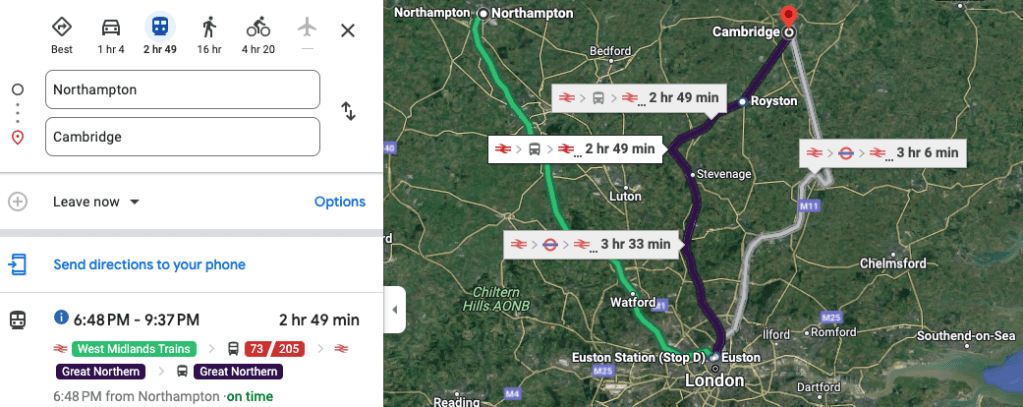
Above – from G-Maps – no direct train to Northampton from Cambridge.
“Why would anyone want to go from Northampton to Cambridge?”
Hear me out! If you added the University of Northampton as an additional site for life sciences, you have a huge opportunity to build several of the things that people like about Cambridge. For example beautiful riverside buildings and gardens.
“Ugly building designers got there first”
Below – from G-Maps – it’s worth exploring the map to get a feel for the natural and built environment of the area – along with existing transport and civic infrastructure. For example in this case the University of Northampton being not far from Northampton General Hospital. Note the University of Northampton does not have a medical school – it only has healthcare and nursing courses. Which given the shortage of hospital doctors and general practitioners would also support the case for building a new medical school there. (I’d add a School of Dentistry too).

Above – University of Northampton from G-Maps
Re ugly buildings, in principle the facades can be removed and replaced by something nicer.
“Isn’t that pastiche?”
Yep. And you serve it in spades! Let The King put a royal stamp on competitions for nicer buildings and urban design and tie it all into a scheme to make Northampton a great city! (It doesn’t have city status and its local governance arrangements are a shambles so the only way is up!) I’m joking. Sort of!
On a more serious point, I would not want Northampton to become a cheap copy of Oxford or Cambridge. Rather I’d want the town to become the best that it could become given its history and potential. One that reverses a longstanding historical wrong (which means Oxford need to stump up some of their wealth to make good their role in that!) and one that has a much more positive vision for the town and surrounding villages given the massive positive civic and environmental potential the town and riverside areas have. Because when you look at the front of Northampton’s Guildhall… ***Wow!*** Who needs oxbridge architecture when you have this to be inspired by?
And yet the institution and the staff that work there?
“Planning staff at West Northants Council were left “ill-equipped” and had “no sense of vision”, a council leader has admitted.”
BBC News 13 April 2023
It’s such a shame. Such a missed opportunity.
Before I suggest such a transformation, the people of the town *must be involved from concept and design stage*
The more serious point is that Dr Andy Williams said in Cambridge, we don’t have the infrastructure to cope with the levels of financial investment heading here. I think there is a much stronger case for ministers to pick another large settlement that’s not too close to London, has a long history, in need of inward investment, and could stand alone as a great city. It’s also equidistant from Oxford & Cambridge. Furthermore it has a nice riverside setting with huge potential, and also is close enough to the West-Midlands, thus drawing away from London & the South East towards the rest of England. In terms of *what* sort of city it becomes, again that should be driven by the people of the Northampton.
“Where do rail links fit in?“
Re-link Bedford with Northampton. Then when East-West-Rail opens from Bedford to Cambridge, you can run Cambridge-Coventry services via Bedford & Northampton.
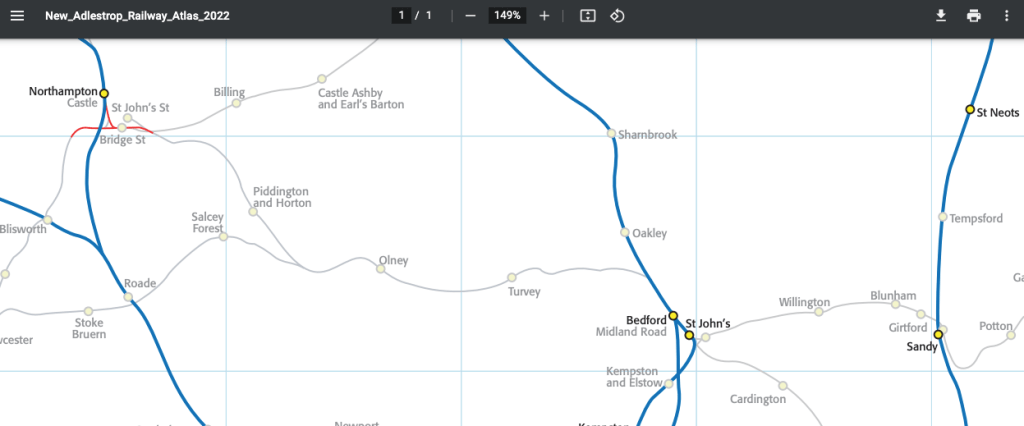
Above – from the New Adlestrop Railway Atlas of lost and current railway lines.
Ministers have chosen a Bedford-St Neots line for part of the Bedford-Cambridge phase of East West Rail. There’s nothing in principle to stop the construction of a spar from Bedford to Northampton. Cambridge-Northampton is 50 miles even via Bedford. A semi-fast train could cover that in under an hour, even stopping at Bedford.
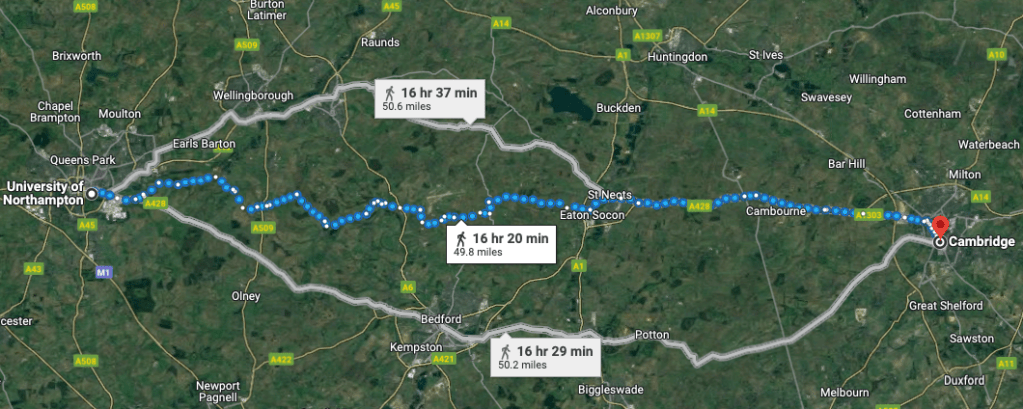
This requires incorporating into a national industrial strategy
Which ministers historically have been hopeless at doing. Especially the present political party in government which is hopelessly unstable despite a large parliamentary majority.
Can a future government make things work for large historic towns like Northampton while relieving the pressure on places like Cambridge?
If you are interested in the longer term future of Cambridge, and on what happens at the local democracy meetings where decisions are made, feel free to:
- Follow me on Twitter
- Like my Facebook page
- Consider a small donation to help fund my continued research and reporting on local democracy in and around Cambridge.

 The Cambridge Town Owl