
TL/DR? We used to have regional plan / regional spatial strategies. They got bogged down in bureaucracy and Eric Pickles zapped them when the Coalition came in. But we’ve seen the impact of a lack of co-ordination. So what can we learn from the last one from March 2010?
You can read the draft East of England Plan of March 2010 here. It covers:
- Economic Development 33
- Housing 47
- Culture 55
- Transport 57
- Environment 65
- Carbon Dioxide Emissions and Renewable Energy 79
- Water 83
- Waste 91
- Minerals 103
- Sub-Areas and Key Centres for Development and Change 105
Above – what’s missing?
A useful starting point with such big documents is doing keyword searches to find out what terms are conspicuous by their absence or relatively few mentions. For example the word ‘shortage’ only comes up four times – in a housing context. The word ‘supply’ comes up 35 times in the contexts of:
- Drinking water and sewage capacity
- Land/suitable development sites
- Housing
- Local labour supply (vs commuting)
- Food
- Energy (gas & electricity)
- Minerals / aggregates (for building)
Policy-makers often link transport with jobs, but seldom link transport with sports, leisure and tourism – yet all of these have economic impacts as well as positive public health impacts.
When was the last time politicians from across East Anglia had a conversation about the location of ‘strategic cultural facilities’?
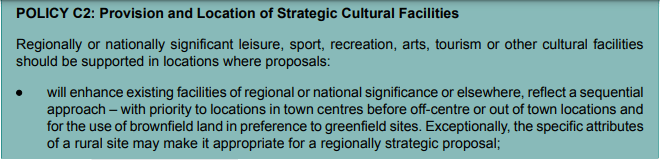
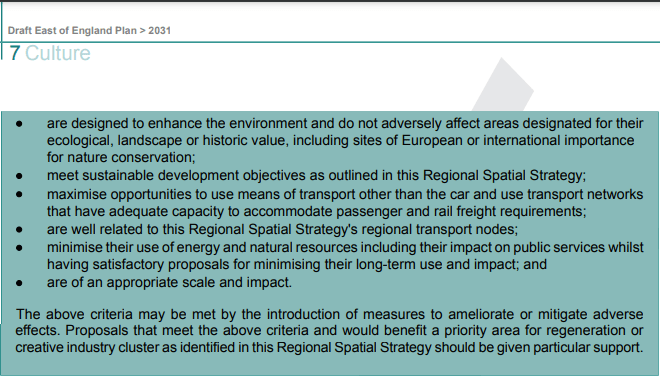
Above – from p57 East of England RSS March 2010
Hence my points about investing in transport and infrastructure links from Cambridge to surrounding market towns using light rail with cycleways & footpaths (‘active travel corridors’) as primary means of transport, with the necessary facilities at each end. I return back to the 1960s diagrams:


Above-left: Redcliffe-Maud’s abandoned proposal from 1969, and above-right Lichfield’s diagram from 1965 of Cambridge’s sub-regional economy and the smaller market town economies within it.
For me, each town should have a rail or light rail transport interchange that should open up onto a town square – one where the locals of the town get to decide the style / architectural vernacular that it should be designed in. How could they do this? See the methods database by Involve UK. The point is that each town can use its local history & local geography to influence what gets built. As far as the market town economies go, citizens’ assemblies could be used to assess responses to a public call for ideas on what the sub region needs and would like. Then the debate can move on to what local people get in return for the inevitable housing development that, let’s face it is going to take place anyway. At least existing residents will be offered both an excellent new public transport facility linked to a comprehensive rail-based network, and a regional facility based in their own town.
Furthermore, at each transport interchange/station should be a sporting / arts / leisure facility that serves not just the town but the wider sub-region, bringing in people from outside and helping sustain much-needed jobs and investment. In some cases, there will be pre-existing attractions that could be better connected. Newmarket Race Course and conference centre for example.
Finally, in terms of creating safe places and designing in financial as well as environmental sustainability, having public facilities that don’t involve retail or drinking alcohol as a primary focus also makes a difference – although I’ve yet to see/read about local good examples in towns. These could include arts centres and lifelong learning centres – see this example by Derby in 1968. Refresh the concept for our present and future ages and see what people can come up with.
Regional links to the nearest large towns/small cities
This was meant to be the subject of my previous blogpost but I got sidetracked as normal.
A new King Charles School of Medicine and Dentistry at the University of Northampton?
Could happen.
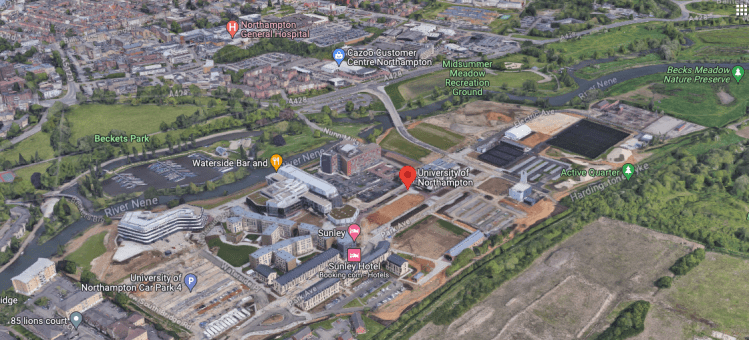
Above – University of Northampton from G-Maps
Say to the King that if he can persuade the Crown Estates’ Commissioners to acquire the sites in the city for such purposes, he can hand-pick the architects to design the buildings!
“Sort of like ‘Poundbury-on-the-Nene”?
Only to a higher standard – one that’s also got residential input from the start! More seriously, this is a reflection that some of Cambridge’s skills shortages cannot be solved within and by Cambridge alone – not least when the city is being marketed as a place for a handful of very profitable industries at the expense of others. (See the negative externalities in land prices and the knock-on impacts on housing and leisure).
The higher education courses that cannot be provided for in Cambridge, and the facilities that require expansive plots of land are ones that should be located elsewhere, and also ones that are connected up to Cambridge by fast/semi-fast regional rail links.
Hence my point about re-opening the Bedford-Northampton line once the Cambridge-Bedford branch of East West Rail is opened. An electric train from Cambridge stopping at say Cambourne, St Neots, and Bedford before reaching St Neots should be able to do 50 miles in an hour.

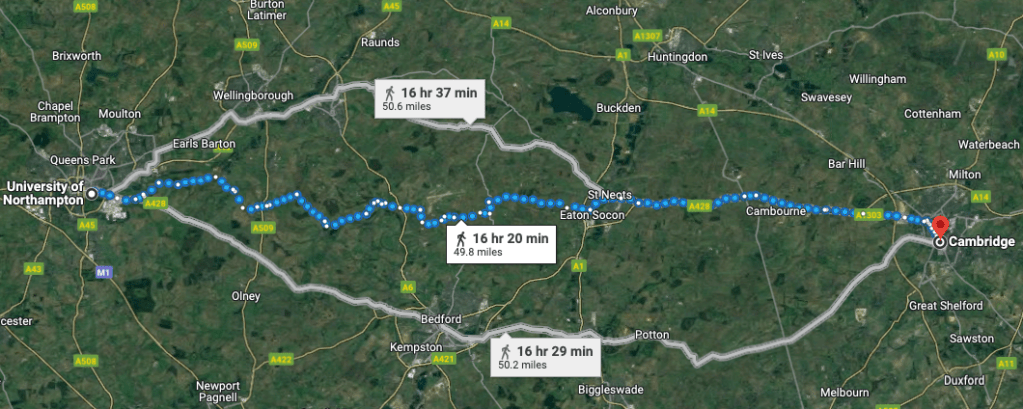
Above – from G-Maps in my previous blogpost. Furthermore, both the universities at Peterborough and Luton should also be invested in to provide new schools of town planning and of medicine and dentistry given the national shortage. These should be combined with upgraded and electrified rail infrastructure and new services – such as a Norwich-Cambridge-Bedford-Luton-Luton Airport.

Above – from the New Adlestrop Rail Atlas of lost railway lines – the old Northampton – Bedford link. (Join Rail Future if you want to campaign for better rail links and upgraded lines!)
Reopening railway lines from Cambridge to the seaside – Hunstanton, Great Yarmouth, and Lowestoft
For me, the reopening of the old Hunstanton railway line (or the building of a new line) is long overdue. You can support the existing campaign here.
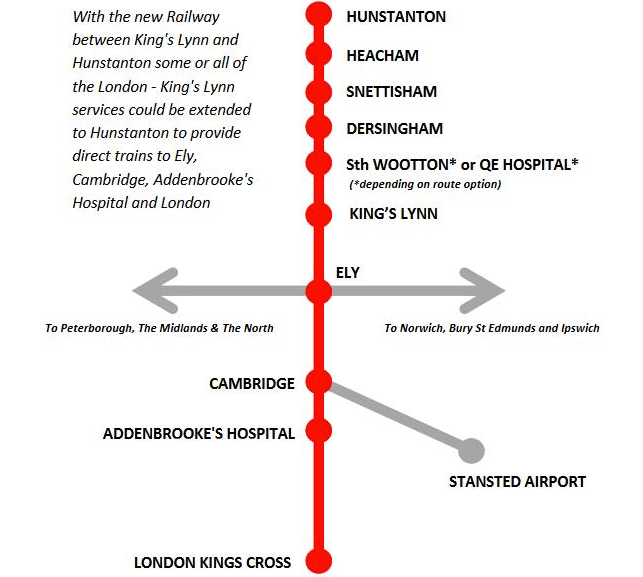
Above – from the Hunstanton Rail Campaign. 90minutes there, 90 minutes back. No driving needed.
Great Yarmouth and Lowestoft
Back in 2005 I was taken on a field trip to Great Yarmouth during my civil service days where we got to look around at what European funding distributed by the regional office was being spent on. The situation was the opposite of Cambridge, where there was next to zero private sector demand for land and buildings, so the local council ended up becoming ‘landlord of last resort.’ It’s something that has stayed with me ever since – a place with a great local history and so much potential – and yet its very poor transport links are at the heart of its problems.
Many of you will be familiar with the Cambridge-Norwich train services which have often been spoken of/written about as in need of a major upgrade & electrification. I’ve also mentioned alternative routes to/around Norwich to get to Great Yarmouth and Lowestoft. The cheapest solution is to re-open the loop just north of Trowse.
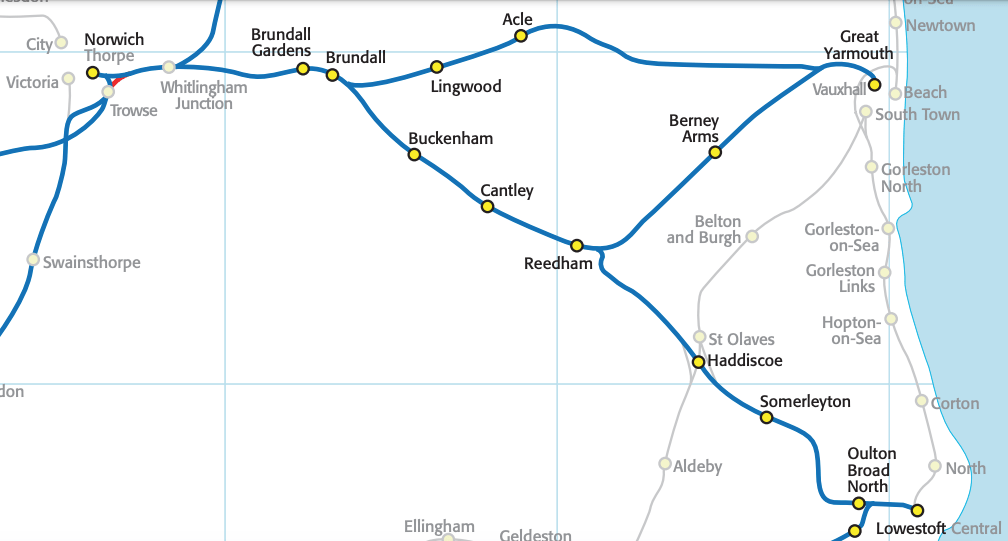
Above – from the New Adlestrop Map
You can have a look at the old railway maps vs today from the National Library of Scotland
You can see below where the now closed loop used to run. You can zoom in further here
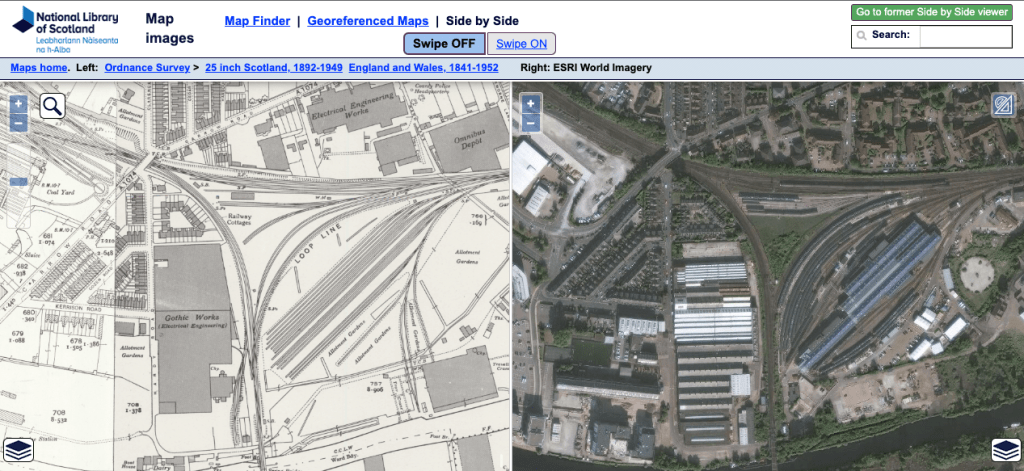
Above – from the National Library of Scotland Maps
This is one of the two pieces of physical infrastructure upgrades needed – the second being the significant increase in capacity of the swing bridge mentioned in this article.
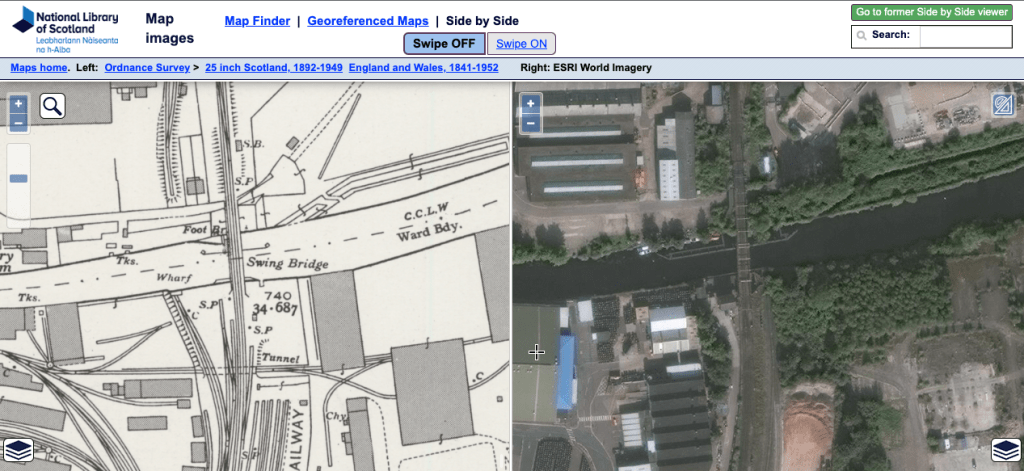
Above – this upgrade is something that Rail Future East has been calling for ***for ages*** – see their presentation from 2019 here
On land use generally
I mentioned that Cambridge is experiencing a spike in land prices, with speculators able to extract as much financial value as they can and exporting it out of the local economy. Hence in part why Cambridge cannot have nice new things. Hence the importance of transport links to places where land prices are cheaper and also where such facilities will benefit local populations as well as the people of a rapidly-expanding Cambridge & South Cambridgeshire.
There have been various calls about inquiries into land use – here’s one from the House of Lords in 2022. You can read the recommendations here. Note the bit about *Strategic planning and co-operation* from para 166.
“Government are worried about businesses either in Cambridge or Overseas”
Former Cambridge councillor Mike Sargeant put this point to me – and he’s right.
You can read the report from the Combined Authority, commissioned by former Mayor James Palmer, here. Mr Sargeant was on the Overview and Scrutiny Committee of the Combined Authority when he was a councillor so robust exchanges over reports like this with the former Mayor became routine. That report was published in 2018. Then the pandemic hit, and then the Combined Authority published its Independent Climate Report in 2021 – which you can read here. The problem is it feels like decisions about Cambridge are being taken without the involvement of the people of Cambridge – those that live, work, and study here. Hence Sam Davies’ post on the ‘triple whammy’. A minister announcing stuff when Parliament is about to go on recess is depressing but not surprising. At the same time – and as I’ve made clear throughout, this does not make it right for someone like me in Cambridge to say to other towns and cities: “You must have X, Y, and Z because Cambridge needs it and you are here to serve Cambridge.” That’s a recipe for disaster. Which is why the recommendations from the House of Lords’ Land Use Report in paragraphs 183 onwards. There has to be co-operation and long term sustained relationships between resourced and empowers councils. Which as the Lords’ report states at the end we do not have.
This brings me back to the need for a wider industrial strategy for the nation. What are the things that each booming city needs but cannot provide for itself? What are the things that nearby cities could provide, and what benefits could they gain from being linked up to such cities without having all of their talent sucked away like London tends to do with the rest of the country? (This is not a slur on Londoners – rather a note on how over-centralised the UK governance, social, financial and decision-making structures & institutions are).
But such is the limited policy-making capacity [due to the self-inflicted austerity] in Westminster, alongside the ideologically hot-wired mindset in ministerial offices that I can’t see much happening with the present administration. It remains to be see what sort of policies and proposed institutional arrangements Labour want to bring in for their manifesto.
But if Labour wanted to snatch Great Yarmouth at the general election, putting a commitment in for those infrastructure upgrades and new services from Cambridge to Great Yarmouth could be a big boost.
Food for thought?
If you are interested in the longer term future of Cambridge, and on what happens at the local democracy meetings where decisions are made, feel free to:
- Follow me on Twitter
- Like my Facebook page
- Consider a small donation to help fund my continued research and reporting on local democracy in and around Cambridge.

 The Cambridge Town Owl