Which could be an interesting one for the incumbent MP for South Cambridgeshire to debate with the voters at the next general election – only he’s staked his political career on opposing such large housing developments.
You can see the table below – one which I threw in at the end of an earlier post on a northern entrance to Cambridge by the East West Rail plan – the principle of which I still support by the way.
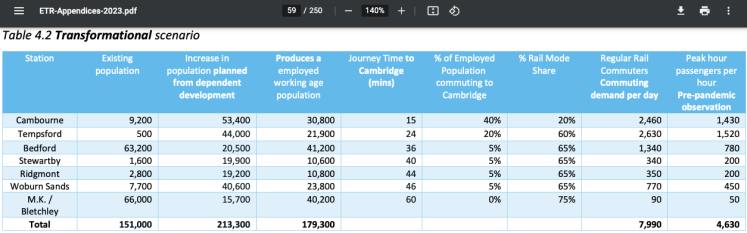
Above – from p59 of the EWR Technical Report
Just as with everything else transport-related, ministers have gone and screwed everything up again – similar to the GCP, alienating the very people they need at least as critical friends.
“Doesn’t that read like it’s straight out of the National Infrastructure Commission’s recommendations from 2017?”
Yep. Pages 36-37 to be precise. You can read the wider recommendations here
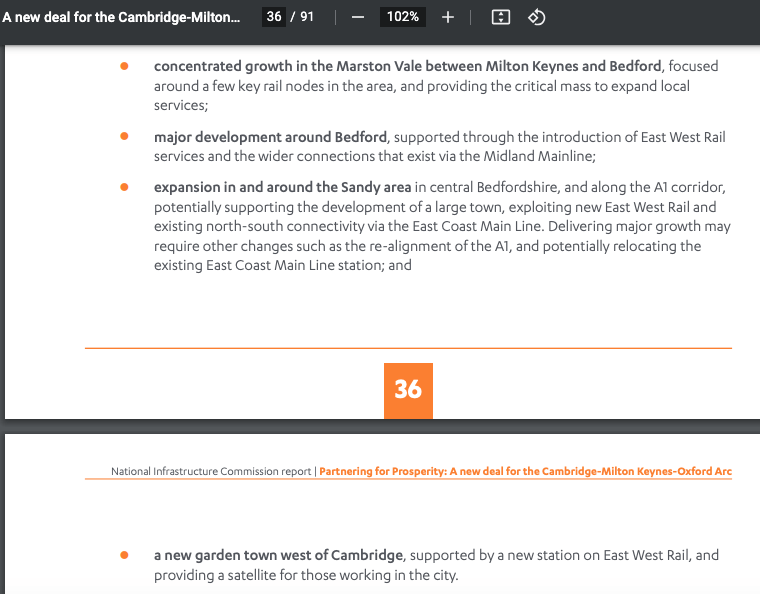
Above from the National Infrastructure Commission – Partnering for Prosperity 2017
- expansion in and around the Sandy area in central Bedfordshire, and along the A1 corridor, potentially supporting the development of a large town, exploiting new East West Rail and existing north-south connectivity via the East Coast Main Line.
- a new garden town west of Cambridge, supported by a new station on East West Rail, and providing a satellite for those working in the city.
The final two points I’ve quoted from the National Infrastructure Commission in 2017 match the modelling by the East West Rail Company for new towns at Tempsford (between Sandy, Bedfordshire & St Neots in Huntingdonshire/Cambs), and Cambourne. Just the size of Cambourne being put at nearly 55,000 people by 2050 may come as a shock!
OxCam Arc – very unpopular with Tory voters in rural areas. Which is why it got no mention in the Levelling Up White Paper.
Not surprisingly, planning, housing, and environmental protection were three issues that the electorate gave the Tories an absolute kicking in their ballot boxes at the recent local elections – the Liberal Democrats and more significantly (I think) the Green Party reaping the rewards. If the Greens are able to solidify their gains in rural areas, they could be much harder to shift electorally on development issues because superficially at least their brand and colour scheme resonates with the public. It’s more tricky for the Liberal Democrats as they run more councils, have a longer political history, and have more to defend.
The Levelling up non-announcement
“I am glad the OxCam Arc appears nowhere in the levelling up White Paper, and is no longer a government priority. Those community groups who fear the consequences of the OxCam Arc on their villages can breathe a little easier.”
A Browne MP (Cons – South Cambs) in the Cambridge Independent Feb 2022
This was a strange piece of political leadership that I lampooned at the time (in February 2022) because pretending the controversial issue does not exist and hoping it will go away is not leadership. It’s the opposite. Far better for ministers to have taken on the issue and provided a clear steer.
It came back to haunt ministers when the big lobbyists got to them and persuaded them that the infrastructure investments were essential for all things life sciences. Hence in November 2022 following the musical chairs of ministerial portfolios (including the top one), the Government announced a sort of alternative which I wrote about/lampooned here.
“Maybe life sciences are important after all?”
Jeremy Hunt, the Chancellor thought it important to announce something on 25th May (very recently) that involved £650million of spending and rule changes along the East-West Rail route. To which those supporting the principle of East West Rail criticised him for going ahead with a diesel line, while those opposing the principle of East West Rail continued to oppose.
The problem for the Government is the assumptions and evidence-bases have stayed the same in the face of ministerial flip-flopping
Yet as we have found out the hard way with the Greater Cambridge Partnership, consultants only account for what they are commissioned to in their models. Cllr Sam Davies called them out earlier.
“presumably the consultants who write these reports are not paid to consider:
- The environmental stresses already manifesting themselves, particularly in terms of water demand (see this previous post);
- The failure to retain the economic proceeds of growth locally or distribute them evenly (see this previous post); and
- The well-documented weaknesses of our local governance structures which cripple any attempt to address either of the above.
Above – from Cllr Sam Davies MBE (Ind – Queen Edith’s)
…who picked up on Phil Rodgers’ point about internal audit still having issues with the Combined Authority’s governance controls.
As I have mentioned numerous times, I consider the CPCA to be inadequate and ineffective by design, hence calling for its abolition at the ballot box earlier this year.
“So, is Cambourne going to end up with 55,000 people by 2050?!?”
No idea – I plan on being plant food underneath a tree in a new woodland burial ground near Wandlebury by that time. Therefore I have no skin in that game. But I appreciate the rest of the county and region does. Which is why we need to look at it.
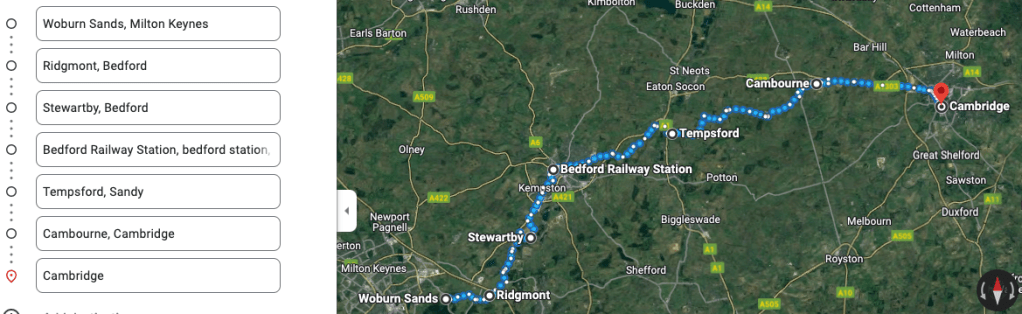
Above – from G-Maps here (with the route)
It’s the route between Bedford and Cambridge that is particularly interesting to us because the two places used to be linked by the old varsity line. Who was responsible for its decline and fall is another story (Both Tories and Labour have political Qs from the time to answer, but there are huge social history considerations that are easily forgotten or overlooked today).
Why the newtowns between Bedford and Cambridge matter for the Cambridge bubble
Lets have a closer look at those numbers. Compare the existing to the proposed populations for Bedford, Tempsford, and Cambourne – two of the three being newtowns, the last being the historic county town.
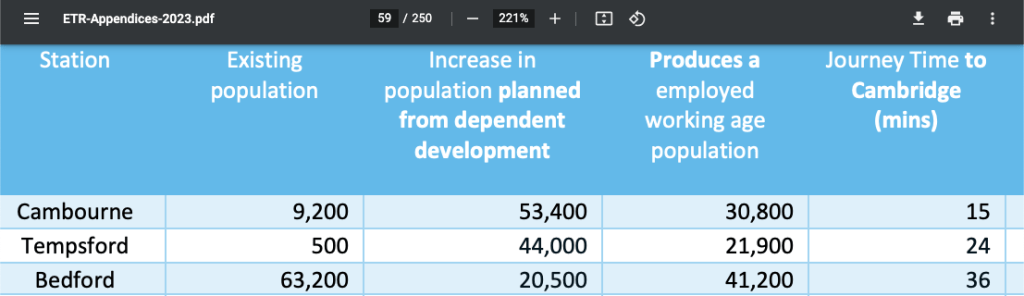
“How big is Bedford?”
Depends which method you use. The report says 63,000 but that’s based on the old town boundaries. Bedford Borough was restructured in the late 2000s making it a unitary council area with with a large rural area surrounding the town. It gives some idea of what a Cambridge & South Cambridgeshire Unitary Council might be like. Furthermore, the digitised maps from the National Library of Scotland show Bedford town in the early 1900s next to a more recent aerial image. In the time between the images being taken, the town managed to turn part of the land south of the old town into a gravel pit then filling it with water to become Priory Country Park. Cambridge effectively did similar with Milton Country Park.
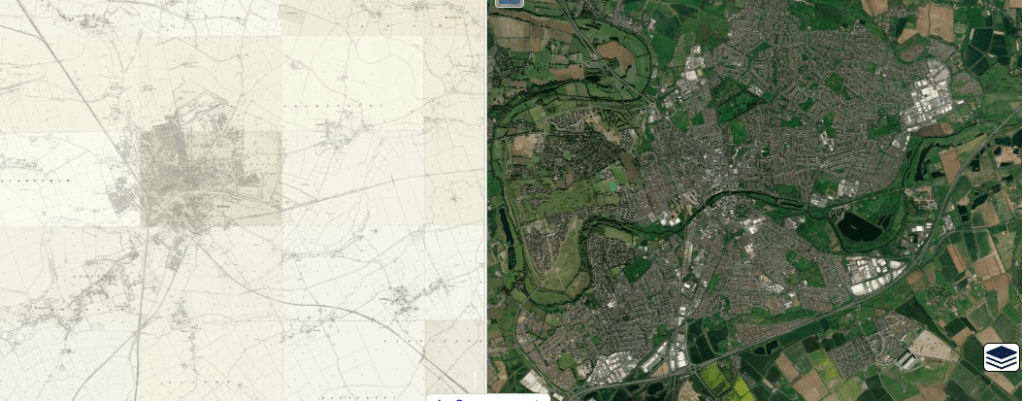
Above – Bedford from the National Library of Scotland Maps
Increasing Bedford’s population by a third is quite a big deal
I just hope someone’s told them!
“And where is Tempsford? Doesn’t sound like a permanent place, does it?”
Local historians are still disputing its origins.

Above – from G-Maps here
I’ve picked out the car company as it’s next to the London-Edinburgh / GNER railway line that the East-West-Rail has to cross. It used to run via a chord and a crossing at Sandy – again see the National Library of Scotland maps here and you can see where the crossing has been demolished and the routes into it have been built over. Far easier to pick a small village and build a new GNER/EWR interchange next to a small village if you’re sat at a desk in London.
Tempsford also matters because it is right next to (but not inside) the new parliamentary constituency of St Neots and Mid-Cambridgeshire.
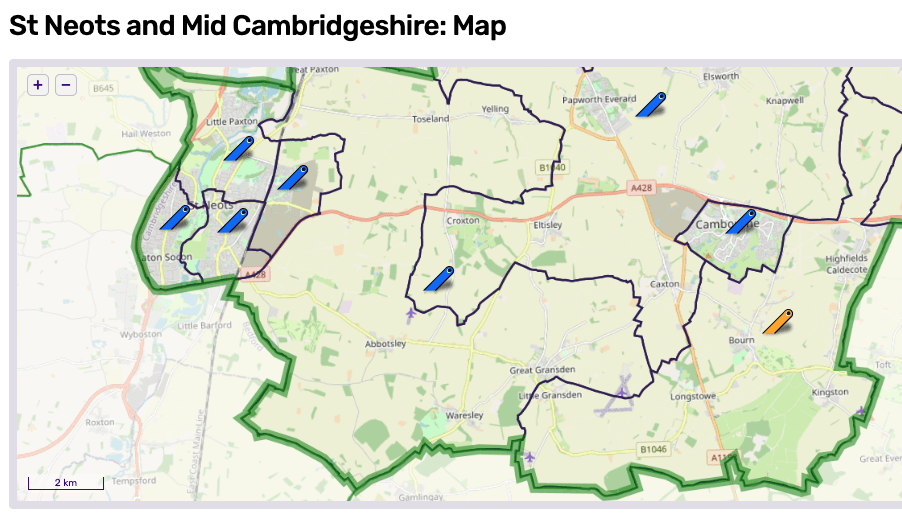
Above- from Electoral Calculus.
Note the scale at the bottom left where it says “2KM”. Now see the label of the village next to it. That’s Tempsford. Note the incumbent MP for South Cambridgeshire has selected this constituency as the one to contest (containing 40% of the old South Cambs – with the re-oriented and redrawn South Cambs containing the other 60%, plus Cherry Hinton from Cambridge constituency and a bit of the old South-East Cambs which becomes East Cambs).
Journey times from Bedford, Tempsford, and Cambourne by heavy rail.
Their table says 36mins, 24mins, and 15 mins. For the latter two, high density accommodation around the railway stations are likely to be constructed. That said, I think to treat both as purely dormitory accommodation for the Cambridge economy would be a big mistake. Not least because it would destroy the character of the city if only only wealthy residents were able to live there alongside a token number of people in social housing. Monaco is an extreme example of this where a large majority of its workforce commutes in from France or Italy.
If ministers want to go down the route of building new towns to help ease the housing pressures on Cambridge, then those new towns need to be sustainable in their own rights and not simply dormitory towns for Cambridge in the way that several of the post-war Newtowns ended up with that pejorative label for London by the 1990s. This is why evaluating the post-war newtowns alongside the more recent property developments is ever so important. Do the policy teams have social historians working in them?
There are more than a few academic theses gathering dust that could be used – such as this evaluation of Hemel Hempstead & Stevenage 1946-70 by Dr Andrew Homer.
“The thesis examines two main areas: firstly, the consequences of social development policy within the British new towns and, secondly, the nature of social changes experienced by the new town migrants.”
And
“The evidence suggests that the new towns soon became examples of thriving communities with ample opportunities for social interaction. However, it should be noted that this social intercourse was often despite, rather than because of, the actions of the government, the new town Development Corporations and the town planners.”
Homer, A. (1999) ‘Administration and social change in the post-war British new towns: a case study of Stevenage and Hemel Hempstead 1946-70’. PhD thesis. University of Bedfordshire / Luton.
Again, this matters because politicians are talking about recreating the same institutional structures for proposed next generation newtowns. Were these the right structures for the previous generations, and if not how can we improve them so we don’t end up making the same mistakes next time around?
What are the financial and environmental limits to growth?
This comes back to Cllr Davies’ point about the assumptions that policy-makers and technical consultants are working on. What are the additional infrastructure costs and who will pay for them? Does the existing structure of our privatised utilities sector have the capacity and competence to build such infrastructure at a price that does not rip off the tax payer or cause a balance of payments crisis because of the volume of imports needed and the overseas-domiciled owners converting the profits denominated in £££ into other hard currencies? Only the UK had similar restrictions on infrastructure projects in the 1960s because of balance of payments and balance of trade issues – albeit under a different global economic structure.
This is why we need a much more thought-through national industrial strategy – one that does not pile into a small area of the country that is beyond the capacity of its governance structures or its local environment. Furthermore – and I’ll save this for a future blogpost, we need to have a look at who is marketing ‘brand Cambridge’ to the world – and whether they are selling a fantasy of a dream that when faced with the realities of our city is anything but? After all, not everyone is going to have those picture-postcard views of the ancient colleges to wake up to every morning. They are more likely to have Eddington-style spreadsheets and disaster-capitalism minimalist architecture and design the sort I’ve been moaning about for longer than is sensible.
Ministers can delude themselves by supporting such activities, claiming that it’s good for the economy and good for growth. What they refuse to understand (imprisoned by their own ideology?) is the scale of the investment in housing, transport, and infrastructure – and new institutions that are needed to deal with the UK’s chronic economic, social, and environmental problems.
So long as they keep our city locked up in market-town governance structures, and continually underfund our northern cities by starving them of much-needed public transport infrastructure funding (amongst other things), it’s not levelling up they’ll deliver. It’s levelling down. And the people deserve better.
Food for thought?
If you are interested in the longer term future of Cambridge, and on what happens at the local democracy meetings where decisions are made, feel free to:
- Follow me on Twitter
- Like my Facebook page
- Consider a small donation to help fund my continued research and reporting on local democracy in and around Cambridge.

 The Cambridge Town Owl