
Developers for the proposed North East Cambridge site (where the sewage works currently is) were at the Strawberry Fair – and so were Save Honey Hill campaigners opposing them, as this year’s event reflected a rapidly-changing Cambridge
If you want to get a feel for Cambridge’s radical edge, go to the Strawberry Fair. The first time I can recall going was in 2003 – I missed it in childhood because of a combination of fear of drugs and violence, and then prioritising exams over everything. Much to my regret because that’s what happens when you let your fears get in the way of life experiences. Furthermore, South Cambridge was a very difference place (I can’t speak for north of the river because I hardly ever ventured there – one for a local history blogpost as to why) compared with today.
Back in 2003 I volunteered as a steward (see here to try it yourself) having only moved back to Cambridge from Brighton the previous summer after three years of university. Those years down the south coast made me wonder what I was worrying about in the mid-1990s! But remember in the 1980s & early 1990s, the Government’s line on narcotics was Just Say No! (as made famous/infamous by Grange Hill in 1986) without actually telling us what the things we should be saying ‘no’ to actually looked like, why people took said things, and what their effects were. It was only after the tragic death of Leah Betts in 1995 that ministers began to wake up to the fact that their strategy was (and still is not) working.
“Why would a corporate developer (okay – it’s partnering with the city council on this) have an outreach stall at the Strawberry Fair?”
Given the numbers of people showing up, why wouldn’t they? Especially given the proposed numbers of homes they intend to build. In this case, it’s the proposed redevelopment of the sewage works site under the name Hartree. It’s all part of the North East Cambridge Area Action Plan. Essentially it’s a new council ward that will eventually elect its own councillors onto the City Council – assuming it goes as planned.
Eva Hartree – first woman mayor of Cambridge?
Yep – see here. Which reminds me, 2024 is her centenary year. (Cambridge City Council, Cambridge campaign groups & civic society organisations, what’s the plan?) She was also a former president of the National Council for Women in 1936.
Either way, you can have your say about the proposals for North East Cambridge here. Much as I would me tempted to say ***it was all me!*** regarding naming things after the women who made modern Cambridge, all I’ve done is the historical research and shared it. It has always been my intention for others to then take that information and do something creative with it – things that are far, far beyond my competency.
I also said I’ve gone as far as I can with my own research – similar to what I said earlier this year at the Cambridge Corn Exchange.
“I’ve taken the solo part of my research on the women who made modern Cambridge as far as I can go. As the women on stage today demonstrated and proved, the next chapter/part involves a much larger group effort.”
Lost Cambridge 28 March 2023
“Why have they got a picture of Lady Alice Bragg on their website when they’ve named the area and work after Eva Hartree?”
Ooops.
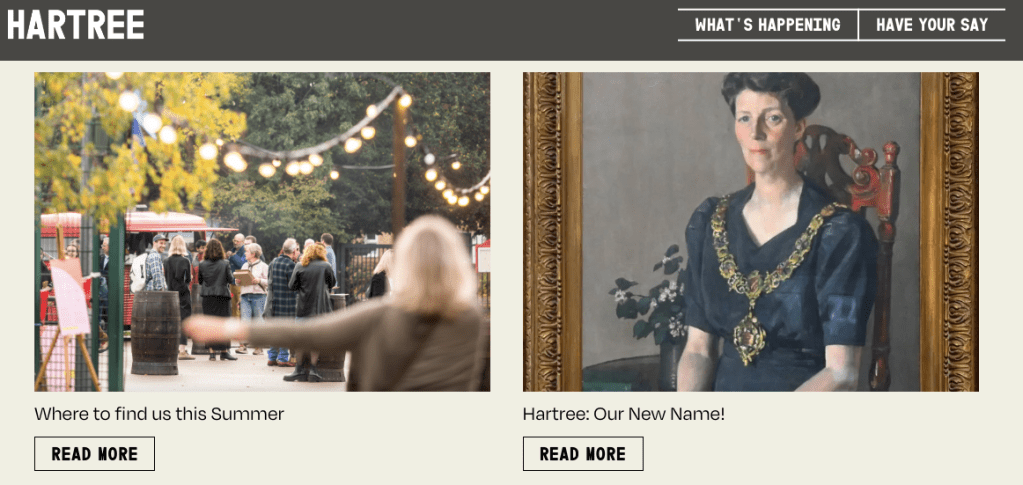
Above-right: Not Eva Hartree – that’s Lady Alice Bragg, the third woman to become Mayor of Cambridge, in 1945 – having spent much of World War 2 co-ordinating public services in town as a co-opted councillor for Newnham.
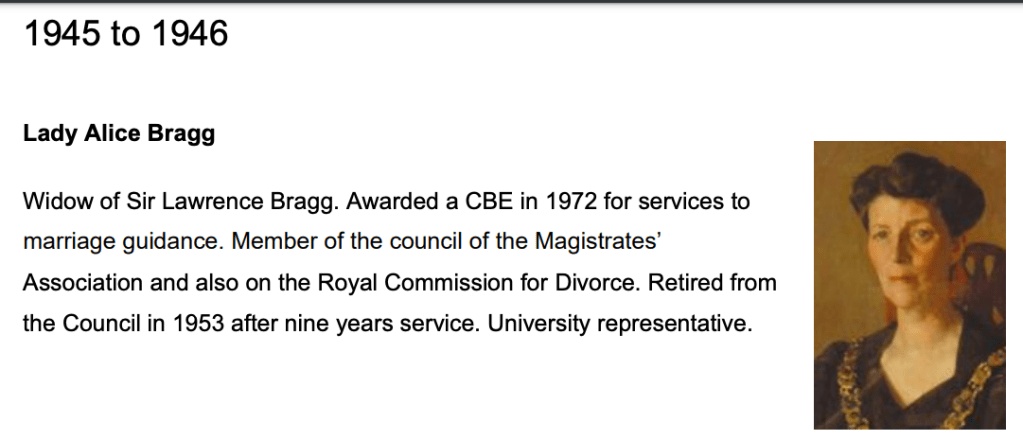
Above – from Cambridge City Council’s list of mayors from 1835
Easy mistake to make because the huge portrait of Lady Alice as that of Eva Hartree as no one actually put a label on it! Lady Alice was the first Mayor of Cambridge to appear on video – have a watch of her speech to the Cambridgeshire Regiment, the men of whom experienced the horrors in WWI of trench warfare and in WWII imprisonment in the Far East following a doomed mission to Singapore just before it fell in the biggest military catastrophe in British military history.
Eva Hartree – our first woman mayor.
I transcribed an article in the Cambridge Independent from 1930 that is archived in the Cambridgeshire Collection about her work in Cambridge up to that point – the original photograph from Palmer Clark below dating from 1924.

Mayor Eva Hartree – the first woman to be elected Mayor of Cambridge in 1924. (Image: Palmer Clarke Archive in the Cambridgeshire Collection, colourised by Nick Harris of Photo Restoration Services, commissioned by Antony Carpen)
I’ve given the original large print out to the Cambridgeshire Collection (Part of Cambridgeshire Libraries) as it was developed from one of their collection items in the first place. I hope Cambridge City Council could arrange a financial contribution to the upkeep of the Collection should they use it. (See also how to donate to the library service here).
The Hartree redevelopment vs Anglian Water’s [controversial] move to Honey Hill: Two separate developments or one-and-the-same thing?
When I spotted their stall, I noticed the people running it were being grilled by supporters of Save Honey Hill who, quite understandably are strongly opposed to having a new sewage works built near their village. When you experience the stench of the existing works (the infamous Milton Pong) you can understand why local residents are up in arms. And that’s before you start examining the merits and otherwise of the case for moving.
I had conversations with both sides – including asking where the display board of Eva Hartree with photo-portrait as Mayor of Cambridge was – given they had named it after her, and also my thoughts with those opposed to the plan as to why in principle I think it will go through. (It’s going through the Development Consent Order process where the final decision is taken by ministers, not the local councils). Cutting a long story short, I said that given the grant from the Housing Infrastructure Fund ministers gave to Anglian Water to move to a new site, this is Government policy and therefore the way to hold ministers accountable is via local Members of Parliament – stating that when a constituent contacts their MP over decisions by ministers that affect their area and asks for ministers to explain themselves, the final response to the MP must come from a Minister of the Crown – ideally the minister responsible for the policy area. Because Ministers are accountable to MPs in Parliament, and MPs are accountable to their constituents irrespective of who they voted for, or even voting/citizenship status. (People can email their local MPs and local councillors via https://www.writetothem.com/). I mentioned to the stall holders for Hartree that it would have saved them a lot of grief if they had said the Anglian Water decision was a Political decision outside of their remit – and the way to hold the decision-makers to account was via their MPs (and providing the means on how to do this).
How the Strawberry Fair has (and hasn’t) changed: 2003 – 2023
That in itself is a local history project – one they could team up with the Museum of Cambridge to create. Furthermore it’s something the Cambridgeshire Association for Local History might be able to provide a research grant for, in return for a presentation to members on the research findings.
The 2001 Census had Cambridge’s population at just below 110,000. The 2021 Census (taken during lockdown when many students stayed at home) had Cambridge’s population at over 145,000. That’s just within our 1935-era boundaries – and inevitably people from across the region & beyond rock up for it. Hence putting it on every year is an incredible achievement for all involved. (You can get involved in future events – see here)
The music – especially from the younger bands was noticeably and understandably more angrier and heavier compared to previous years. Given how much sand they’ve had kicked in their face by central government, I can’t say I blame them. Prominent were their covers of 1990s indie classics (and their own tracks inspired by them) from the last time the country had experienced 13 years of Tory austerity! And the teenagers were there in huge numbers.
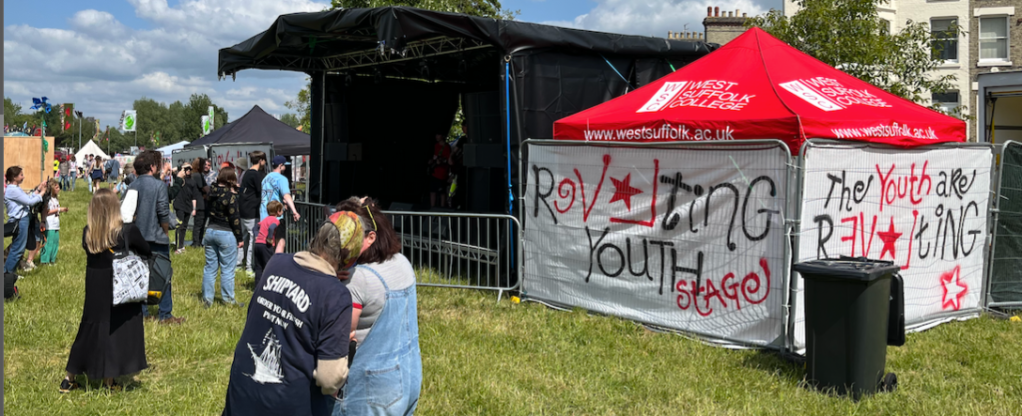
Above – Young people revolting. Supported by West Suffolk College. The stage that is.
Otherwise you’ll have tabloid headlines about “Woke Suffolk College supporting young anarchists who want to overthrow the King!”
Actually, given the catchment of the college includes a fair amount of Mid-Suffolk (whose boundary is almost next door to Bury St Edmunds where the college is based) the election of a majority Green Party Council a few weeks ago might show that things are also stirring outside urban areas too.
Given how so little is provided for young people by ministers whether directly or though their (mis)management of local government, I’m not surprised young people from outside Cambridge turn up in huge numbers. It was the same in the 1990s – me and my friends were astonished at the number of people who crossed county boundaries to go to teenage club nights at The Junction.
Why was no one doing transport surveys at the entrance?
One for the Combined Authority or Cambridgeshire County Council to sort out next year? Commission researchers and the Strawberry Fair organisers to survey the people in the queues as they make their way onto the site. See what the results are. One group can do random samples (eg every tenth person – ask for their postcode), while another can try and get everyone possible to put stickers on a big map. Others can interview people about methods of transports they used, how easy it was to get into town, and what improvements they would like to see.
Who has what experiences at the Fair?
This would make for an interesting extended project for anyone in further education – in particular anyone examining the expansion of our city and integrating new arrivals and communities into the life of our city. For example how do the experiences of longtime regulars compare with say young people there for the first time, or recent arrivals to our city experiencing the fair for the first time. In particular with the latter, do their experiences correlate with where they’ve moved from? (eg another part of the UK to another part of the world) to the circumstances that brought them to our city? (eg work or because of war/disaster where they were living previously?) The same could go for experiences of people who live within Cambridge’s boundaries vs those that have travelled in for the day from surrounding villages and beyond. What did they make of it?
The reason for asking such questions is that I think the results of such questions would reveal some very striking insights into our city and how it has changed and is still changing. A repeated set of surveys over time would be even more interesting. The same could be done for the Cambridge Folk Festival that also happens annually. What would both events tell us about our city? (One for CambridgeBID to commission?)
On volunteering for the fair
Again, if you’ve not been involved in helping organise an event and want to see what it’s like and dip your toe into it, one of the best places to start is volunteering for the Strawberry Fair. This is because so many people are involved and so many people have a huge experience of putting on such things over the years. That way you can learn by observing and listening as much as anything else.
Below – a stewards gathering and briefing session several days before the fair when the weather was cold and damp. It warmed up just in time.
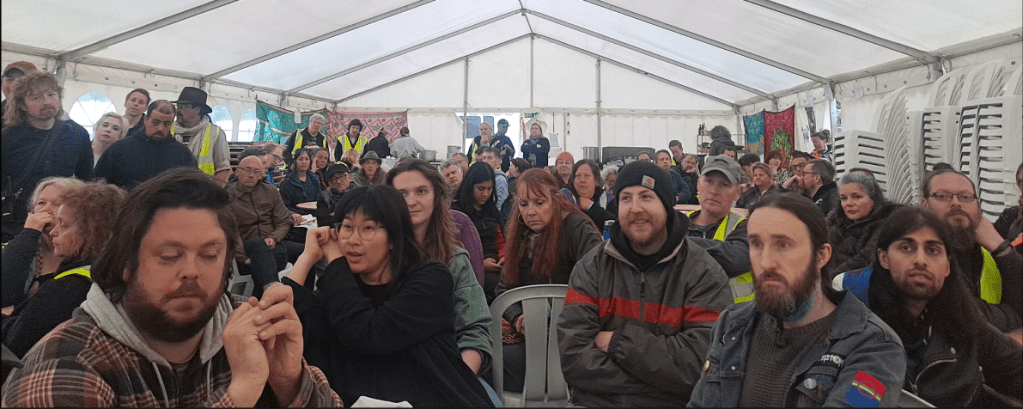
Above – Strawberry Fair stewards – ***lots of them***. Photo. Andrew Osborne
I remember 20 years ago being a newbie that our role was simply to be the eyes and ears. of the organisers, and to help the senior stewards nip things in the bud as and when needed. You got to meet lots of people and you also got a crash course on the day in crowd dynamics – including how potentially hostile people back down when they see lots of you in hi-viz waistcoats facing them. In 2003 some of you may remember that was a drought year and the fair took place in the middle of a heatwave, so we had to be very vigilant about fire risks – including barbecues and performers literally playing with fire!
If you are interested in the longer term future of Cambridge, and on what happens at the local democracy meetings where decisions are made, feel free to:
- Follow me on Twitter
- Like my Facebook page
- Consider a small donation to help fund my continued research and reporting on local democracy in and around Cambridge.

 The Cambridge Town Owl