
This is from one of the submissions (I wrote a guide on how to explore this here) in the call for sites a few years ago.

Above – a concept map for North Cambourne – east and west
“Nice of the owners and developers to do a large public engagement exercise before drawing up their plans.“
Actually they did – you can see their presentation on 19th March 2021.
It falls into my category of ‘published but not publicised’.
It isn’t just Bourn, but Elsworth that picked up on it – see their blogpost here. (This is another reason why how local media is funded and supported needs overhauling as well – because professional journalists need to be employed to interact with village-level blogs that pick up on such things easily overlooked by the mainstream and even the trade press).
Talking of published but not publicised, ministers have a habit of burying things in written statements – normally just before recess. Few people bother to read them but in the grand scheme of things they have been made public because the public can access them – even though the vast majority of the public has no idea what a written ministerial statement is. It’s a bit like finding jobs or work experience in politics – there is a website that advertises such posts – http://www.w4mpjobs.org/ – but few people know of its existence. Want to know who is lobbying for what? Have a look at the list of vacancies. Some of the announcements are formalities – such as the Life Sciences Growth Package (from earlier today – 05 June 2023) that confirms East West Rail is part of National Government Policy on the ‘Golden Triangle’ for life sciences. What that means is changing the route alignment to a northern entrance into Cambridge is unlikely to happen because the Chancellor has made it clear that a direct link to the Cambridge Biomedical Campus is Government Policy. The best that opponents (living south of Cambridge) can do realistically is to lobby for significant improvements in the designs, accepting that a change is highly unlikely under the present government *unless* there is a significant new evidence base that arises that changes things.
“So, who wants to do what with Cambourne then?”
When I was going through the initial set of sites submitted (Red being residential, purple being mixed, blue being employment, and green being Green Belt), one of the first things to be mindful of is that what has been submitted by developers is not what will automatically get built.
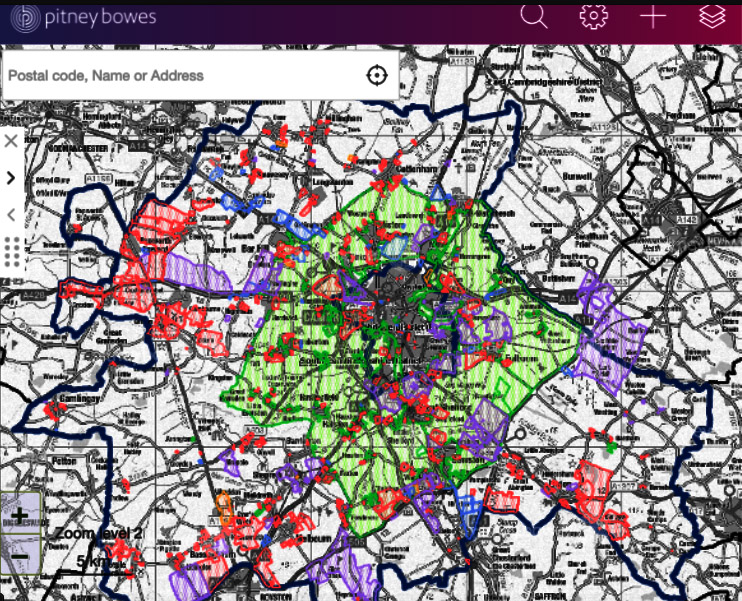
Reasons include such large scale development in such a short space of time would:
- be politically and electorally unacceptable that no political party would dare that level of barely-restricted housing growth
- the building industry does not have the capacity to build on all of the sites submitted even if such permissions were granted
- some speculators who have signed options agreements with land owners may only be interested in selling on the site once it has been designated as suitable for development – and banking the uplift (and extracting the value from the local area). It’s purely a ‘paper profit’ waiting to be realised – one that could easily be vanquished by say a future government coming in and bringing in a land value uplift tax of 99%, and changing planning laws so that when a site or a firm that owns a site is sold on, any planning permissions they hold expire.
We have civic and leisure infrastructure issues and we must address them
“Developers build houses, not communities” I was once told during my civil service days. One of the things successive governments have failed at is making sure developers provide sufficient spaces and resources for community, civic, sporting, leisure, and arts facilities. Not least because so much existing infrastructure is beyond its replacement date.
Above – you can read the report by the APSE here
“The developers and pressure groups are calling this ‘North Cambourne’ to hide the fact that it would be a new town (of the same size as Northstowe).”

The red line shows the area that could be developed if planning approval is given. That could bring housing development to about 1.5 km (just under 1 mile) of Elsworth. The site is stated to have capacity for up to 10,000 houses at a density higher than in Cambourne. This would mean perhaps up to 30,000 people (and tens of thousands of cars).
Elsworth Parish Council 16 May 2021
Given the existing Greater Cambridge local plan timelines, the present North Cambourne site is currently outside of both the existing and the emerging local plan proposals. Expect significant lobbying pressure to be placed upon the Greater Cambridge Planning Service to release the North Cambourne sites now that confirmation of East West Rail *and* new stations at Cambourne and (to its west) Tempsford just over the county border in Bedford have been confirmed.
“How do residents and allies prevent Cambourne from becoming a Cambridge dormitory settlement?”
Not having everything located in Cambridge’s municipal boundaries that date from 1935? Note I’ve written about:
- Facilities that Cambridge is already overdue given its status as a regional centre
- Distributing facilities in surrounding towns and villages that Cambridge does not have the space for, but which would bring additional visitors to market towns
- Distributing new industries and regional facilities in geographically nearby cities and linking them up by heavy rail
Without those facilities, people will simply desert their own settlements as has happened in the past. Hence why transport has to be integral to new arts, sports, and leisure facilities in surrounding towns to encourage city residents to travel out of the centre. Because if everything is left to the development and property markets, what will happen is Cambridge would start to resemble Monaco, where most of the people who work there will have to commute in (and without whom the place would collapse) while only the most wealthiest or connected could afford to live there. (The country already has loneliness issues – and not just as a hangover from the pandemic – making the city more exclusive won’t solve them. Quite the opposite). As I said at the Queen Edith’s hustings in the Cambridge City Council elections in 2023, I cannot afford to live independently in Cambridge because of chronic illness. Hence I boomeranged back to live with my parents. Even though my election proposals were more about asking voters to speak to the other candidates and influence their policies (the front page of my election flier providing them instructions on how to do this!) I still had 261 people voting for me!
“Why should developers be allowed to build another single property when they’ve not delivered on their civic and leisure infrastructure promises?“
Quite – they are still waiting for their swimming pool in Cambourne (see this from 2018) – one that would serve some of the local villages too.
In the meantime, the planning minister made a laughable comment about building infrastructure *before* new and upgraded developments with increased density.
The Minister confirmed that her Government’s new Levelling Up and Regeneration Bill (now in its final stages in the Lords) would ensure infrastructure would be build before developments. (Have a listen to her response to Kerry McCarthy MP here). I cannot take the minister’s assurances seriously given the record of previous ministers. Furthermore, there’s not nearly enough in the Levelling Up Bill to ensure that underfunded local councils will be able to enforce what few powers the legislation provides for.
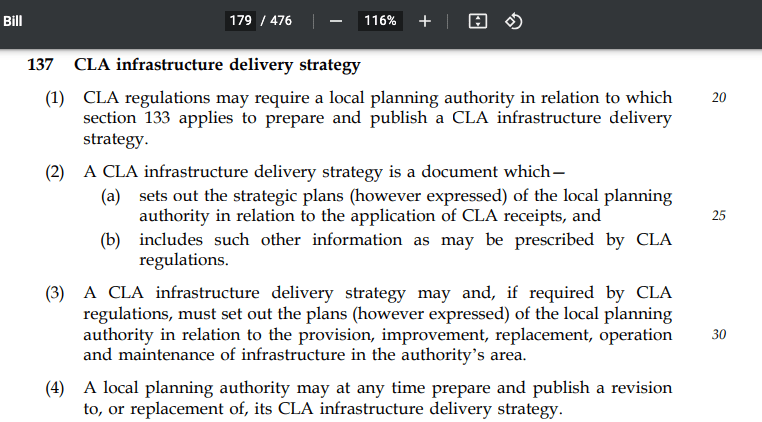
Above – more strategy writing for councils (like we don’t have enough of them already) – and also the proverbial will be in the detail of the regulations in terms of what powers and responsibilities are provided for. Will there be anything that will require developers to provide the infrastructure first? Or will they lobby hard enough to undermine the legislation to get out of such commitments.
New development corporations
These look like fun! Actually they are potential horror stories that bypass existing democratic systems of local development control by creating development corporations – which effectively take over local planning powers for a designated area of land.

The question is what concessions will local councils be able to extract from central government in order to agree to create one.
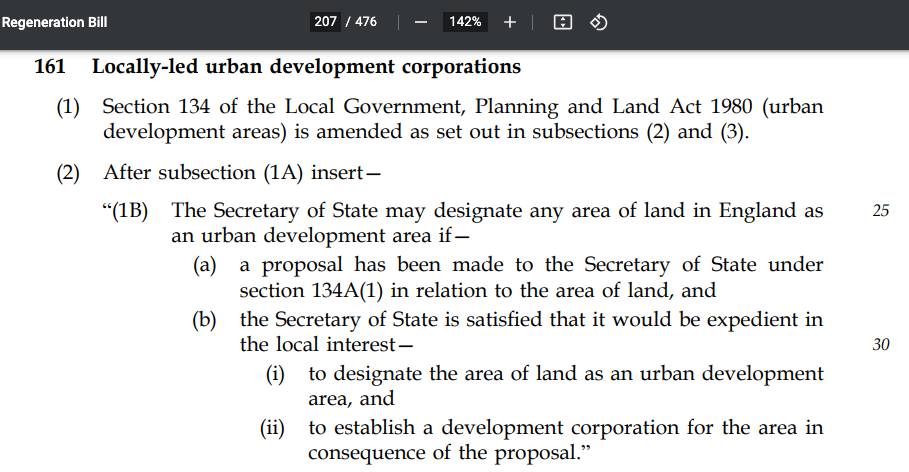
Above – S161 – the Bill as at the end of Committee Stage in the Lords
So things may still be tweaked at Report Stage and in considering the Lords’ amendments by the Commons, but at this stage nothing substantive should be added to the Bill before it goes for Royal Assent.
“What does all of the above mean in plain English?”
It means that ministers could establish a separate institution – a North Cambourne Development Corporation – and pack it with developers and their financial backers in order to build the new towns around the stations along the East West Rail Route. Which is why the secondary legislation needs scrutinising in detail – the shortcomings of which the Hansard Society has raised repeatedly – most recently here.
“How will they square that with the climate emergency?”
Good question
Because the Cambridgeshire Green Infrastructure Map is taking shape

Above – from the map: The ‘green buffers’
Note there’s nothing on that map from 2021 that even mentions a North Cambourne settlement.
- West of Cambridge in pale orange is the ‘Coton buffer’ (ironic given Coton Orchard issues),
- North of Cambridge in pale green is the much needed green space for people failed by previous development plans that under-provided for large green spaces. Just ask. the teenagers at the North Cambridge Academy and Chesterton Community College.
- East of Cambridge in pale blue is the enhancement of the Eastern Fens (which could become an extension of Wicken Fen southwards)
- South of Cambridge in pale pink is the Gog Magog and Chalkland Fringe
Furthermore, it’s also worth looking back at who said what nearly a generation ago – the below map is from 2006.


Above – split into two, from Cambridgeshire Horizons in 2006. Note the planning area goes beyond Cambridge & South Cambridgeshire district council areas, but not beyond the county council border
It has been over 17 years since the above was published. Progress update?
“Doesn’t this all reflect a failure of broken regional policy amongst other things?”
Yes – and for those of you interested, read David Higham’s guest post here.
“It’s all very complicated”
I think I started writing this about three – four hours ago. (It takes a bit longer with CFS/ME). And I still cannot get my head around it all. Public policy is complex by its nature, but what we have at present is made artificially complicated on top of that. Hence why it is so difficult to scrutinise. One of my big concerns is that in trying to simplify the system, the benefits end up being skewed towards the powerful and wealthy few, rather than to the many. Too many of us have to live with the symptoms of that system – whether the ‘light touch regulation’ enabling the worst in the big industries such as banking or construction to make fortunes at the expense of others, or in the bland designs of newbuild estates that lack the promised community facilities.
What will opposition parties have in their manifestos for the next general election that might change this for the better?
18 months and counting.
Food for thought?
If you are interested in the longer term future of Cambridge, and on what happens at the local democracy meetings where decisions are made, feel free to:
- Follow me on Twitter
- Like my Facebook page
- Consider a small donation to help fund my continued research and reporting on local democracy in and around Cambridge.

 The Cambridge Town Owl
2 thoughts on “Someone snapped up the rights to build on fields north of Cambourne ages ago”
Comments are closed.