
Deadline for submissions – 07 July 2023 with the overarching theme being Creativity Unwrapped (although in reality you can pitch up almost any idea!)
See the full details of Open Cambridge here. If you have your own idea or proposal, get in touch with Open Cambridge’s organisers here.
I’ve presented local history-related events in the past, including
The latter was facilitated by Delilah Knight who at the time had recently completed her finals, and wrote this article for Varsity making the case for such a new concert hall as a joint town-gown venture.
This year I’m looking at any (or even all of) three potential options.
Celebration of Cambridge Women – on stage
The first is the Celebration of Cambridge Women, which is a Cambridge City Council project that I and others have been commissioned by the council to deliver. We had a reception at the Cambridge Corn Exchange to show off some of the work by artist Marina Amaral who was also commissioned by the council as part of that project to restore and colourise the exquisite Palmer Clark glass plate prints from over a hundred years ago.
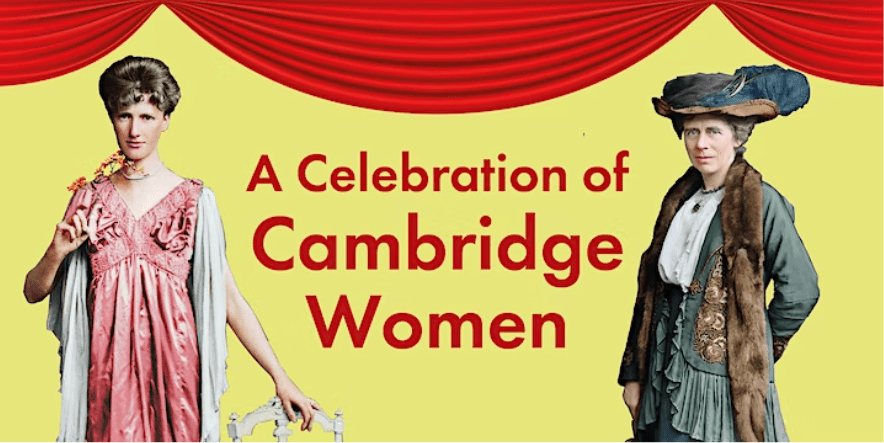
Above – Eglantyne Jebb (left) and Florence Ada Keynes (right) featuring in the publicity for, and who were reimagined in a short series of sketches a number of Cambridge local artists. It’s those performances I’d love to see put on – perhaps at the old Festival Theatre round the back of the Cambridge Buddhist Centre.
Cambridge and County Transport Reimagined
Obviously it’s very topical at the moment and will be for the next decade as the more decisions are made on the big infrastructure projects. Rather than a series of ‘death by powerpoint’ followed by Q&As that inevitably start with “Well this is more of a statement than a question…” sentences by middle-aged men who talk too much (i.e. me!) I’m thinking about multiple conversations around display pieces and interactive tables with maps that people can explore, see what was proposed in the past, and learn more about non-fossil-fuelled modes of transport.
Some of the display boards might be from specialist groups such as Rail Future East featuring the studies they have commissioned, to the past history of CamCycle and the series of ideas that their members have put forward over the decades and looking at which ones were constructed and why. It could also look at where there has been collaboration with campaigners interested in other modes of transport such as all things streets and pedestrians with Living Streets Cambridge.
How does the City of Cambridge function and malfunction – and how is it interdependent on the towns and villages that surround it?
This follows on from some of the feedback I received from the election campaign on how local residents said they found the explainers on local and contemporary history useful in understanding ‘how we got to here’.
Again, I don’t envisage a ‘death by powerpoint’ followed by a Q&A, rather a similar format to the transport workshop as one that has multiple displays and tables for multiple conversations to take place. It could be done as an open space / unConference event in the morning where in a series of workshops people thrash out, learn about, and debate things like specific public services, or specific geographical areas. The latter part could involve trying to piece the jigsaw together to trace the lines of accountability and identifying where the gaps are between service provision and the general public.
It could be flexible enough to cover a range of levels – from building Lego brick buildings and putting them on a map with a label, through to the people who want to get into the public policy detail of re-imaging the structure of a municipality that has democratic oversight of all locally-delivered public services. It could involve inviting the public to browse through books published recently to over 100 years ago that seek to educate the public about democracy – and have them pin feedback notes onto a board. It might involve the public telling existing institutions how useful (if at all) they find their printed and online literature.
Part of it could also include learning about where our city is in terms of our democratic literacy – how much knowledge does the public actually have about how our city functions, and if we were to do something about it as part of the lifelong learning offer from city and county, what sort of content and at what educational level would it cover? (The policy area now falls within the Combined Authority).
I can’t lead on any of them because of health, but am happy to take part
I have an extremely low regard of my event organisation skills. Think drinking sessions. in breweries. Furthermore I think it’s better if a small group of people work on something together rather than having me being the single point of failure with my own initial ideas. Finally, I think the experiences of the past few years in and around our city has generated enough interest and motivation for new and existing groups to get together and put on any of these events collectively without having an over-anxious over-talkative me running the risk of micro-managing stuff. (I am my own harshest critic at the best of times).
“Won’t this get a bit too party political?”
There is that risk but it’s one I think that can be managed. Furthermore, we have to acknowledge we’re having a general election within the next 18 months so there’s a public interest in inviting the public to start doing some of their thinking, questioning, and background reading now (mindful that southern Cambridgeshire now has an additional constituency in St Neots & Mid-Cambs bordering Cambridge) so that come election time they are better prepared to ask more searching questions of any of the candidates that put themselves forward for election. For those that are members of political parties, the events may give them ideas to feed back into their parties’ manifesto debates given that they are being drafted already.
Food for thought?
If you are interested in the longer term future of Cambridge, and on what happens at the local democracy meetings where decisions are made, feel free to:
- Follow me on Twitter
- Like my Facebook page
- Consider a small donation to help fund my continued research and reporting on local democracy in and around Cambridge.

 The Cambridge Town Owl