
Or a once in a [insert time period of choice] chance, but the slow, painful implosion of the party in government has delivered some political events that future historians and students of politics may be writing essays about for years to come.
And yet under a year ago, one recent broadcast outlet ran with this debate:
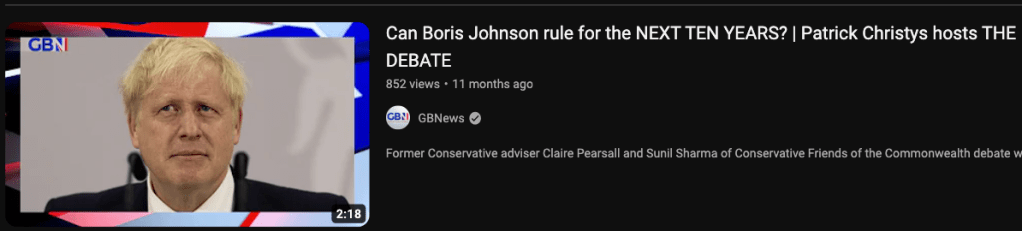
How the mighty fall?
When political news jumps out of the political bubble into day-to-day chat in the wider public, the front page of the Daily Star can be a useful barometer.
Which is their lead following the conclusion of the Commons Privileges Committee. You can read their news items prior to the headlines of today here – when the former PM Johnson appeared before them.
Here are some highlights from The Guardian (a paper hostile to him) of what he said.
…with Matt Green’s take below
In the meantime, Nish and Ahir called it right.
Above – UK: The Final Season from The Mash Report in 2019.
Yet as Dr Hannah White concludes:
“Few people had heard of the Privileges Committee before it began its investigation into Boris Johnson. But in a post-truth world, the value of a mechanism which enables a small group of parliamentarians to enforce the principle that politicians must tell the truth is of exceptional value to our democracy.”
Dr Hannah White, Institute for Government, 09 June 2023
Here’s a podcast from the Newsagents.
Former BBC journalists who, free from the restrictions of the corporation have become much more hard-hitting in their analysis as is often the case with people (myself included) who are able to use their experiences of their previous roles as a reservoir to draw from when scrutinising the world of politics.
Ironically it took a Prince of the Realm, i.e. Prince Harry – someone who has never had the vote, to force the media to speak the truth to power – i.e. itself by his statement in the High Court.
“Democracy fails when your press fails to scrutinise and hold the government accountable, and instead choose to get into bed with them so they can ensure the status quo.
“In my view, in order to save journalism as a profession, journalists need to expose those people in the media that have stolen or highjacked the privileges and powers of the press, and have used illegal or unlawful means for their own gain and agendas.”
The Duke of Sussex quoted by the BBC 07 June 2023
As many others have said – and as Emily Maitlis said, Boris Johnson did not care about the functions and responsibilities of the office of Prime Minister, it was about Boris having the title. Similar to David Cameron? The Green Party called it out back in 2016
Above – The Green Party’s 2016 Party Political Broadcast – spoofing a TV show of the time
Finally, the ‘resignation honours list’ is part of this too.
“So…will a future government take the opportunity to overhaul the structures of the state?”
This is what I mean by the very rare chance to change politics in a very radical way. The last time this happened was with New Labour in 1997 which resulted in the massive step-change in the representation of women in the House of Commons. The snapshot below of Margaret Thatcher’s last PMQs shows the wall of suits reflecting the male-dominated nature of the institution – one we are continually reminded of with Parliament’s inability to stop women being harassed by influential men on the palace estate.
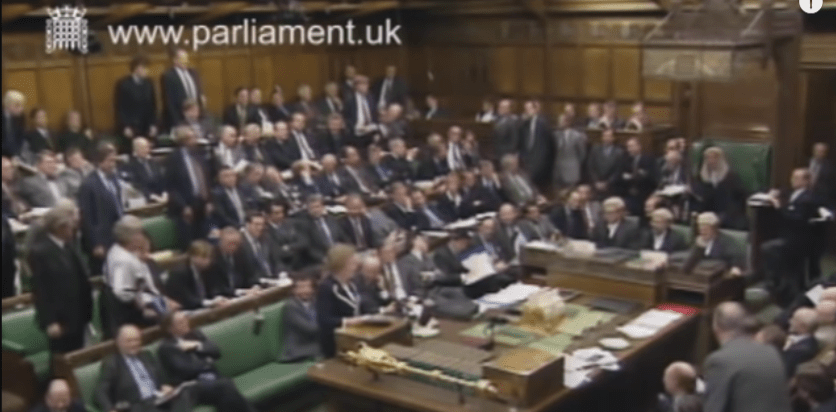
Above – From Margaret Thatcher’s last PMQs in 1990
Previous sea-changes in politics off the top of my head include:
1979 – the end of the post-WWII settlement and the rise of the present neo-liberal age
1945 – Attlee’s post-war government establishing the modern welfare state as we know it
1929 – Universal Suffrage with equal votes for men and women (opportunity missed?)
1910 – The two general elections when David Lloyd George’s “People’s Budget” established the first pensions and restricted how the ability of the the House of Lords to block the Commons on finance bills and manifesto commitments.
You could make the case for 2010 being another opportunity off of the back of of the MPs’ expenses scandal – which I saw from the inside the impact it had on the Labour Government.
“Boris has put The King in a totally invidious position [with his resignation honours list”
Emily Maitlis on The Newsagents, 09 June 2023 from 24mins in
It will be interesting to see what the reaction of The Palace is to all of this – especially so soon after the Coronation.
Opposition political parties need to open the debate on the specific changes they would make if they find themselves in government following the next general election.
Furthermore, they have to lead that conversation and take it out to the people, and not have it inside the Westminster bubble. Part of that conversation also has to involve helping educate the public about how political institutions function both in principle and in reality. – warts and all. That way will be easier for the public to spot the short-comings and thus demand changes and improvements.
And if you don’t know where to start, go to where the kids are at.


Go to the nearest children’s bookshop and ask for recommendations on books about politics and democracy – see what they recommend.
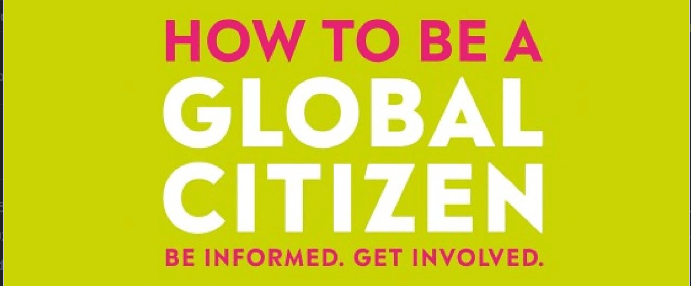
Above – this by DK is a good one as it starts with the basics of citizenship rather than diving straight into the institutions.
Hence my thoughts for a workshop at Open Cambridge where we co-design citizenship workshops or a syllabus for a potential series of evening classes. Because it’s very difficult to solve collective problems if our institutions of governance are broken. And the present government has not only broken many of them, but has demonstrated just how badly they are broken. The collective responses to all of this now need to move up several gears – especially with a general election due in the next 18 months – maybe even sooner.
Food for thought?
If you are interested in the longer term future of Cambridge, and on what happens at the local democracy meetings where decisions are made, feel free to:
- Follow me on Twitter
- Like my Facebook page
- Consider a small donation to help fund my continued research and reporting on local democracy in and around Cambridge.

 The Cambridge Town Owl