
He gave an extended speech during a Westminster Hall debate on 13 June 2023
You can watch the video of the debate here – led by Richard Fuller MP (Cons – North Bedfordshire)
“What’s a Westminster Hall debate?”
It’s a relatively recent invention (in parliamentary history terms) brought in by the Labour Government as a means of giving backbench MPs more opportunities to raise issues with ministers in public. Furthermore, it enables MPs to speak at length on any issue, knowing that a Minister of the Crown is expected to address the issues raised by MPs at the debate. See the guidance from Parliament here.
“So…a talking shop basically?”
You could put it like that, but on the other hand it is something on public record that competent MPs should be able to make use of further down the line. Note this is when the ministerial code is being properly enforced. So if a minister gives a commitment on the floor of the House – which includes Westminster Hall debates, they are as good as their word in responses. This might sometimes include responding to invitations to visit a constituency – as happened in this debate from Mr Fuller about the route.
“What did Daniel Zeichner MP say?”
Have a watch of Mr Zeichner’s speech here. Unlike Mr Fuller MP who has become a significant critic of the entire scheme (and not without good reason), Mr Zeichner – representing the city of Cambridge (town and gown) wants the project to be an electrified railway and wants the project completed as quickly as possible. Again with good reason – Cambridge’s housing crisis means that the firms wanting to invest in Cambridge cannot house their workforce. Furthermore, as Mr Zeichner said, you can’t have a city where the only inhabitants are post-graduate level researchers and executives. Council/social housing and affordable housing has to be a significant part of the mix. Furthermore, commuter housing in surrounding towns and villages has to be part of that mix too because our environmental limits simply will not cope with the million+ homes that were mentioned in the OxCamArc debates.
Reducing commuting times and increasing door-to-door access
“In the morning rush it can take almost an hour to get from Cambourne to Cambridge. With East-West-Rail that is reduced to 15 minutes. From Bedford…it’s 75mins, 90mins by bus; I’m told 35 minutes by train.”
Daniel Zeichner MP (Labour – Cambridge) 13 June 2023 Westminster Hall, 14h57m30s
He was followed by the MP for South Cambridgeshire.
…both MPs raising the negative impacts of rapid housing growth (including the latter mentioning the water crisis, calling on engagement with Defra) – the pace of which has been so great that southern Cambridgeshire has an extra parliamentary seat in the revamped boundaries due to come in later this year.
Shadow Rail Minister Tan Dhesi MP spoke for Labour prior to the Minister’s concluding speech.
“The top 50 employers in Cambridge have written to ministers in support of East-West-Rail”
Tanmanjeet Singh Dhesi MP (Labour – Slough), 13 June 2023
Furthermore, Mr Dhesi urged the minister (along with Wera Hobhouse MP for the Liberal Democrats) to reconsider the decision about how the trains should be powered, urging electrification from the start.
“This line covers an area of rapid change. This means significant decisions on a great deal of infrastructure. Failure to provide government funding to ensure people’s needs are met is unacceptable.”
Tan Dhesi MP, June 2023
He made the interesting point about the provision of GPs – which feeds into some of the points made by other MPs about the capacity to absorb that much growth even though ‘the market’ [i.e. the international sci/tech property bubble along with the international housing bubble] seem to be demanding more and more.
“How much more do the advocates of growth believe we need to build in order for these factors to reach equilibrium? Or is the demand effectively infinite and therefore insatiable, for all the reasons explained in Deborah Potts’ excellent presentation to Cambridge Commons?”
Cllr Sam Davies MBE (Ind – Queen Edith’s) 22 Nov 2022
Above from Cambridge City Councillor Cllr Sam Davies – the rail line passing through our part of town. (Hence why I want the long-overdue eastern entrance built as recommended by Holford & Wright in 1950, and Rail Future in 2018)

Above: Rail Future East’s recommendation for Cambridge Station.
If you want to support campaigns for significantly-improved rail infrastructure, please join Rail Future East as they are leading the campaigning locally. Their next regional meeting is in Ipswich this Saturday 17 June 2023 from 2pm – St Mary’s at Stoke, Stoke Street, Ipswich IP2 8BX. Do go along if you’re free and interested. Also read the last few newsletters here.
“What did the minister say?”
As the Minister said, he was in Cambridge recently at the start of construction of the new Cambridge South railway station.
“When it comes to the business case [for East West Rail], as is standard for a project of this size, the final business case will be published when planning consent has been secured, and prior to this a Development Consent Order application has been prepared in accordance with the Planning Act 2008.”
Huw Merriman MP, Minister for Rail, 13 June 2023
Ten years…it’s been. along time since Ed Miliband announced his support for re-opening the Oxford-Cambridge line while on the campaign trail in Cambridge
Understandably half the weblinks in my blogpost at the time are now dead links, but it was in response to my off-the-cuff Q that he confirmed he’d support it. Only in the run-up to the county council elections that year I managed to persuade Labour candidates and councillors that given it was extremely unlikely they would win a majority at Shire Hall, they could put in a line giving in-principle support without losing face. With the then Leader of the Labour Party in town, I assumed he wouldn’t want to contradict what his party had published in a local manifesto.
“Miliband confirmed that the Labour Party would be backing the reopening of the Oxford-Cambridge railway.”
The Tab Cambridge, 15 Apr 2013
“He was asked about the so-called bedroom tax, about how to get young people back to work, if he supported the plans to reopen the Oxford to Cambridge rail line and improve the A14 – he does”
BBC News 17 April 2013
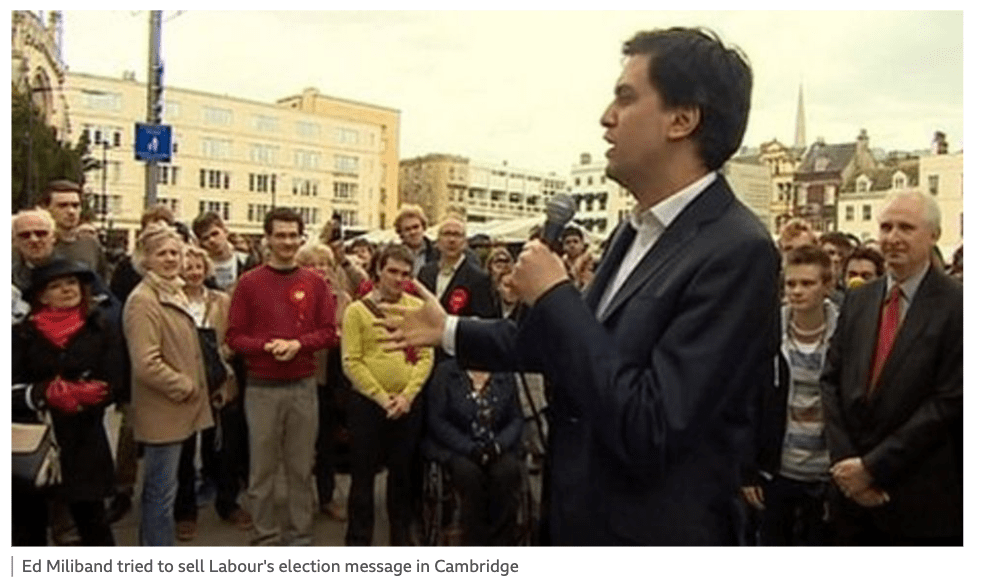
Above from BBC News in 2013 – I was standing somewhere behind a younger Daniel Zeichner – then Labour’s MP-candidate for Cambridge. Recognise any other younger faces?
When senior politicians – in particular a leader of the opposition is quoted in any print press publication, political advisers to ministers are watching like hawks. Communications units in those days had sections devoted to covering who said what, and providing press summaries to senior managers. Chances are Mr Miliband’s quotations will have gotten back to the Department for Transport via Downing Street by the end of that day, and a request for briefing on the Oxford-Cambridge line following soon after. What happened after that I can only speculate further. But that was my little bit in getting the ball rolling!
In the medium-longer term I can see Cambridge bring linked up to Luton – as others such as the Rail Enable Blog described in their 2019 article
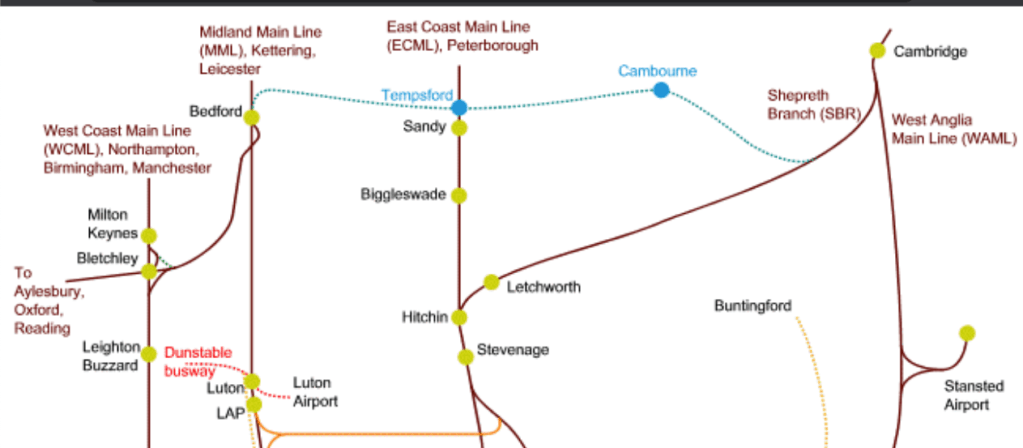
Above – from Rail Enable – note the chord to Luton Airport Parkway that joins the East Coast Main Line south of Stevenage at the northern end of the ‘Hertford Loop’.
Other options are available including a short link between Luton Airport Parkway to the GSK plant in Stevenage (which could be re-orientated to incorporate railway station – and thus a direct stop-to-stop link with the Cambridge Biomedical Campus)
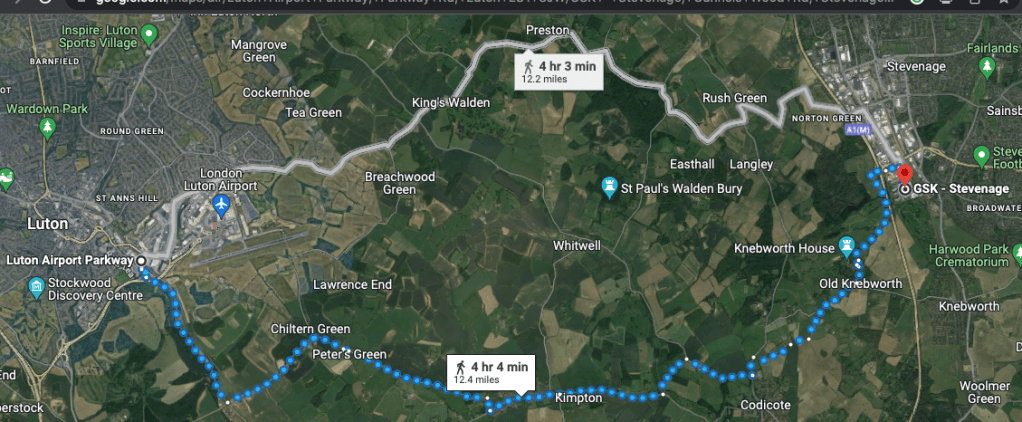
Above – from G-Maps here – Luton Airport Parkway to the GSK plant at Stevenage (a commuting landmark for anyone who as done the commute to London via Stevenage)
It was a serious consideration over a decade ago (see here – scroll to the foot of the post). When you consider the housing pressures and job vacancies in Cambridge (especially a technical/Level 3 grade), a 30 minute rail link to a nearby large town such as Luton (with its own commercial airport – providing competition with Stansted) means that Cambridge would not need an airport of its own. Furthermore, the levels of unemployment in Luton (“There are above average levels of unemployment and deprivation, with high levels of child poverty.” notes Luton Borough Council from the 2021 census) means that some of that unemployment could be relieved by a decent commuter line. But…
It can’t be all ‘take-take-take’ by Cambridge.
A regional strategy (I wrote about the last one here) must incorporate the wealth from Cambridge being properly shared out – even if it means taxing the excess profits and wealth generated in and around Cambridge and spending it in surrounding towns where commuters into Cambridge live. After all, their work is essential to Cambridge’s prosperity. It doesn’t seem fair for Cambridge to be seen to be keeping it all, or more realistically, having that wealth exported out of the city, region, and country.
Which brings me back to broken institutional and governance structures – and attempts by The Democracy Network to overhaul them.
See the Democracy Network’s latest publication here.
I’ll save it for a future post, but it’s a reminder that major infrastructure planning is complex. And when done badly (as often seems to be the case these days) people who start off supporting in principle end up becoming opposed – something that as we’ve seen with the GCP, is utterly avoidable. When will we learn and stop repeating past mistakes?
If you are interested in the longer term future of Cambridge, and on what happens at the local democracy meetings where decisions are made, feel free to:
- Follow me on Twitter
- Like my Facebook page
- Consider a small donation to help fund my continued research and reporting on local democracy in and around Cambridge.

 The Cambridge Town Owl