
The Director of Cambridge Science Park Ltd, Jane Hutchins, said it was “not right” that for all the wealth being generated by firms on the science park, King’s Hedges ward remains one of the most economically deprived parts of Cambridge and Cambridgeshire – in a city that is the most unequal in the country.
As part of the Cambridge Wide Open Day I got up especially early to go to a workshop hosted by Jane Hutchins of the Cambridge Science Park. A few weeks earlier I had emailed her about the possibility of a new swimming pool on the motor garage site on on the southern side of the guided busway opposite the Science Park – one that would serve both employees and guests of the science park and also residents of King’s Hedges, the students at the North Cambridge Academy & Cambridge Regional College, the nearby primary schools, and all of the villages along the guided busway for whom the St Ives Leisure Centre in St Ives is too far to get to.
Above – a vlogpost by me outside the Science Park busway stop that could serve a new swimming pool, and pictured is Cllr Clara Rackham, one of our civic heroes whose campaigning over half a century got Parkside Pool built in the 1960s.
While Ms Hutchins had a very successful science park to promote, she was refreshingly honest about its failings – and her sector’s failings in failing to deal with the huge inequalities within our city. Some of you will recall I was scathing in my comments about the University of Cambridge boasting about its impact on tourism when our city council cannot even afford to maintain a full time tourist information centre. I contrasted this with the approach from Cambridge Ahead’s Young Advisory Committee which took a much more positive approach on inequality in Cambridge. The signals from younger generations is clear: They won’t tolerate such extreme inequalities in our city. (Note Millennials are now in their late 30s – I’m in that generation between Generation X & Millennials who were in education (School/college/uni) as the internet was becoming mainstream).
Persistent ministerial failures to fund a new generation of town & transport planners in local government to meet a chronic shortage in the sector is now a risk to the economic success of Cambridge’s sub-regional economy
I’ll say it again.
“Persistent ministerial failures to fund a new generation of town & transport planners in local government to meet a chronic shortage in the sector is now a risk to the economic success of Cambridge’s sub-regional economy”
It’s very difficult for businesses to plan for the future if they do not have talented local development planning staff in local councils to negotiate with. It’s very difficult for local councils to recruit and hold into talented local planning staff while ministers insist in austerity budgets and maintain their ban on local councils from raising revenues from a much wider range of tax bases.
While some businesses benefit financially from this situation – whether the short term gains from land and property speculation to the provision of professional services to those in that market, it is bad for other businesses and the rest of the city if this means essential services cannot be provided. This could range from an ideal site for a regional lifelong learning facility close to a transport interchange, or a new site suitable for a transport interchange having luxury apartments built across it, thus preventing the construction of a light rail line or active travel route. Councils have neither the finances nor the legal powers to insist on what might be called sound urban planning. Letting the market rip might suit one group of businesses in the short term but it may do the opposite for businesses in another sector, and make things more difficult for the city and the sub-region generally.
“What is the role of the science park and its tenants?”
Part of it has to be asking what is right for the city as a whole, not just the short-term financial return for the land owners (mainly Trinity College). Given Ms Hutchins mentioned things like the health of the staff, inviting local residents to use the green spaces on the site, and working with neighbouring residents on how to improve significantly the benefits for what is one of Cambridge’s most economically impoverished areas, the positive feedback loop could be significant for the Science Park when it comes to filling the shortages in the technical level jobs it has.
Part of Cambridges emerging local plan – and also the lifelong learning strategy for the Combined Authority all include the various science parks as both potential providers of, and supporters of lifelong learning opportunities. This could be supporting the establishment of a new lifelong learning college – for example collectively providing match-funding for a central government grant. Alternatively it could be commissioning their expert staff to teach some evening classes or daytime workshops. And they must be more than just courses focused on work, as I wrote here.
Note that any new lifelong learning centre established in England must have the consent of the Secretary of State before going ahead.
For me this is an unnecessary level of bureaucracy given that previous generations did not need to go to ministers to ask permission. They just got on with it – in particular Dorothy Enright who went around town surveying the needs of employers nearly 100 years ago when she became the first woman to become a principal of a technical college in England.
“Why do ministers need to sign off such things?”
I have no idea. But I got the confirmation of it from Cambridge’s Member of Parliament Daniel Zeichner MP, who wrote to ministers on my behalf regarding lifelong learning. You can see the Minister’s response here. The minister who signed off that response – Gillian Keegan MP, is now the Education Secretary.
Hence there is an important lobbying function for Cambridge’s science & technology sectors
It is not about asking for more funding, but rather about demanding an overhaul of our governance structures. Being a city with a global brand run like a large market town means civic leaders cannot make the decisions that other municipalities in other countries can do. City councillors have to go to a junior minister who has to go to the Treasury to get approval. That’s no way to run a city like Cambridge.

Above – from Smarter Cambridge Transport. No way to run a city or a county.
As I’ve mentioned before, the 1969 proposals from Redcliffe-Maud’s Royal Commission for a unitary council alongside Lichfield’s observations from 1965 of the Cambridge Sub-region incorporating the local economies of surrounding market towns sit nicely with the proposals from Cambridge Connect Light Rail for a light rail line or three that pass underground through Cambridge’s city centre – thus potentially avoiding the protests at Coton and south east of Cambridge in recent years.


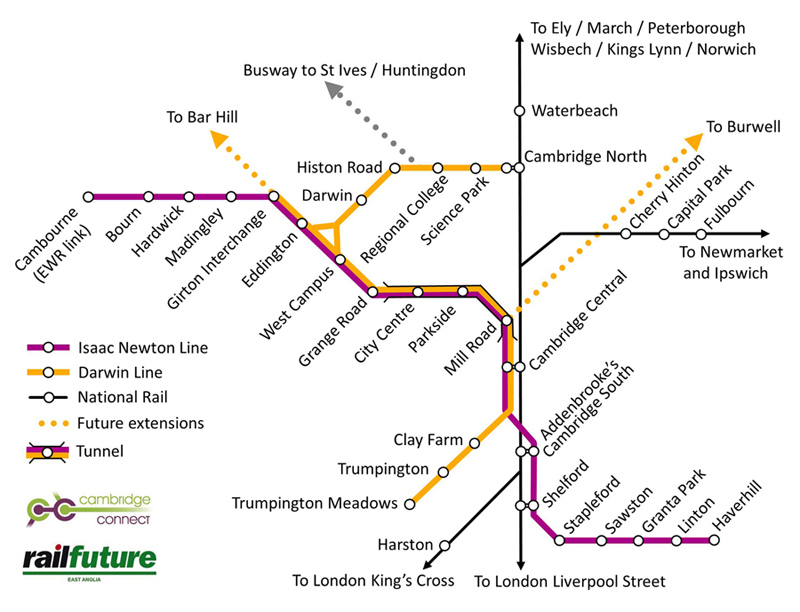
Any individual persons or firms interested in supporting a light rail for Cambridge and the surrounding towns & villages – Great Cambridge if you will, can join Rail Future East Anglia here. The campaign group has a regional meeting on Sat 17 June in Ipswich at 2pm – details here if you want to make the train journey. (It’s worth it just to pop over to see its magnificent town hall!)
In a nutshell?
It’s good to see some civic leadership from a business leader in Cambridge – let’s encourage more of them to follow Ms Hutchins’ example.
Food for thought?
If you are interested in the longer term future of Cambridge, and on what happens at the local democracy meetings where decisions are made, feel free to:
- Follow me on Twitter
- Like my Facebook page
- Consider a small donation to help fund my continued research and reporting on local democracy in and around Cambridge.

 The Cambridge Town Owl