
“The proposals meet the capacity studies with the design of the station proposed to meet the 2043 Central Case Demand Forecast (1.3% p. a.) of 2,364,236 yearly passengers.” says the application.
Prediction: It will be ***much more than that*** by 2043. Unless we’ve had a climate catastrophe and society has imploded.
Which could happen.
“How do things look with Cambridge North?”
“In 2021/2022, Cambridge North had 733,612 entries and exits, making it the 497th most used station in Great Britain.”
https://www.railwaydata.co.uk/stations/overview/?TLC=CMB
A figure that’s only going to get bigger when Brookgate complete their work in Cambridge North, which sadly they have chosen to work against rather than with the planning authorities by going straight to appeal to a planning inspector on what is inevitably a complex project as described in the Cambridge Independent. (See the documents here).

Above – from the design statement
If you go to the Greater Cambridge Planning Portal applications site at https://applications.greatercambridgeplanning.org/online-applications/search.do and type in 21/02957/COND17 into the search box, you should get a ***big list*** of documents, most of which are illustrated plans.

Above – 93 documents listed – which means a lot of scrolling and browsing if you’re interested in the details.
Scroll down long enough and you come to the Design and Compliance Statement (the row that I’ve put a blue tick in)

Above – same page but scrolled to the end.
The document looks like this…

…and has two pages per sheet of paper which means online it looks like 48 pages but in reality it’s double that. Unless you like reading small writing.

Above – from the contents
“Inclusive, collaborative, connected…sounds familiar”
They have “Community” too!

Above – part 8 on Community.
In someone’s mind they must be thinking: “We have considered the community opportunities and feel they get int he way of commercial opportunities so have designed them out.” Which sort of reflects what Brookgate did to Cambridge Station when it emerged from the ashes of Ashwell PLC. Will Cambridge South be a better development?
Actually, the document is an interesting case study of how designers have responded to concerns and feedback from local residential groups and city campaign groups such as CamCycle. As a member of the latter, what many people perhaps do not appreciate is how such groups campaign to improve the initial (and too often poor) designs of buildings and infrastructure (because costs are the biggest driver and commercial incentives mean all too often developers go with the cheapest they can lawfully get away with first before conceding on anything).
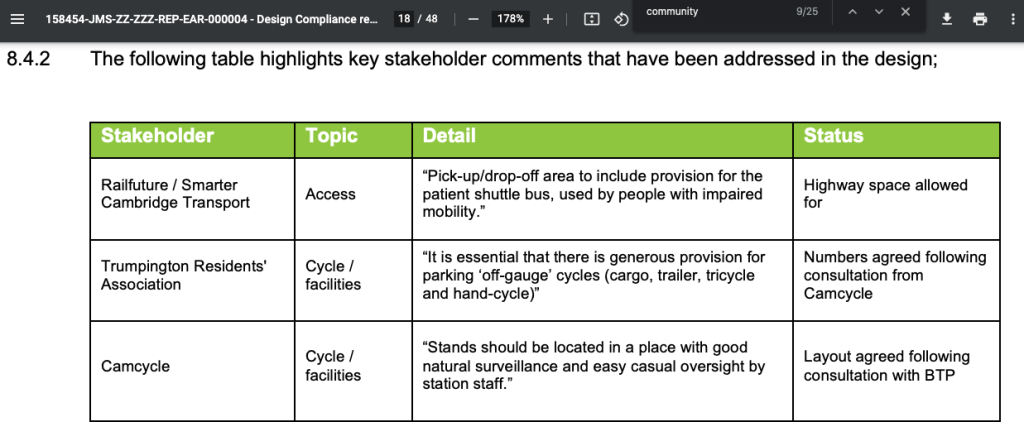
Above – p18 from the design statement – an example of why it is beneficial for communities to self-organise into campaign groups.
The challenge for local councils is how to make such self-organisation easier for people to do, and sustain in the longer term without the council feeling the need to micromanage things. (Austerity has often meant things have gone to the other extreme – the lack of a presence of local councils reflecting in my view a lower level of civic pride).
A new southern guided busway route built in – instead of light rail
You can see the reference to CSET on the diagram below.
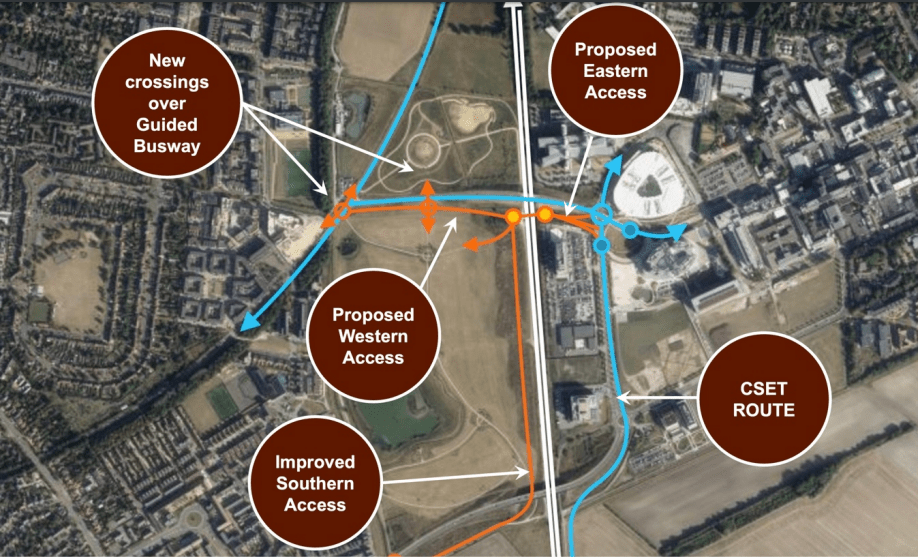
The plans stem from a consultation here where even the MP for South Cambridgeshire called for the proposal to be reconsidered, and to consider a rail or light rail option.
I think the exclusion of light rail is a missed opportunity because the concrete-railed busways for me a tried and failed system because:
- The costs of construction and maintenance of busways have ended up being far more expensive than predicted (after years of legal wrangling, the County Council and BAM Nuttall settled out of court recently
- As a concept, the busways are simply a road with restrictions on access
- Busways do not deal with the ‘last mile’ problem, getting snared up in motor traffic in the city centre like standard bus services do.
Hence my preference for a light rail that goes under Cambridge as proposed by Connect Cambridge for Cambourne-Cambridge-Addenbrooke’s-Haverhill

Above – I’ll keep going on about this until we get it in one form or another – from Cambridge Connect and Rail Future East.
Rail Future East meeting in Ipswich on Sat 17 July at 2pm
It’s at St Mary’s at Stoke, Stoke Street, Ipswich IP2 8BX. If you know anyone who commutes by rail and talks lots about travel issues, point them to this meeting (see details of meetings here).
I’ve never forgiven the Greater Cambridge Partnership for excluding Rail Haverhill – not surprisingly this influenced my decision to call for their abolition repeatedly, most recently at the ballot box. The history in part is set out in this old blogpost of mine. It highlights the Cambridge-Haverhill Corridor Study from Nov 2015.

My take? The entire technical study now needs reappraising in light of the Census 2021 and planning policy developments local and national.

Above- travel to work data using 2011 data. It’s now 2023.
Now compare the bus times. Stagecoach shows: 13-X13
From Haverhill Bus Station to Addenbrooke’s and Drummer Street
The service from 0730 gets in at 0818 to Addenbrooke’s – about 50 minutes assuming little traffic. From Haverhill Sainsbury’s to Addenbrooke’s takes 35 minutes.
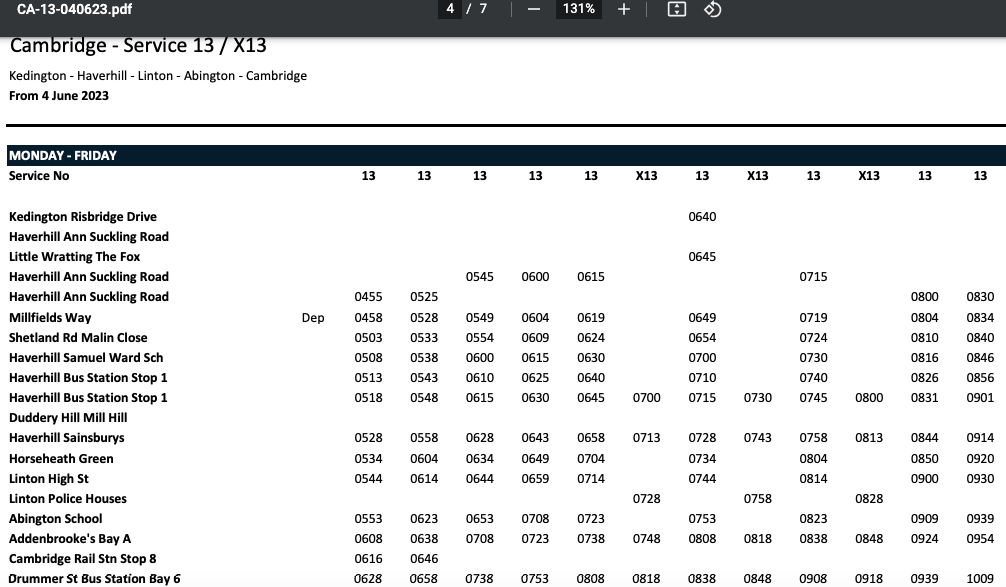
A Haverhill gateway station (effectively Haverhill Sainsbury’s) would take 25 minutes – but most importantly it would take a significant amount of road traffic off of the roads (freeing up road space for existing buses and traffic for whom light rail is not suitable), and enable faster connections onto Cambridge North (the Cambridge Science Park) and Cambridge Regional College, mindful that the range of vocational courses for teenagers living south-east of Cambridge are simply not available closer to where they live.

“Couldn’t a busway solve all of these problems?”
- Not when they hit Cambridge Station where they get stuck in traffic
- With no through-routes available, it does not help the hundreds of students needing a service from south east Cambridgeshire to Cambridge Regional College – something that an integrated light rail network would provide. (In Cambridge Connect’s case, switching from the Isaac Newton Line (Haverhill-Cambourne) to the Darwin Line (Trumpington – Cambridge Science Park – Cambridge North). In my own experience living/working/studying in cities with light rail, changing lines is much easier & more pleasant on a light rail system than a bus network.
Busways, light rail, active travel… …and e-scooters?”
There’s been a report out from UCL commissioned by VOI Technology, the firm that refuses. to put in docking stations in Cambridge. So I must moan to the Combined Authority again. This report is on emissions savings.
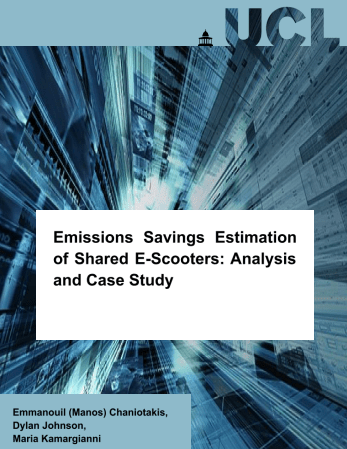
Above – you can read the report here
Jim Chisholm picked up on the issue of walking trips & cycling journeys replaced by e-scooters – which are disbenefits.
For those of you reading the report, it’s worth picking up on this point and following it through with the Combined Authority next time it meets.
“Even though their transport committee met earlier this week“
The public is only allowed one question and my allocation was used up on rail. (You can listen to the question & response here). My question relates to the study mentioned on p4 of Rail Future’s newsletter Feb 2023
Essentially I thought the study commissioned by Rail Future was excellent and wanted the CPCA to take it on themselves and make it much more widely available. How they will do this remains to be seen given the enthusiastic response to the work that Rail Future does.
How it will all work with the new Cambridge South Station…remains to be seen.
Food for thought?
If you are interested in the longer term future of Cambridge, and on what happens at the local democracy meetings where decisions are made, feel free to:
- Follow me on Twitter
- Like my Facebook page
- Consider a small donation to help fund my continued research and reporting on local democracy in and around Cambridge.

 The Cambridge Town Owl