
Following on from Reimagining Cambridgeshire run by Hilary Cox Condron and friends for the Cambridge Festival 2022, could we take the concept further using local history, maps, and displays to get people learning about how our city functions and how we might improve it for future generations?
As I mentioned in an earlier blogpost:
“Deadline for submissions – 07 July 2023 with the overarching theme being Creativity Unwrapped (although in reality you can pitch up almost any idea!)
See the full details of Open Cambridge here. If you have your own idea or proposal, get in touch with Open Cambridge’s organisers here.”
“What do we mean by “Cambridge”?
Always useful to be clear with definitions when doing big public policy things. In this case however, that’s a question to put to the participants. Are we talking gown or town? Or city? Or economic sub-region? Who decides?
Are we talking about (L-R below)
1) Cambridge City Council’s municipal boundaries from 1935? Or 2) perhaps the borough boundaries from 1913? Or 3) the proposed boundaries in 1969 of a new unitary council? Or (second row 4)) the Cambridge travel to work area? Or 5) the boundaries of the administrative Cambridgeshire – sometimes called “Cambridge County Council” 1889-1960s? Or 6) the Cambridge economic sub-region as Nathaniel Lichfield identified in 1965 (and with some amendments, John Parry Lewis in the early 1970s?)


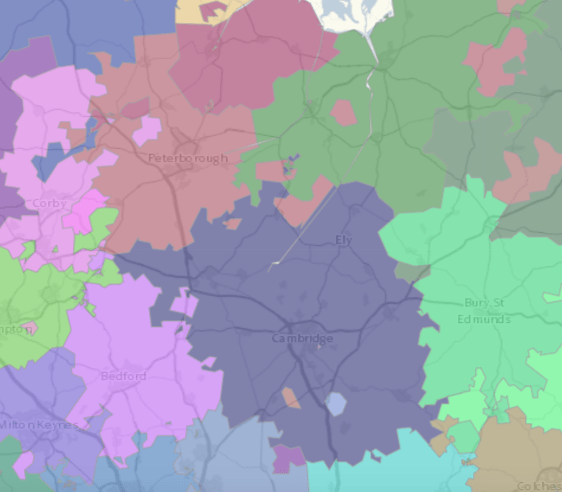
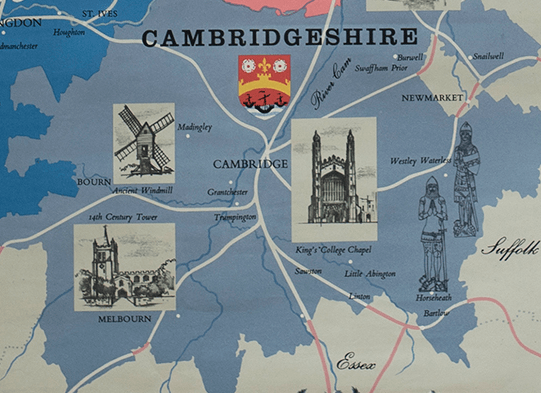

Or alternatively are we only talking about the University of Cambridge what what/who it and its member institutions own?
“How did we reimagine Cambridgeshire back in 2022?”
Something like this
I wrote about the event back in April 2022
Inevitably we don’t have the systems or structures in place to take these things further. This was something raised in numerous debates where the nature of annual funding cycles means that good ideas are hard to follow through because of the instability in local government public policy making in Westminster.
“What is this proposed event asking people to do? What are its objectives?”
Aims:
- To get people to understand that local government boundaries, structures and systems are not permanent – i.e. they have been changed significantly in the past and will change again in the future
- That change is not inevitable – it requires people to make those changes (and in doing so, by trying out different actions, tactics, and strategies rather than repeating the same thing over and over again and not learning from each attempt)
- To inspire people to talk to each other with the maps and displays as discussion points, encouraging multiple conversations and ultimately a commitment from each participant to commit to taking one small one off action or behaviour change as a result of participating.
At its most basic would be a large room full of displays of maps, with tables in the middle and somewhere for people to write their observations and thoughts on post-it-notes to be put up on a board somewhere.
At the other end, you could have a hall full of displays and stalls containing stands from each of the main public service providers who are there to explain what they do, and take questions from the public. The public can then join volunteer-facilitated groups to discuss what they’ve learnt about how each public service area functions, and discuss how they would improve it, writing up their proposals. Furthermore, participants could be pointed in the direction of existing scheduled public meetings and invited to table a public question to a local institution of their choice on the back of what they have learnt.
“And for more creative types who want to do more drawing and less talking?”
Have similar to what Hilary Cox Condron and friends had but have it more 2-Dimensional with maps and diagrams for people to redraw things like city and county boundaries, or new cycleway routes, light rail routes, bus lines and so on.
An opportunity to show what past and present proposals look like
Part of this involves making people aware of what has been proposed before (such as John Parry Lewis’s abandoned proposals for Cambridge in the early 1970s that would have increased Cambridge’s population to 200,000 by the Millennium) to the most recent set of sites proposed by landowners and developers.
Below: from the set of proposals from developers on sites submitted to Greater Cambridge Planning Service for the emerging local plan 2031-40, from which planners have to pick which ones to accept and put them to a planning inspector to assess and decide

Above – from the Greater Cambridge Planning Service
Below – when you look at the proposals for South Cambridgeshire from land owners and developers, you can see that if they were allowed to build on all of the sites submitted, there would be two very large ‘newtowns’ either side of Cambridge. One that is likely to become a conurbation of all of the developments in and around Cambourne following the East West Rail announcement is all-but-certain. Long-established proposals at Six-Mile Bottom east of Fulbourn have long been resisted by local council planners and councillors.
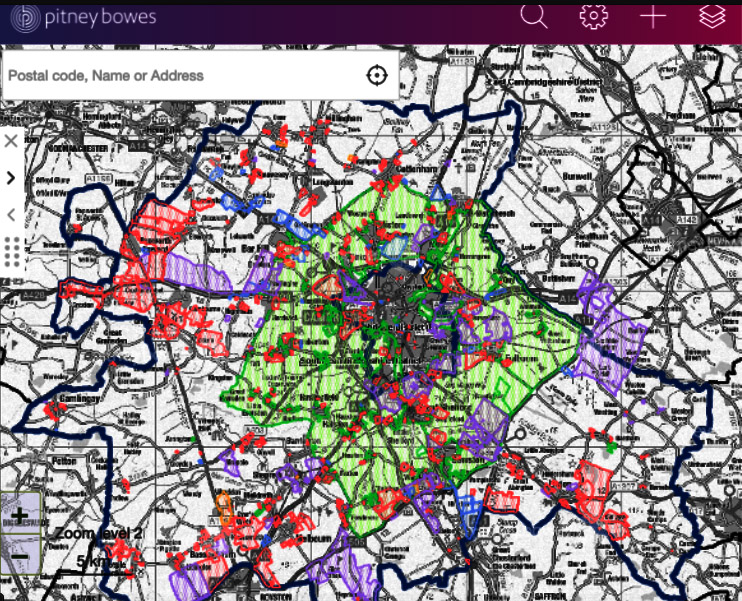
Above – from the Greater Cambridge Planning Service
Encouraging people to think/talk about the infrastructure needed to underpin new communities
This for me includes asking if it is possible to have such economic growth without an increase in the volume of resources that we consume. Some of this will involve all things Doughnut Economics – we have a Cambridge Group. Some of you may also be familiar with the concept of the circular economy.
This is also a chance for people to raise the issue of our lack of water infrastructure – noting the broken timeline between when the new local plan 2031 starts to when the Chatteris Reservoir will be onstream. Furthermore, without the increase in waste water processing – whether through greywater recycling at large building or neighbourhood level, through to district and regional infrastructure, we run the risk of repeating the crisis of the 1970s when all large building projects were put on hold for several years until the Milton Works were upgraded. Broug

Above – from the British Newspaper Archive. Could history repeat itself?
“Could Open Cambridge point people towards visiting the Waste Management Plant at Waterbeach as part of their programme?”
Could do – whether as scheduled events or simply pointing people to organise their own visits. In early 2016 I went on one such visit – and made a video of it too.
Above – at the Waterbeach Waste Management Plant
The stench of the place was enough to get me consuming less and recycling more!
“Whose Cambridge?”
A surprisingly large number of adults are disenfranchised and effectively excluded from taking part in civic and democratic life of our city simply because of nationality – even though they live here, work here, pay their taxes and contribute to. the life of our city. Or perhaps this should not be a surprise given the much more international outlook Cambridge University has, alongside the research bubble that has grown up alongside it with experts from all over the world living and working here – and being a net financial contributor to HM Treasury.
“No taxation without representation”?
We’re more than familiar with that slogan. How do we make it more than that? Hence there’s a conversation to be had about the rights for migrant workers which the Migrants Democracy Project campaigns on. This could be an additional event that Open Cambridge could have as part of their programme – noting that in 2020 Scotland changed its voting laws in local and Scottish Parliament elections to one of residence-based voting. What are the experiences of, lessons from that policy change that the rest of the UK can learn from? Furthermore Scotland brought in votes at 16 too.
“This report examines how different cohorts of young people aged between 16 to 31 years engage in politics. The analysis distinguishes those who were first enfranchised at age 16 or 17 from those who were aged 18 years or older when they were allowed to vote for the first time.”
Votes at 16 in Scotland – Eichorn & Huebner, University of Edinburgh
Above – you can read the report by Jan Eichhorn and Christine Hübner on Scotland’s experience and their recommendations for the rest of the UK.
So it’s not just lines on a map that we could redraw.
Food for thought?
If you are interested in the longer term future of Cambridge, and on what happens at the local democracy meetings where decisions are made, feel free to:
- Follow me on Twitter
- Like my Facebook page
- Consider a small subscription to help fund my continued research and reporting on local democracy in and around Cambridge.

 The Cambridge Town Owl