
Cambridge Matters – the city council’s quarterly magazine has arrived. Yet it is limited by the artificial silos that ministers have placed around local public service providers so cannot provide the ‘state of our city’ report that might be more useful to residents.

Above – you can read the digital version here.
It’s not a huge expensive glossy-and-glamorous magazine, nor is it a detailed academic journal. If anything it’s written for an audience more familiar with real life stories magazines than the readers of Municipal Journal Magazine.
There’s no right or wrong answer to the question of whether (and if so how) to change or improve the publication without having piloted those changes and gotten feedback from target audiences.
The publication’s purpose:
“Cambridge Matters is our magazine for residents – it’s packed with the latest information about council services.”
https://www.cambridge.gov.uk/cambridge-matters-magazine
It would be nice to have digital copies linked to the above page from previous editions. It doesn’t need to be a massive archive (although local historians might find that useful should the time and resources be available to do that – even if uploaded to the Internet Archive)
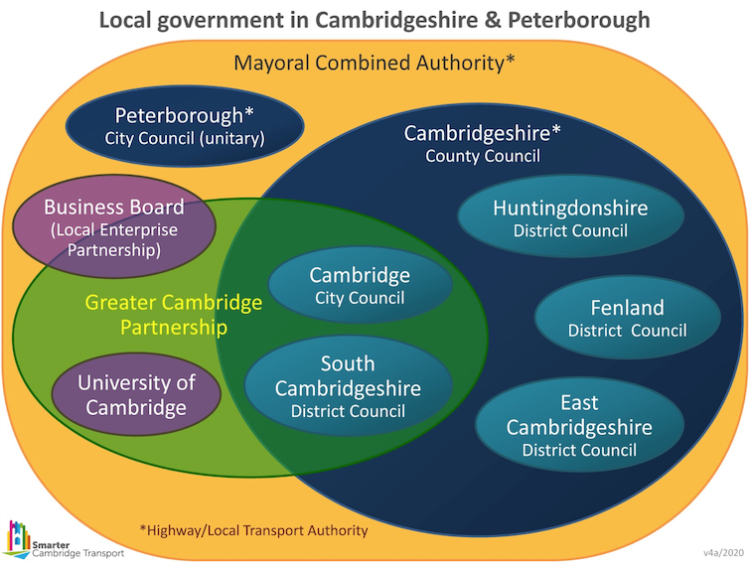
Primarily it is about information on services provided by Cambridge City Council. Note that South Cambridgeshire District Council has a residents’ magazine here, but I don’t think Cambridgeshire County Council has one – county issues popping up within both the city and district publications.
From whose viewpoint should such publications be written from?
- The institution?
- The service user?
- The community defined geographically?
- Something else?
“Don’t neighbourhood newsletters exist for such things?”
Yes – although without long term funding to keep things going, the quality can depend upon the skills and the drive of a handful of individuals, the loss of whom can result in a publication’s demise. Abbey Ward is an interesting case study – and potential local history project for any teenager heading off to college this September: What do the newsletters of Abbey Ward tell us about its past, present, and future?
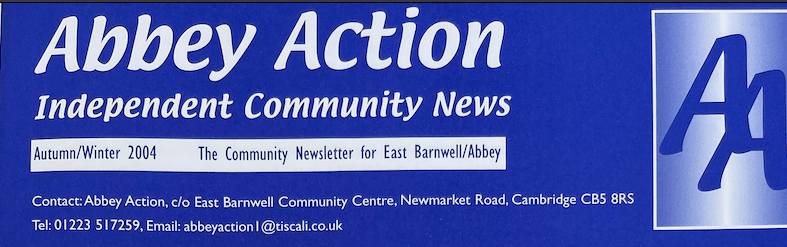
Above – Abbey Action from nearly 20 years ago, courtesy of Abbey People (who have all of the others covering about a quarter of a century). Have a browse of this from late 2004.
It didn’t always used to be like this – in the interwar era everyone and everything was thrown in
The Cambridge Blue Book Directory from the late 1930s – I got an old copy online and digitised the municipal and social guides

Above – snapshot of the Cambridge Blue Book 1937.
Sadly it seemed to have ceased publishing after War broke out. Again.
“They may have been scoundrels but at least you knew who was responsible for what!

Above – some of you may recognise the surnames of some civic titans in that list, including Cambridge’s first Woman Mayor Eva Hartree, her counterpart from the Women’s Citizens’ Association the Housing giant Dorothy Stevenson, Labour’s first woman councillor Clara Rackham, and the party’s only ever MP for Cambridgeshire, Albert Stubbs.
Note the heads of function too:
- Town Clerk
- Surveyor
- Finance chief
- Medical officer
- Education officer
- Chief Constable
- Librarian
- Sanitation inspector
- Building inspector
- Highways inspector
- …and many, many more.
You get the sense that this was the guide that listed the people who ran the city on a day-to-day basis.
Today? As one local business owner told me recently, the renting out of the guildhall in the face of austerity represents the decline of both civic pride in Cambridge and also of the importance of local and municipal governance as far as ministers and the University of Cambridge are concerned. (Otherwise they’d have done something constructive about it and they have not).
What would a residents’ guide to Cambridge look like today?
(Mindful of the destabilised population on the back of changing employment patterns set down by employers – in particular fixed term research contracts).
This is something worth thinking about given the international profile of our city – and the number of residents who are excluded from democratic life because of the country of their passport. Hence the Migrant Democracy Project.
“Must know, want to know, would like to know”
During my civil service days I was trained up to brief ministers by sifting information using the above categories. “Imagine you have 30 seconds with the minister before they are about to go into a bear pit that they have not prepared for because something has hit and they are going to get grilled on it. And you are the person who knows the most about the issue.”
It’s a bit like that, but when thinking about a reference book what would you include in the essentials bit?
It’s like the early websites for universities where what their senior executives wanted on their landing pages was not reflected in what users were putting into their search engines. Most often it was a map of the physical site they were about to visit, and not the musings of the Vice Chancellor, or the visit from a junior minister and former student.
“What do we need to know?”
From a day-to-day perspective, normally it is because something has broken and needs repairing or sorting out. Potholes, buses, street lamps, blocked drains, uncollected bins, any councillor who gets out and about in their communities will give you chapter and verse on not messing up the basics. It doesn’t matter how strong your political principles are, if you mess up when you are in party political control you’ll get an ear bashing!
The fragmentation of our public services also means that essential health and education services are now outside of the remit of local government. Think:
- Doctors’ surgeries/general practitioners
- Dentists (especially given the chronic shortage which is a major public policy failure)
- Schools and further education – and lifelong learning too
- Privatised public transport – we don’t have a single organisation responsible in the way London has TfL – despite repeated calls for this by cities across the country. Again a major public policy failure.
From a more longer term ‘how to improve our city’ perspective, one of the more prominent complaints heard is consultation overload. And that’s just the GCP consultations! See Cllr Sam Davies MBE (Ind – Queen Edith’s) on Cambridge City Council here – mindful that local residents across the political spectrum see her as one of the most informed and engaged of councillors in the city. (She polled the most votes for any candidate in Cambridge (not just Queen Edith’s) in the 2021 local elections that saw her elected). She’s up for re-election next year.
Hence I come back to our broken system of local governance – one that does not integrate health services into local government even though the latter has a massive role to play in preventative measures to reduce demand on hard-pressed general practices and hospitals. Furthermore, most people don’t know about:
- Healthwatch Cambridgeshire
- Membership of Addenbrooke’s / Cambridge University Hospitals NHS Trust
- Membership of Cambs & P’boro Foundation Trust (covers mental health)
- Cambridgeshire Magistrates
- Cambridgeshire School Governors
You don’t have to be party political to get involved in finding out about how our city is run, or getting involved in scrutinising how those public services are delivered.
The problem is we don’t publicise this or educate the people who make up our city on how to get involved. Hence why I take the view that Cambridge is malfunctioning as a city – performing nowhere near to its potential (even though some people and institutions are making *a lot of money* from that malfunctioning. Just ask anyone who has sold a development site having just secured planning permission for it).
“It’s not like a publication will solve everything – or even anything anyway”
Exactly. Therefore we also have to think what else needs. togo with it in terms of actions. Individual and collective.
Food for thought?
If you are interested in the longer term future of Cambridge, and on what happens at the local democracy meetings where decisions are made, feel free to:
- Follow me on Twitter
- Like my Facebook page
- Consider a small subscription to help fund my continued research and reporting on local democracy in and around Cambridge.
 The Cambridge Town Owl