At the Academy of Urbanism’s Congress 2023 in Cambridge I was glad that international delegates I spoke to were able to comment on the governance structures of the City of Cambridge – which I’ve described as a city with a globally-recognised name that is run like a market town.
I should say Thank you to Shane, Jas, and Connie, along with Cllr Sam Davies MBE (Ind -Queen Edith’s) for facilitating my attendance at the event both as a local historian and as a community voice. I won’t pretend to be a representative of anyone as I don’t hold elected public office. (Although 261 people in Queen Edith’s ward indicated at this year’s city council elections that they agreed with my point that Cambridge needs a major governance overhaul).
Professionals and academics from all over the world were there and given the range of internal governance structures and political cultures that they grew up in and live/work in, I asked them what they thought about the political governance structure of Cambridge and Cambridgeshire, using the Smarter Cambridge Transport diagram to illustrate the point.
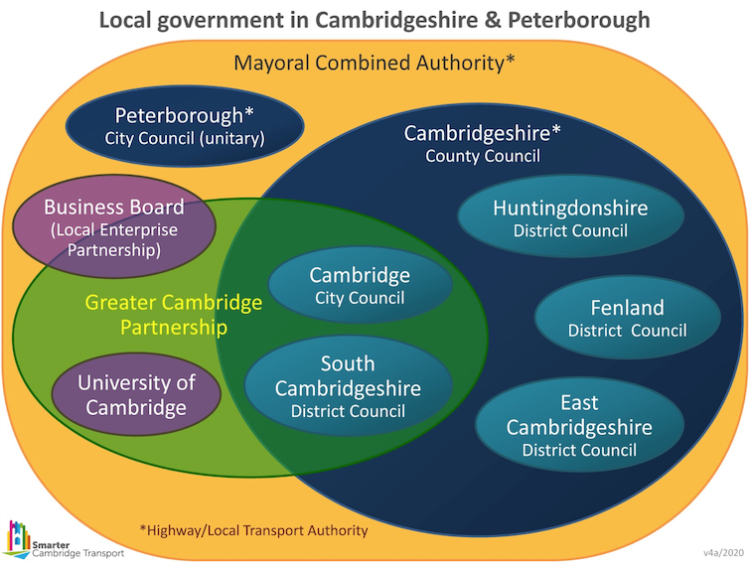
Above – from Smarter Cambridge Transport
I produced a A4 single sheet folded into a pamphlet to hand out to anyone interested that summarised this, some historical proposals from the 1960s, and Cambridge Connect Light Rail’s proposals, with some statements and questions on what suggestions they might have to improve how Cambridge is governed.
Comments from citizens, academics, and local government officers of countries as near as the Republic of Ireland to as far away as the USA and China were (anecdotally at least) united in their criticism of the model put in place by David Cameron and George Osborne when they were Prime Minister and Chancellor. The first – the Greater Cambridge Partnership was the result of negotiations during the Coalition Government 2010-15, during which Cambridge for the most part was a Liberal-Democrat-led council with an MP from the same party (Dr Julian Huppert) representing the city in Parliament (2010-15). Their party was the junior partner in that Coalition, for which history tells us they paid a very heavy electoral price, one that they are only just beginning to recover from. The Combined Authority was signed off by ministers in 2016. Both the creation of the GCP and Combined Authority were announced by Chancellor George Osborne in his budgets of 2014 and 2016 respectively.
How do municipalities/towns/cities maintain democratic accountability of its governance functions when a single very large institution outside of its direct control dominates the the local economy – and local society?
I was today years old when I found out that the Dutch City of Eindhoven was dominated by the multinational Philips – and that their local footballing team that the late Sir Bobby Robson retired from the England job in that hot summer of 1990 to join, was named after the firm: Philips Sporting Vereniging – AKA PSV Eindhoven.
And as a local history aside…
This is the same firm that bought out and broke up the former Cambridge-based electronics giant PYE of Cambridge – whose exhibitions you can see at the Cambridge Museum of Technology, as well as online via The PYE Story. To give you an idea just how big the firm was, during WWII the PYE factories had their own Home Guard units of the 5th Battalion the Cambridgeshire Regiment.

Above – from Hyperion Auctions – an image of the PYE Company of the Cambridgeshire Home Guard.
Cambridge – being on the GHQ line was a designated ‘defended place’ and in the event of an invasion was expected to be defended to the last man.
Cambridge’s industrial past is still within living memory of our older residents
And we forget our local history at our peril lest we end up making the same mistakes of previous generations. Hence making enough noise about it via my Lost Cambridge project that as the Mayor of Cambridge for 2023/24, Cllr Jenny Wood stated last night, the proposed new housing development in North East Cambridge is, following a public consultation, being named after our first woman mayor of Cambridge, Eva Hartree, elected in 1924 by fellow councillors. Hence reminding their representatives of this and inviting them to consider how they wanted to commemorate Eva Hartree’s centenary – mindful that as a former Girton student there is an opportunity for a town-gown tie-up.
Which brings me back to the University of Cambridge and the influence it has on the future of our city.
My big learning point from the Congress was that there is no competent institutional structure or system to enable town, gown, and now villages to cross-examine senior decision-makers of both the colleges and the University. As I mentioned previously here, most residents that have nothing to do with the University of Cambridge in their day-to-day lives just see ‘The University’ rather than a complicated collective of separate institutions with their own royal charters, and a long and controversial history not just with the town from which it takes its name, but as recent revelations about the slave trade have exposed, the rest of the world too. In my part of town where I once delivered newspapers in the early 1990s we have Rustat Road.
One of the reasons local democratic accountability has become so controversial locally is because the complicated structures imposed on Cambridge in the 2010s have made it difficult for the public to identify clear lines of political accountability.
In the current national political climate, these issues have only been amplified. It has gone beyond the political cliche of ‘letting the public have their say’ (and then completely ignoring what they said) and moving towards a system where people are informed about how things work and can influence the eventual outcomes when everything is at design stage.
As mentioned, the University of Cambridge is represented on the senior decision-making bodies of both the Greater Cambridge Partnership and the Combined Authority. (Some of you older residents may remember over 50 years ago the University of Cambridge had its own councillors sitting on Cambridge City Council).
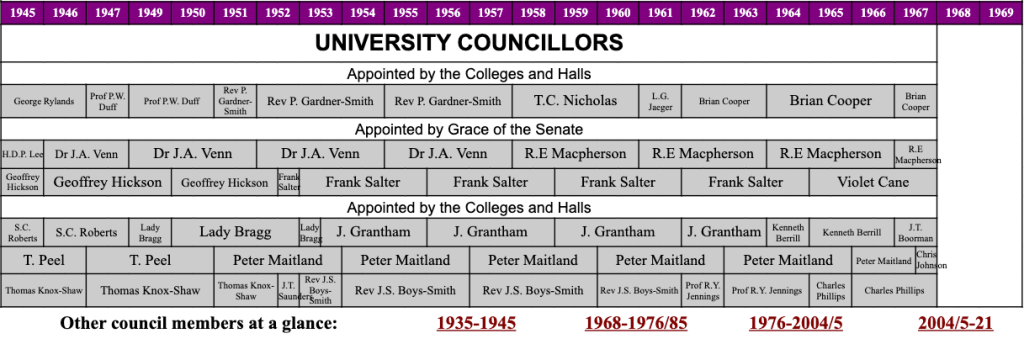
Above – from Messrs Edkins and Rosenstiel
Former Mayor Alice Bragg was co-opted as an Independent councillor in Trumpington ward before being elected in Newnham ward in 1945. When she stood down in 1947 it looks like the colleges got together and put her back on the city council. But with Lady Bragg we got very lucky because she was very highly regarded as an organiser and administrator in wartime Cambridge in what has and remains an under-researched part of our local history: The women who made our modern city. We also got lucky with Peter Maitland who joined the Cambridge Housing Society in 1929, later becoming a University Councillor on Cambridge City Council after WWII. Note also the son of Venn diagram inventor Dr Venn.
While the influence and work of individual Cambridge University graduates and figures were critical to the modernisation of our city, that’s not the same has institutional accountability to the people affected by the decisions of said institution.
Today’s local councillors on Cambridge City and Cambridgeshire County Councils include a number of senior academics – and their speeches and interventions at council meetings has been a noticeable step up compared to some of their predecessors – in particular on the county council where a decade ago the Conservatives were only able to pass their county budget proposals because of support from a dozen UKIP councillors elected in the north of the county – massively Brexit-voting territory mirroring the opposite in Cambridge which supported Remain by a similar margin. Just as local politicians have (rightly) asked why councillors in North Cambridgeshire should have a vote on car parking policies, residents in North Cambridgeshire may well ask why the University of Cambridge gets to have a seat at the table of an institution that affects transport policies amongst other things on the Combined Authority. How can residents living in North Cambridgeshire scrutinise an institution that is based ages away in Huntingdon? (Mindful of the economic deprivation in Fenland combined with very poor public transport infrastructure).
Therefore the issue goes beyond a grumpy middle-ages townie like me complaining about the lack of a new large concert hall, new large swimming pool, new light rail and all of the other things on my civic wishlist for my home town.
Actually I don’t know what the comprehensive answer is
I’d be more than happy to see a new workstream commissioned to explore how large institutions outside of democratically accountable institutions of state (central and local government) can be held accountable for their decisions that affect the lives of the people on their doorstep. (Note this is very separate to academic and intellectual freedoms which is making some noise in the print press). This is something that Involve UK could be commissioned to help facilitate – perhaps with the involvement of interested parties of both town and gown. It’s not as if Cambridge is short of academic researchers exploring how to improve democratic structures and processes. After all, I’m acquainted with some of them!
How is it then, that a city with a university that can attract some of the best academics and researchers in the world – and students with some of the greatest potential too, is unable to solve some of the problems which in part are of its own making: the housing and transport crises in and around Cambridge. Because if the University of Cambridge *and* its colleges helped create the problems, then surely their members can challenge their own institutions to become part of the solutions.
Just as the University of Cambridge and its colleges were driven to make significant changes by generations of brave, pioneering and passionate individuals in the centuries gone by – from the removal the religious qualifications, the growth of the sciences at Cambridge (for which Prince Albert had a significant influence on), the removal of the marriage ban on fellows, the removal of the ban on women graduating, to the removal of the ban on women at the previously all-male colleges (The last to fall was in the 1980s), is the University of Cambridge and its colleges ripe for a new era of reform?
There are more than a few student campaigners out there campaigning for it.
What can the rest of the city do to support them?
Food for thought?
- Follow me on Twitter
- Like my Facebook page
- Consider a small subscription or donation to help fund my continued research and reporting on local democracy in and around Cambridge.

 The Cambridge Town Owl