Papers from the Combined Authority show our county needs to ramp up our retraining and re-skilling efforts to deal with what sounds like existing jobs and careers becoming obsolete. Having lived through that transition in the late 1990s, the costs of retraining cannot and should not be left to employees and those unemployed, underemployed, or in jobs where the is a skills mismatch
The papers for the Employment and Skills Committee are here. If you want to ask a question of the Combined Authority, see here. The figure I’m quoting above is cited in the CPCA’s Employment and Skills Strategy 2022.
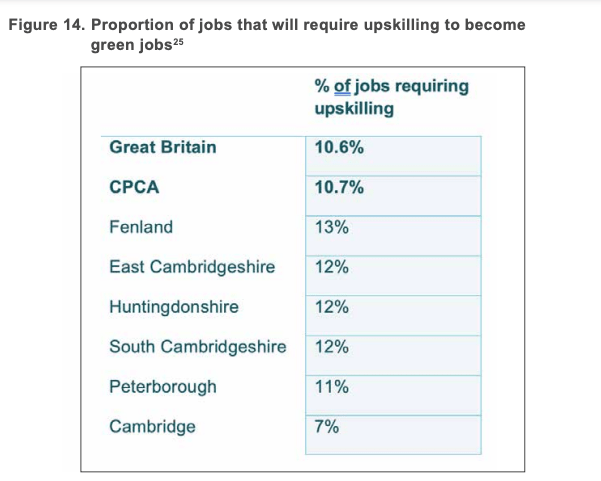
Those figures were obtained from the Place-based climate action network at the University. of Leeds.
There are more interesting figures from the Office for National Statistics on economic inactivity which may indicate why thrashing the whip at those seen as unemployed may not be the best solution when dealing with macro-economic policy-making.
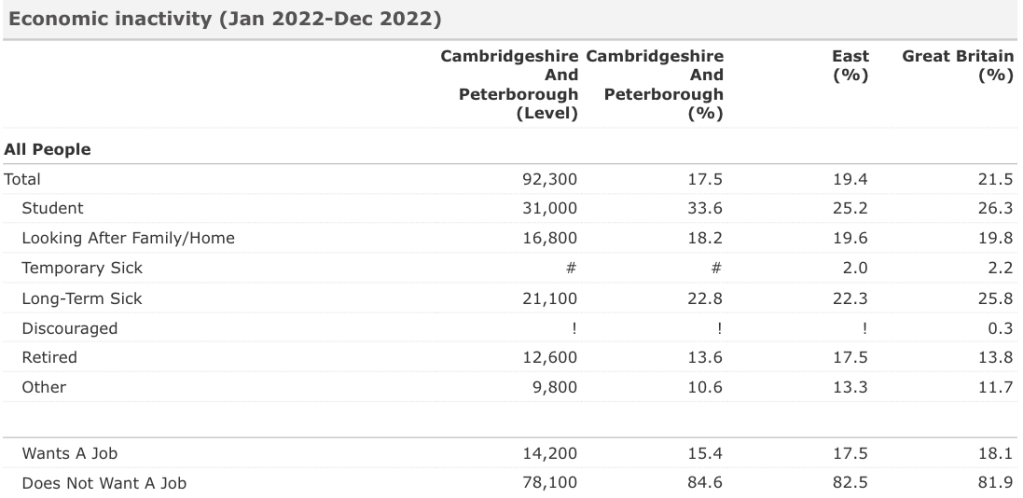
Out of the 14,200 people who want a job but not classed as unemployed*, what research has been done on those of us (myself included) still have something to contribute, but can’t really do so because of chronic illness? For example my local history research on Cambridge’s first woman mayor Eva Hartree influenced the naming and branding of the proposed new large mixed development in North East Cambridge. But there is no mechanism for that sort of work or research to be remunerated. (At that time I was effectively self-funding from an inheritance from my late grandparents – but it was never going to last forever).
*Note the ONS states: “People not in employment who want a job but are not classed as unemployed because they have either not sought work in the last four weeks or are not available to start work.”
One of the reasons why I’m persistent in asking questions about lifelong learning is a soul-destroyingly brutal one: It’s one of the few opportunities left that I have of a meaningful life for the remainder of my years. And as things stand, our city and county have neither the funds nor the facilities to enable me to do that. I don’t see it from a ‘Woe is me!’ perspective – rather that if someone like me who is fairly well connected in politics and public policy is not being well served by the present system, how many more are also being failed by it? Perhaps even more so than me?
“Who is responsible for lifelong learning again?”
The Combined Authority – but you may have missed the announcement from ministers.
“Devolution of the Adult Education Budget (AEB) from 1st August 2019 has enabled the Cambridgeshire & Peterborough Combined Authority to take responsibility for delivering high quality Adult Education in the local area…This means we can decide locally how we spend and use the £11.9m budget that we get every year to improve opportunities and life chances of residents.”
CPCA Adult education budget
“£11.9million split between 850,000 people is not a lot!”
Not a lot, yes – but it’s more targeted than spread equally over the 850,000 people because subtract the number of children in that figure and the number of people eligible for activities funded by that budget starts falling – thus increasing the per-head spend.
We need to learn from Dorothy Enright’s record from a hundred years ago.
Dorothy Enright is one of Cambridge’s forgotten heroes. Without her, there would be no Anglia Ruskin University. I wrote about her here in Lost Cambridge.

Above: Legend. Dorothy Enright, the first woman to become the principal of a technical college in England when she was appointed to the post by the old Cambridgeshire County Council. (The same county council that appointed Brinley Newton John as Headmaster of the Cambridge County High School for Boys – hence the late Dame Olivia being a daughter of our city too).
What Ms Enright did was to go around the town surveying the training needs of every major employer and then create a syllabus that matched their needs, while at the same time creating one that also catered for wider interests. She died before her time, but you can get a sense of the curriculum she inspired (and the firms that made use of it) in the course prospectus I bought that dates from the mid 1950s.
Central government policies on public transport have been letting down students young and old for decades – with poor transport links restricting the options that learners have.
It was something I didn’t really appreciate in the 1990s because what you don’t know exists you don’t yearn for. Yet listening to several teenagers over the past week (including today as well) telling me about how messed up everything is for them both locally and on their courses, the picture is becoming more clear.
“Areas outside the UK’s major cities suffer from a shortfall of skills, leaving them less equipped to deliver on their potential. In order for that to change, these areas must demonstrate that they offer young people a practical and attractive pathway from education, to acquiring skills, and building a career.”
Keith Osborne for Showhouse, 27 Apr 2022
Consider the above, and consider Cambridge’s large sixth form colleges in South Cambridge. Now consider what an integrated suburban or light rail network connecting Cambridge with its surrounding market towns might be like – again using Nathaniel Lichfield’s diagram from 1966 to illustrate the point.

Chances are you will find teenagers commuting huge distances to get to the colleges – and to Cambridge Regional College too. The challenge for the Combined Authority not just in southern Cambridgeshire as depicted here, but in northern Cambridge around Peterborough, is to make fast, reliable, and cheap public transport provision to enable those in smaller towns access the courses not provided for where they live. Furthermore, there’s an opportunity for new and/or upgraded stops to have lifelong learning centres and or their own further education colleges built close by so that transport access is widened to people living in nearby villages.
Getting the science parks to pay their fair share towards new learning facilities and the courses that come with them
I seem to have met a number of science park people in recent days and have made the point to them repeatedly that local councils do not have the revenue-raising powers to tax the wealth generated in and around Cambridge to pay for the desperately-needed learning facilities and the course/teaching costs to enable adults to retrain in the fields that firms and employers (especially the public sector) that need filling. I made this case today at the consultation for the science park proposals off Coldham’s Lane at the Cherry Hinton end. In fact I spent an hour there having really intense conversations with the developer’s consultants trying to persuade them to lobby the Combined Authority and ministers to get moving on the Cambridge-Newmarket rail line upgrade – and offer to match-fund some of the costs of feasibility studies to get the whole thing progressing faster.
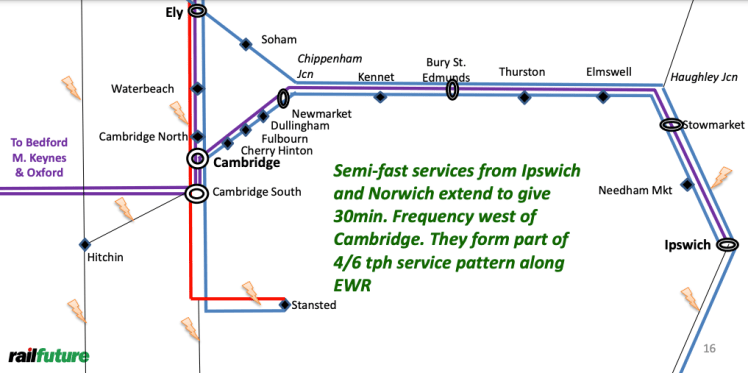
Above – from Rail Future. ***Upgrade the line!!!*** As if to underline the point, I also made a video too!
Above – me trying to persuade anyone who will listen that upgrading the Cambridge-Newmarket rail line, and building a series of heavy or light rail stops for where three new proposed science parks are being suggested for might be a good idea.
My point remains that building decent learning facilities close to busier public transport hubs and stops needs to be incorporated into masterplanning. This goes for all of the science parks current and proposed. Make it easier for the learners to get to and from the site because there will be a greater total number of people needing easy access than for a private building not accessible to the public.
Not everything needs to be in Cambridge – and our city may not be the most suitable location for training for some of the essential jobs and careers
I was going to say no one would set up a mountain climbing school in North Cambridge on. the edge of the Fens, but I need a better example than that.
Anyway, if you have Qs & concerns about lifelong learning in Cambridgeshire, have a browse of the papers here, and then submit your public question here. You don’t have to be there in person to ask it – you can ask an officer to read it out for you on your behalf like I do (because chronic illness means I cannot get to Huntingdon and back easily). Again, I blame the Conservatives for 1) creating the institutions and 2) locating the institutions in a place that I cannot get to. Which in part explains why am calling for the abolition of the Combined Authority and the Greater Cambridge Partnership.
The difference between what I’ve been writing about in this post vs my very *Political position* on the existence of the institutions is this. One is engaging with the institutions as they are and as they have been constituted – i.e. working within the system as is. The second is making the Political point about changing the system – one that I view to be utterly broken and dysfunctional. The approach to take to try and get the best from either of them are not the same.
Food for thought?
- Follow me on Twitter
- Like my Facebook page
- Consider a small subscription or donation to help fund my continued research and reporting on local democracy in and around Cambridge.

 The Cambridge Town Owl