
The co-founder of the Government Digital Service from one of my previous lifetimes wrote a list of twelve principles back in 2018. While Mr Loosemore has invited readers to suggest updates – but for Cambridge, we’d do well to implement his first set of proposals!
Tom Loosemore posted this:
You can read Mr Loosemore’s article here
I’ve pulled out and tweaked/localised the headlines from the above-linked post.
- Design for citizens’ needs, not organisational convenience
- Test your riskiest assumptions with actual users
- The unit of delivery is the empowered, multidisciplinary team
- Do the hard work to make things simple
- Staying secure means building for resilience
- Recognise the duty of care you have to citizens, and to the data you hold about them
- Start small and optimise for iteration. Iterate, increment and repeat
- Make things open; it makes things better
- Fund teams, not projects [think the Queen Edith’s pavilion that has no team to run it post-construction]
- Display a bias towards small pieces of technology, loosely joined [Compare this with the CAM Metro]
- Treat data as infrastructure
- Digital is not just the online channel [think of the multiple organisations and websites reflecting the fragmentation of local government in/around Cambridge rather than having a single ‘Great Cambridge Transport’ that has oversight over everything transport-related – and ensure digital supports offline systems and actions – esp face-to-face].
“The structure of governance has hardly been designed for the needs of citizens – more it seems to have been designed to ensure party political control based on the politics of a decade ago!”
It’s easy to forget that when Chancellor George Osborne signed off the establishment of a new combined authority for Cambridgeshire and Peterborough, the Conservative Party controlled all of the district-level local councils, and would go onto retake full control of the county council in 2017 having previously been propped up by 12 UKIP councillors representing North Cambridgeshire divisions between 2013-17.
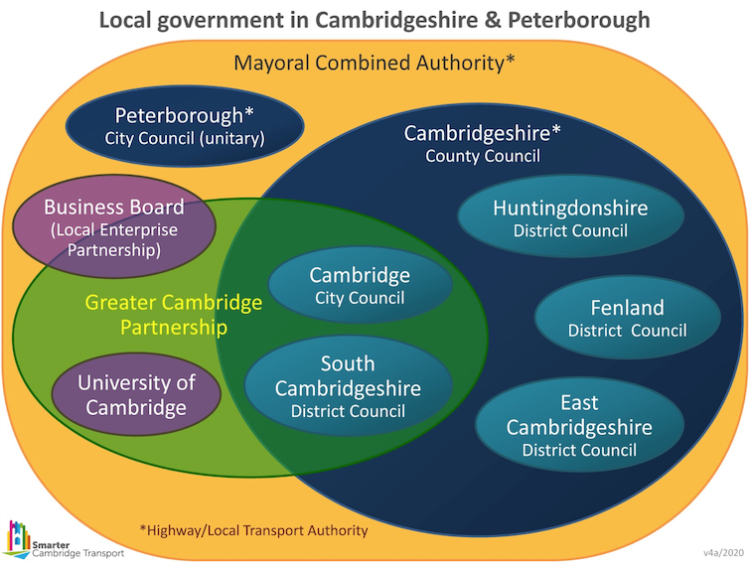
Above – by Smarter Cambridge Transport
Note Cllr Naomi Bennett (Greens – Cambridge) stated in this week’s Cambridge Independent that the controversies of GCP transport planning has focused the attention of residents on our broken systems and structures of local governance.
Structures and assumptions
On 2-3, the structures mean that the senior officers of the Greater Cambridge Partnership have taken for granted one of the riskiest assumptions: that there will be the political will to drive through their proposals. That assumption is now being put to the test and is being found wanting. What I mean by that is many of the candidates returned at the Cambridge City Council elections for Labour and the Liberal Democrats had to make a series of policy concessions on congestion charging in order to keep out their Conservative opponents. It remains to be seen whether Labour can keep out the Tories at the unexpected King’s Hedges by-election on 04 July – this time next week. Both Labour and the Liberal Democrats will have to ask whether it’s worth the political and electoral hit driving through the GCP’s proposals – just as the Conservatives (if they make any electoral gains) will need to come up with alternative proposals, of which I’ve not seen any.
The fragmentation of local government combined with austerity also means that we don’t have the empowered multi-disciplinary teams covering the necessary policy areas to solve the problems we face. The separation of housing and transport is one example – with Cambridge City Council and South Cambridgeshire District Council sharing a town planning function (both casework and the wider local development plan for the future), while the Combined Authority is currently on its second local transport plan – Cambridgeshire’s third, since 2014. All three have significant differences between them.
Big and complicated vs small and iterative improvements
This covers 7 and 10 – in particular the principle of busways vs light rail vs CAM Metro. Part of the problem stems from competing institutions – the GCP vs the mayoralty that resulted in a four year turf war between the first CPCA Mayor James Palmer and the Greater Cambridge Partnership – which for the first year his mayoralty was Conservative-led (and had a Conservative board member throughout his mayoralty). That this was allowed to happen was the result of the Conservatives wanting to design systems (whether deliberately or by accident) than enabled them to keep political control of Cambridgeshire (and the Cambridge economy) without having to contest other parties at the ballot box in a unitary authority. (I cannot think of any other reason why ministers would choose such a governance structure).
One of the complaints about the whole busways concept is that it has not moved with the realities of wider population increases, the sci-tech bubble, nor the growing calls for light rail as an alternative. As one prominent business figure told me, affluent car drivers won’t use buses, but they will use a light rail. Ultimately cities need to have a public transport system that people of all incomes are willing and able to use. This time last year two of Cambridgeshire’s MPs wrote to the Mayor of the Combined Authority and to the Minister responsible at the Department for Transport calling for Haverhill Rail to be examined as an option. Better late than never (I called for it nearly a decade ago!) The most recent updates from Rail Future East are here. The problem remains that GCP senior officers are not interested and the councillors on the GCP Board have refused, for whatever reason, to change policy direction. You can see their latest (now closed) consultation papers on a Cambridge-Granta Park busway here.
What Cambridge University and representatives from the Sci-tech bubble could have done – and some real and substantial political leadership could have helped here, is to have come up with a financial package to put to ministers for joint funding to meet the additional costs for a light rail line. Had they done that, we might be in a better place. As it is, trust in local governance institutions has been destroyed – in my view beyond repair. Given the national mood towards politics anyway, both a general election and the radical overhaul of the structures & systems of governance national, regional, and local. seem to be (to me at least) the bare minimum required to help rebuild that lost trust.
Consultation overload
I informed the voters in Queen Edith’s ward that the institutions do not talk to each other.
“Wouldn’t it be great if the GCP actually worked with our local democratic structures, adding to their relevance and helping join the dots for residents? Radical thought, I know.”
Cllr Sam Davies MBE (Ind – Queen Edith’s)
Which brings us back to No.2: ‘Test your riskiest assumptions with actual users’
The GCP and CPCA assumed that the people who make up the city of Cambridge have the time, knowledge, and motivation to engage in convoluted consultation processes that by experience have shown the institutions simply going ahead with what they planned to do anyway. Hence the toxic state of local democracy in and around our city. Furthermore, the University of Cambridge and its colleges *as institutions and as a single collective entity* are in a state of denial over the risk that such malfunctioning and unpopular governance structures pose to their own long term plans, whatever they may be. Which is the democratically-empowered tier of government that can say “No!” to the University of Cambridge and its member colleges? This is something I looked at in a previous blogpost.
On 4, 6, and 8 “Make things open, make things fair” – for too many people who have kept tabs on decisions made by the GCP, it has been anything but open and fair. Not surprisingly, it is now at the stage where it is on the receiving end of legal proceedings on more than a few things. It should never have gotten to this stage where it has to spend even more money on lawyers to defend itself over risks that could have been designed out at the start, and involved the public much more constructively.
I’ve seen it spoken and written – mainly in cycling forums – that there’s a culture within the highways engineering profession that puts all things motor cars ahead of all other forms of transport – hence too many examples of road design that discourage other active travel users. The growth of the e-scooter means the profession is going to have to go through a cultural overhaul.
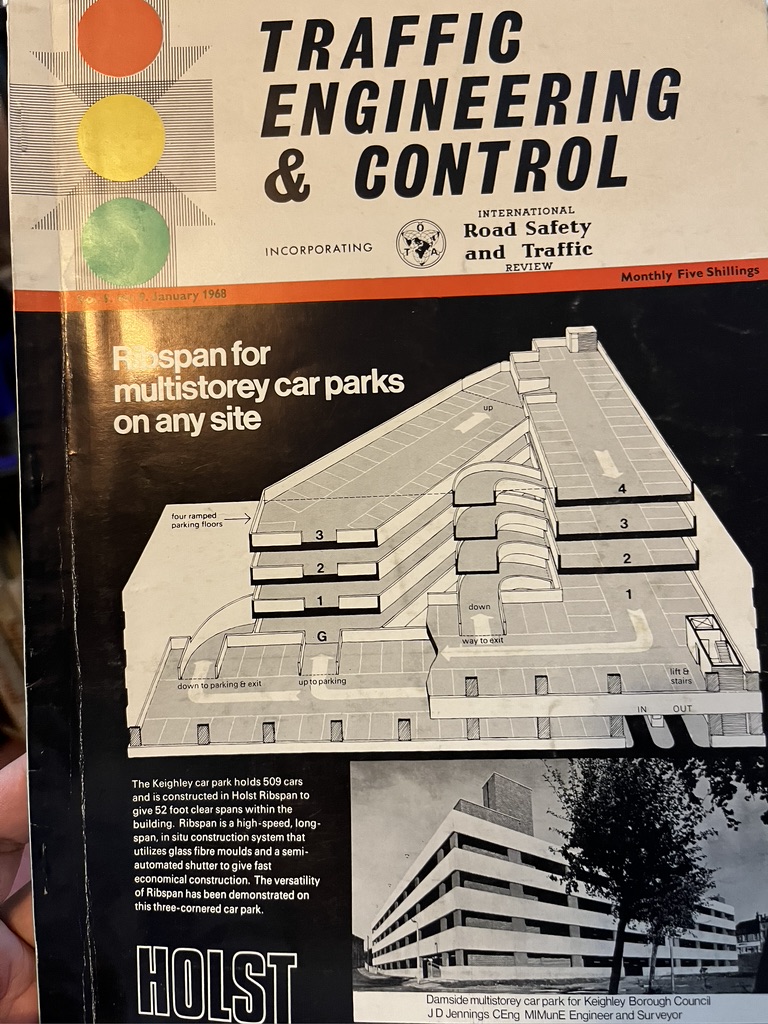
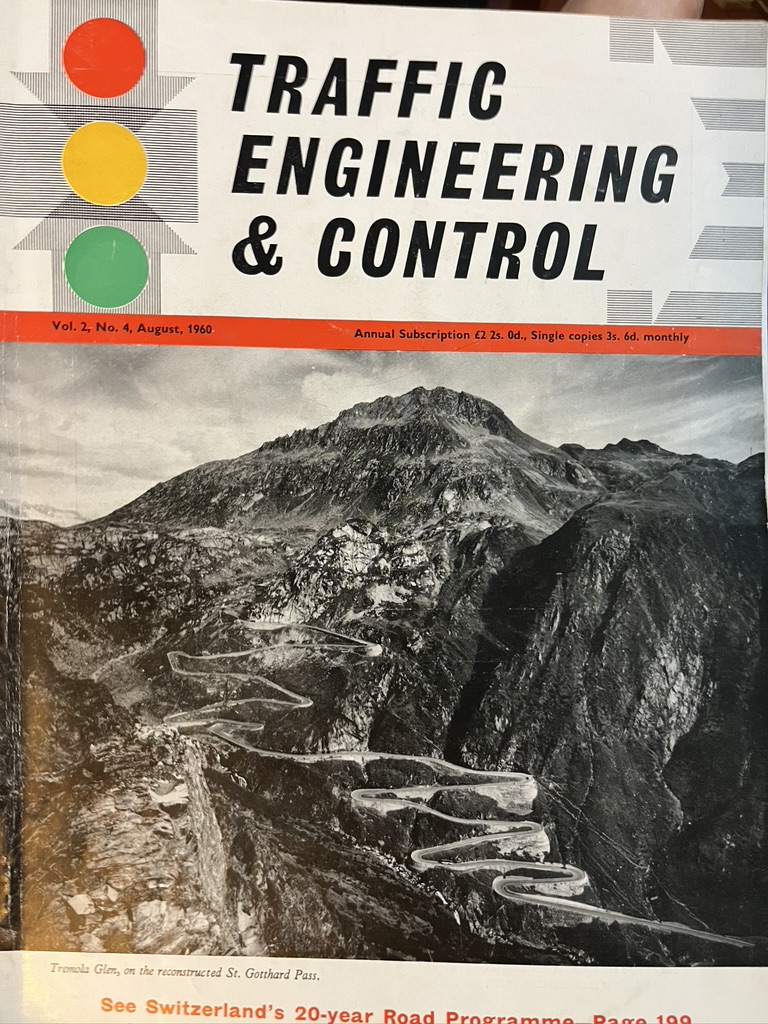
Above – the old Traffic Engineering & Control magazine that I acquired from Plurabelle Books in Cambridge. Published in the early 1960s in an era where every transport problem could be solved by a new trunk road and a multi-storey car park.
I’ve not been through these in detail but I want to get into the mindset of the profession’s thought process of the time. That’s not to say the construction industry was all bad. This was still an era of pioneering municipal innovation for shared public and community facilities.
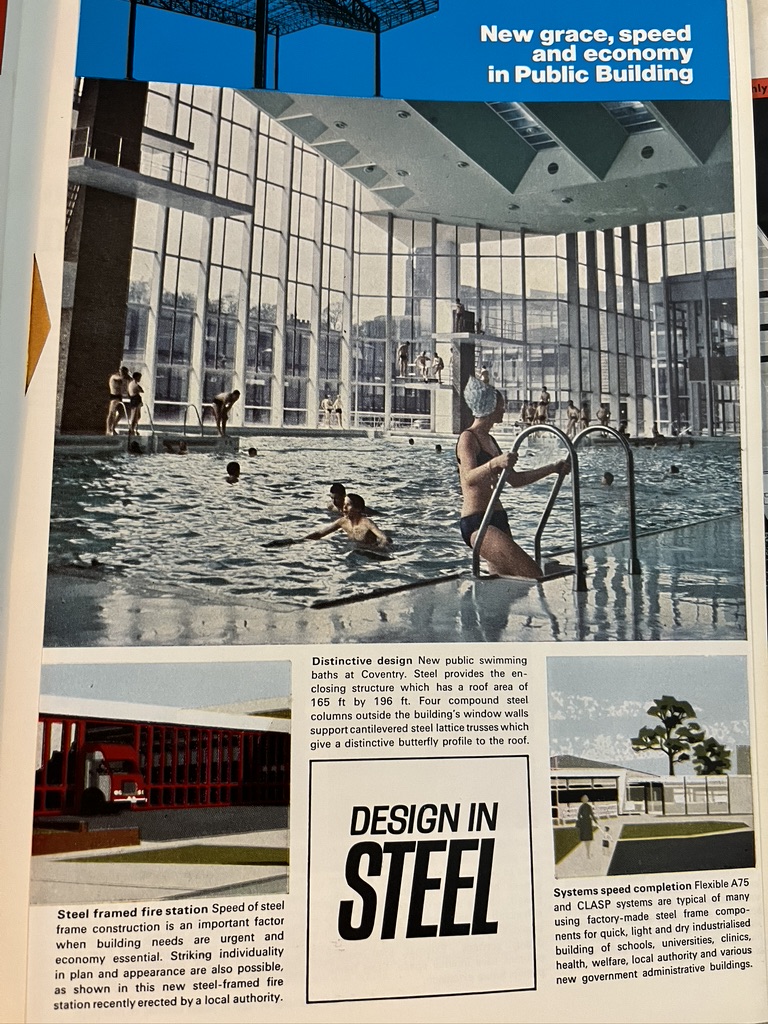

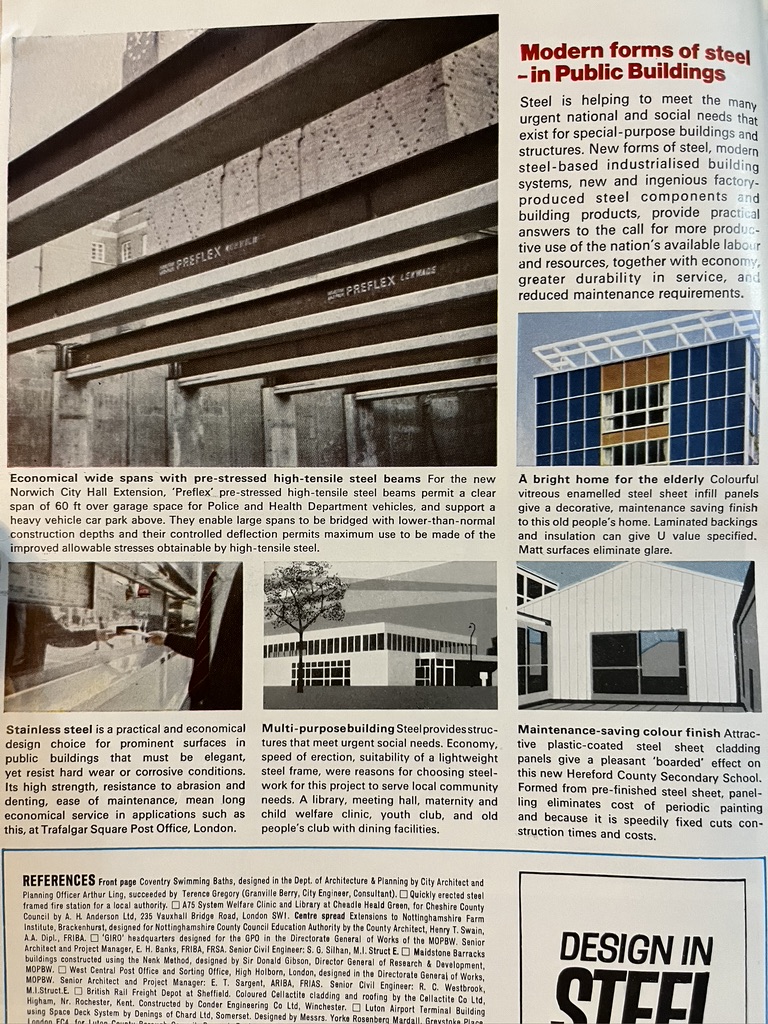
Above – an advertorial from “Official Architecture and Planning” magazine, Feb 1967
Has too much damage been done to continue ‘business as usual’ by the GCP?
I called for its abolition at the ballot box so yes in my view. More seriously Mr Loosemore states this:
“Use openness, regular show-and-tells and assessment via peer-review to demonstrate progress, and to know how to change the direction of a product or shut it down all together”
Tom Loosemorepoint 8, 12 Oct 2018
Both the CPCA and the GCP have struggled and are still struggling to cope with the change of policy direction. We saw this after the 2021 super-elections – I wrote about it in this extensive blogpost from Sept 2021. How does it read nearly 2 years later?
“[The Cambourne to Cambridge Busway Project] …offers no solution apart from the City Access program of soft measures to restrict on-street parking and reallocate road space to active travel. The assumption is that these measures will be enough to enhance bus speeds and provide more reliable journey times across the city. However, no detailed modelling of the likely impact has been conducted so it remains uncertain whether bus accessibility will improve.” [Audit Comment A4].
Greater Cambridge Partnership meeting papers 01 July 2021, p385
Have GCP senior executives actually resolved this issue?
Or are we still waiting?
If you are interested in the longer term future of Cambridge, and on what happens at the local democracy meetings where decisions are made, feel free to:
- Follow me on Twitter
- Like my Facebook page
- Consider a small subscription to help fund my continued research and reporting on local democracy in and around Cambridge.
 The Cambridge Town Owl