
If the landowner and developers do not agree to build a large regional facility on one of the biggest sites in Cambridge, they will have failed most of East Anglia, not just our city
TL/DR? See https://cambridgeeast.com/
It’s a big site – and a long-expected one that will have the developers’ world salivating with the visions of big profits and asymmetrical identikit towers with those awkward-looking mass-produced window frames that I assume are the result of regulations to keep heat loss to a minimum.
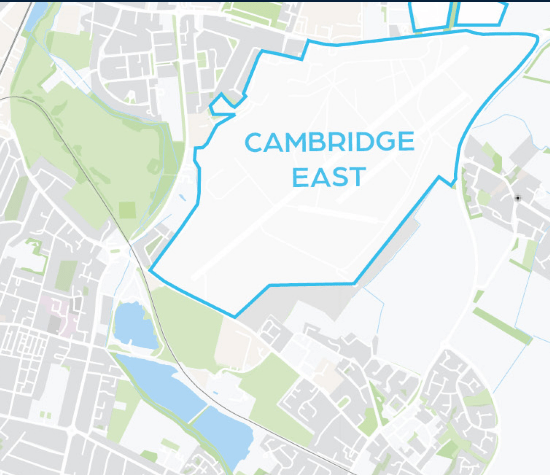
Above – As you can see, it’s a ***very big site***
“Cambridge East will be a 462-acre mixed use development, with sustainability and connectivity at its core; delivering a diverse range of architecture, homes, research and development, employment, education, healthcare, culture, sports and leisure opportunities and facilities to meet the needs of residents across Cambridge and beyond for generations to come – an extraordinary new urban quarter for an extraordinary city”
Cambridge East – summary
“I’m sure I’ve seen some pictures and drawings before”
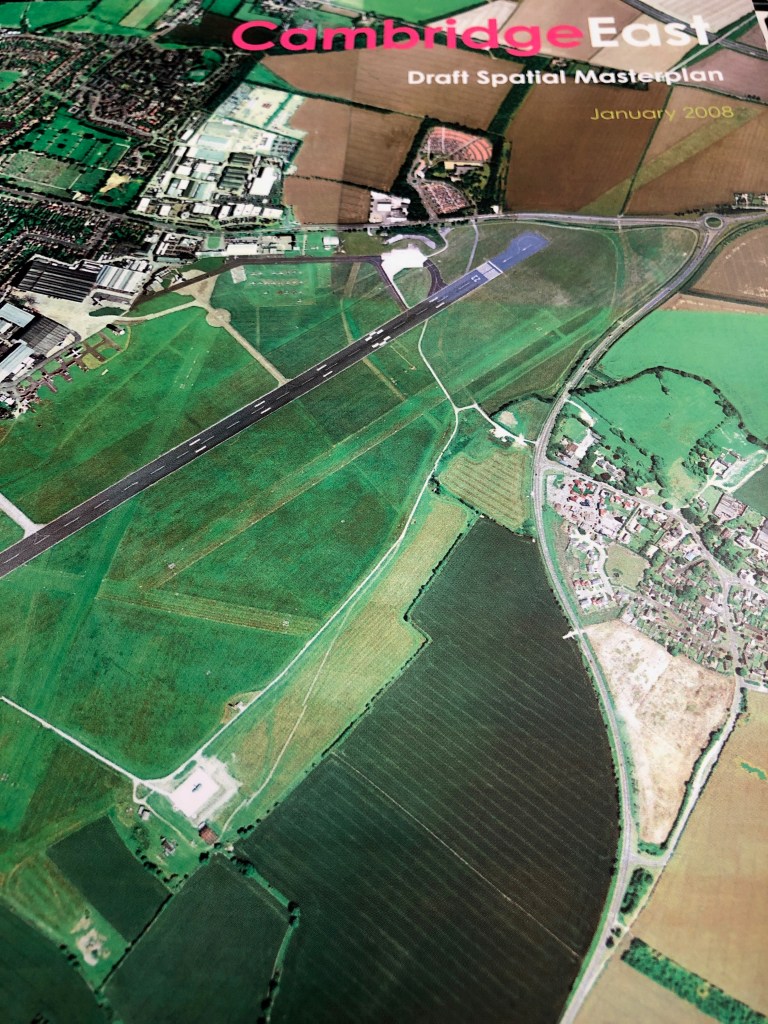
Above – from the Cambridgeshire Collection
Even in 2008 the designers were making pointless comparisons between Cambridge’s historic college buildings (the silhouette of the King’s College entrance on King’s Parade below-left) next to what looks like a badly-designed prison below-right.

Above – I’m not entirely sure what the context behind this was other than to make me angry about something!
Ugly Sh-te
It’s stuff like this that is so rage-generating it…don’t get me started!

Above – Ugly concrete stuff dominating the proposals.
Just as well they didn’t get the go-ahead to move in the late 2000s!
The other big issue is how much of the site will be built on – mindful that a fair amount around the airport has already been developed, or marked for development.

Above – the last of the screengrabs courtesy of the Cambridgeshire Collection – you can visit the collection to read the document in full.
You can also donate money to the Collection to support their work. (They also have a collection of locally-published books you can buy – pop into the Collection on the 3rd Floor of the Central Library in Lion Yard, Cambridge.)
They will need a Cambridge East railway station – and a light rail.
This is not a new thing, but the population increase makes this more important than ever. Especially given the proposals for the Beehive Centre and the land south of Coldham’s Lane sci-tech park plans. Furthermore, ministers will need to ensure the water supplies are in place before any new homes are built. Note the Environment Agency has ***finally*** started objecting to house building on water supply grounds. Darwin Green gets a mention noting that this isn’t the only problem they have – As well as the 36 new homes they have to take down due to poor foundations, other plots are affected as well. Cambridge Labour organised a public meeting with the developers – it doesn’t sound like anyone was reassured at all by the latter. Councillors also are understandably furious.
“How can a broken building industry be expected to build the homes that so many desperately need?
The Grenfell Inquiry’s lead counsel Richard Millett KC put it better.
Above – from Richard Millett KC’s closing statement to the Grenfell Inquiry
I’m of the view that Cambridge needs to be able to spread out the tidalwave of investment and speculative funds hitting the city because we don’t have the infrastructure to manage it.
Hence my suggestion that Cambridge links up formally with nearby large towns that have/are their own sub-regional centres (I suggested Bedford and Northampton as both are historical towns with capacity for harmonious riverside developments on former industrial sites) which could be linked up by fast heavy rail. Alternative routes could include Norwich & Great Yarmouth via Thetford (already identified – just lacking the rail infrastructure!), Lincoln via Peterborough (both with substantial cathedrals), and possibly Chelmsford via Stansted Airport. As it is, ministers have created a system that tries to crowd everything into Cambridges 1935-era boundaries while at the same time attempting to preserve the stereotypical atmosphere of Cambridge in the inter-war era of splendid chaps punting along the Cam reading patriotic Rupert Brooke poetry.

Above – sorry to disappoint, but Rupert Brooke was a radical liberal, and campaigned against the Tories in the 1910 general elections!
RailPEN present their updated proposals for the Beehive Centre – with laughable transport figures
“Today, the Beehive Centre generates significant congestion locally, with over 10,000 cars accessing the site daily during the week with this increasing to 12,000 at weekends. In the future, private car use will be limited to essential use only for those who need it, with an increase in people cycling, walking and using public transport. The result would be much less traffic on surrounding streets with only 550 car trips per day to the site expected during the week and 250 at weekends.”
Beehive Centre Proposals – connectivity and transport
“For real?”

Buses. Not good enough.
Furthermore, without its own light rail stop, the Beehive Centre risks generating more overcrowding at Cambridge Railway Station (already beyond its capacity) given the number of commuters that inevitably will be travelling in from distance.

Above – I am against the principle of private commuter buses – much preferring a comprehensive network of public transport that eliminates the need for such private provision that segregates firms from local communities.
At this rate every science park will have their own special commuter service because ministers don’t have the guts to enable local government to tax the wealth and speculative bubbles to provide a world class public transport system. And local politicians of all parties have to insist that the developers and their backers get together with the Mayor of the Combined Authority, Rail Future, Network Rail and the Dept for Transport to come up with a rail-based solution to some huge development proposals that will utterly transform the eastern half of our city south of the River Cam. And I’ve not even mentioned the Sewage Works move.
“Can we recap?”
We can – these from the State of the City blogpost. The top[ three are all along the Cambridge-Newmarket line where I made a video calling for a new heavy/light rail stop.
- The Beehive Centre where RailPEN want to build a sci-tech park
- Mission Street’s proposals for Land South of Coldham’s Lane / Cherry Hinton Innovation / Project Newton / watch this space for future name changes
- The Longfellow Group’s emerging proposals for Fulbourn Hospital and Capital Park
Note this is on top of the continued expansion at the Cambridge Biomedical Campus, Cambridge Technology Park (the latter won on appeal to a Planning Inspector despite impact on congestion and neighbouring Green Belt) and the further developments including:
- The revamp of Westbrook off Milton Road near Mitcham’s Corner
- The Grafton Centre redevelopment (which would be within a 15 minute walk of a Beehive Centre light rail station *if* the necessary segregated active travelway / foot & cycle path was built.)
There will be others I’ve omitted.
Some of the building design actually looks reasonable (for sci-tech buildings)
…which is an unbelievable thing for me to concede, but there are a few things I could work with.
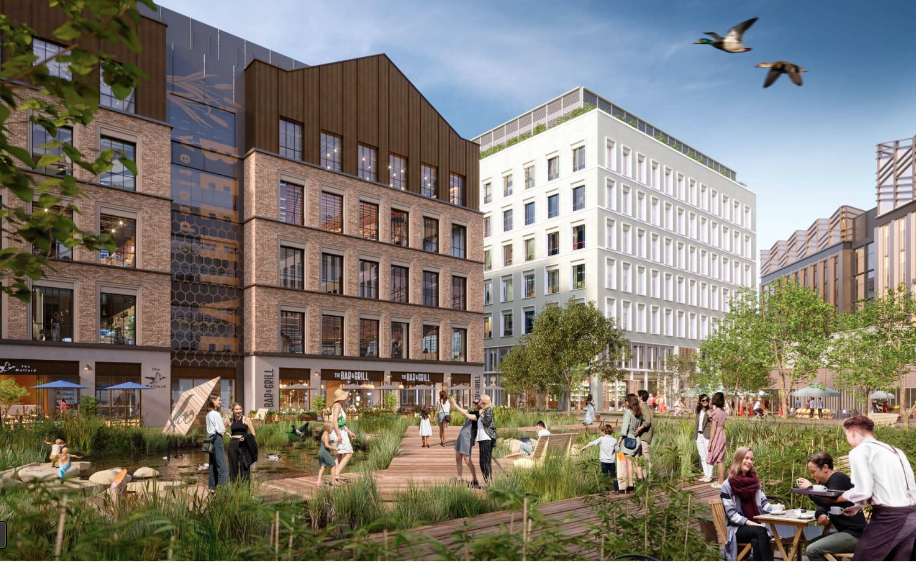
Above – focus on the buildings behind rather than the people and greenery which get in the way of what planning committees should be judging the development on
Although the developers have done a far better job than say Brookgate (I know, a low bar) on involving community groups seldom heard (such as Cam Skate and Make Space for Girls) – several of us encouraging them to do so and making the introductions, I still think it’s a missed opportunity to relocate Parkside Community College (which I wrote about in June 2022) onto the southern end with an extended green space next to the residential areas. But that involves Cambridgeshire County Council and the academy chain having money. Which neither has.

Above – the bold colours indicating skate-friendly facilities.
All medium and large developments should be looking to Make Space for Girls to work up some new and pioneering ideas, engaging with local secondary schools to see what might work in their local neighbourhoods.
“How does the Beehive redevelopment look overall?”
Better than I thought it would, but still a huge amount of work to do on traffic and transport because I simply don’t buy those figures they are quoting. The Combined Authority really needs to do some very heavy lifting – along with the local MPs and potential parliamentary candidates too. The combination of The Grafton, The Beehive, Coldham’s Lane, Fulbourn hospital, and Cambridge International Technology Park redevelopments are more than enough to make the case for a major upgrade of. the Cambridge-Newmarket line for a light or suburban rail loop service that goes from Cambridge – Beehive – Fulbourn – Newmarket – Soham – Ely – Waterbeach – Cambridge North – Cambridge. Furthermore, Cambridge’s sci-tech communities should also be lobbying for this too.
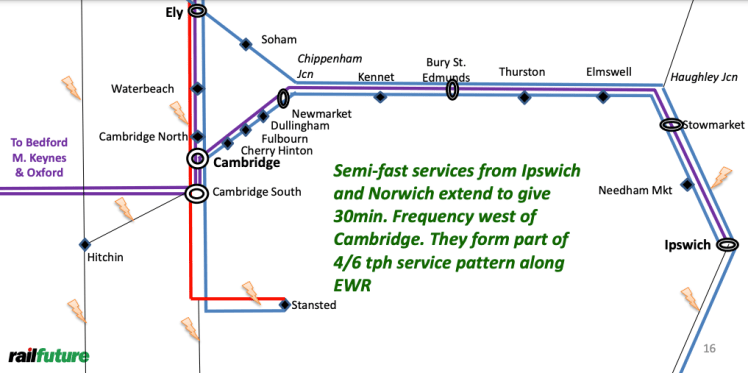
Above – from Rail Future East. Science Park People! Join them!
Finally, all of these schemes have to be made to work for those on the lowest incomes and those with the least influence who are most affected. The development is on the edge of the most economically deprived ward in Cambridge. (See Abbey People for more). The proposals have to work for them – and also the people living in the eastern villages that use/work at the shops that will be relocated. We don’t want to become like Monaco where those on the lowest incomes are priced out of our city and all have to commute in. If you don’t know what I mean by that, listen to the residents of King’s Hedges. Only they have an unexpected by-election next week.
Food for thought?
If you are interested in the longer term future of Cambridge, and on what happens at the local democracy meetings where decisions are made, feel free to:
- Follow me on Twitter
- Like my Facebook page
- Consider a small donation to help fund my continued research and reporting on local democracy in and around Cambridge.

 The Cambridge Town Owl