
Kristin Anne-Rutter for the University of Cambridge focused attention on the big challenge in financing any future public transport system in and around Cambridge. The problem is that ministers have refused to provide the public policy options to have what Sir Humphrey might say is a robust debate leading to a mature and responsible conclusion!
Sir Humphrey and Sir Bernard discussing reforming local and regional government.
Above – Yes Prime Minister
“Over the course of this I have been convinced that we do need to have a way of an independent revenue stream to support the transport that is sufficient in size to do what we want…and an STZ is the way to raise that revenue”
Dr Kristin-Anne Rutter to GCP, 26 June 2023
Above – quoted from the video link from the meeting of 26 June 2023 (see the papers here). Speaking just before her was Dr Karen Kennedy of the Strategic Partnerships Office. Both are relatively recent appointments to the GCP assembly compared to those such as Cllr Tim Bick (Lib Dems – Market) who has been there from the start (and who helped negotiate the original deal with ministers a decade ago). It’s worth noting that in the public questions, other funding options were raised at the GCP Board meeting on 29 June 2023. (See the video from the start of the PQs here)
The difference between working within existing systems and structures vs overhauling the existing systems and structures.
At the Cambridge City Council Elections 2023 my main theme involved raising the profile of overhauling how our city is governed. Rather than wasting any more time on the detail of the GCP I just said scrap the GCP – noting that if the GCP were abolished, any of their proposals such as congestion charging would go with them as well.
Above – from the Queen Edith’s hustings 28 April 2023 (with the Cambridge Town Owl staring back at you).
I also dealt with the issue that candidates against the congestion/road user charging plans were reluctant to deal with – and that was how to make up the funding shortfall. This is where a public policy background helps because one question you are *always* asked on any new policy proposal involving new spending commitments is where the money is going to come from. Note in recent times how Labour in particular has gone out of its way to emphasise that its policies have been ‘fully costed’ because the inertia of branding of pre-1997 Labour governments (in particular in the 1970s) was very difficult to shake off.
The problem with the existing system: Options for independent local revenue streams are very, very limited.
This is where both Drs Rutter and Kennedy could throw the question out to Cambridge’s academic public policy community: What are the alternative public policy options for providing the City of Cambridge with new alternative sustainable revenue streams that are independent of central government that could pay for new and improved public transport systems? (In particular one not over-dependent on buses?) After all, the University of Cambridge has its own Institute for Public Policy (The Bennett Institute) that could easily examine the case for that. That the University and its member colleges have not commissioned its own researchers and directed substantial sums from its £2.2billion of fundraising into such local challenges that affect the institution and its members day-to-day is something I think its members – staff, students, alumni and more – should be grilling the senior decision-makers over.
Are alternative independent revenue streams a can of worms that the University of Cambridge (as both a collective of institutions and an institution itself) dare not open?
Holding the University of Cambridge accountable for its decisions that affect us town people is something we have tried to do for centuries and on the whole we’ve failed miserably. It has only been when things have hit the national press or disturbed the sensibilities of a monarch or senior royal (eg Prince Albert) that things got changed.
How do the residents of Cambridge (and those that live outside our city but commute in, ensuring essential services can be maintained) hold this huge and powerful institution accountable? How do we get to cross-examine them on their priorities for our homes and communities?
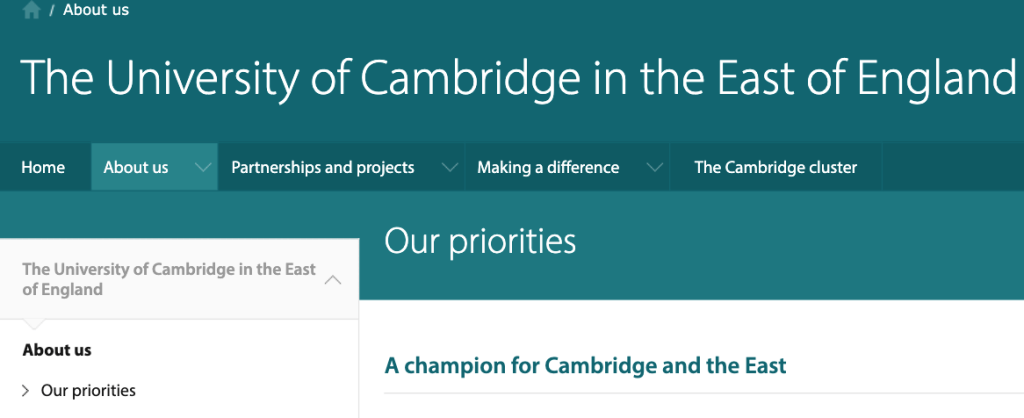
Above – the University of Cambridge has priorities for the East of England – but how do the people of East Anglia get to ask questions of the people who make the decisions?
“How is an under-staffed, under-resourced, district-level council supposed to keep up with all of this?”
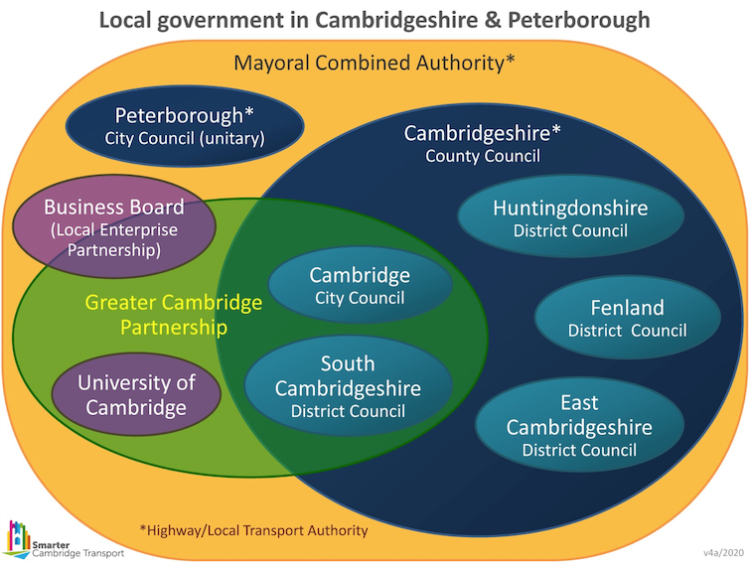
Something I looked at in a previous blogpost when Dr Andy Williams of Astra Zeneca – on the GCP Board as a non-voting member, came to speak to us local residents in Queen Edith’s just before the city council elections. (There’s a video link or three in that blogpost so you can listen to Dr Williams’ answers in the Q&A session). Note one of my conclusions from the King’s Hedges hustings was that many people in the audience asked questions about issues that were not within the legal competency of, or the direct responsibility of Cambridge City Council. That isn’t the fault of the residents, that’s a system design flaw from the 1970s that successive governments have refused to address. Which is why we have such a broken structure of governance in and around Cambridge that does not match how people live their lives, nor how businesses and employers function.
“What if we redesigned everything from the perspective of the citizen?”
This is the point Tom Loosemore’s principles from 2018 point us towards, but is one far too radical for most institutions to cope with. At the moment the public sector is still stuck in an outsourcing-and-privatisation paradigm – one that is clearly coming to an end whether due to pressure from the bottom from grassroots civic society, in the middle from public policy organisations (eg https://www.newlocal.org.uk/) to campaigning charity organisations, through to the implosion at the top involving debt-laden privatised utilities. We can’t say we weren’t warned at the time, as these publications from the 1980s noted.
Would a major review of the governing of the Cambridge economic sub-region lead to calls for both external oversight of non-academic decisions made by Cambridge University and its member institutions?
I hope so! But I can imagine those that currently hold the power/influence within – and it seems few know who the individuals and/or offices of the institution are, would want to keep things as they are. Furthermore, the idea that the University of Cambridge should be taxed in any way beyond what is already in law is something that the colleges and the University have resisted for centuries. Don’t think they won’t resist such demands in the 21st Century even though they acknowledge the inequalities in our city and county.
“Pockets of tremendous success still sit close to areas of significant deprivation. Life expectancy within Cambridge varies by nine years, as does the average between the north and south of Cambridgeshire as a whole.”
https://www.eastofengland.admin.cam.ac.uk/our-priorities
What happens when public debate starts examining the privileges of the institution – and the decisions taken by it? What happens if more and more people conclude that the actions of the institution are a major cause of the inequalities in our city?
Cllr Kevin Price [Labour – King’s Hedges 2011-18] said the university was “let off” providing social housing by the planning inspector at the outset of the project in favour of providing its own rented homes for university staff. “Since then the affordability ratio in Cambridge has significantly worsened,”
Cambridge News – 10 Aug 2017
Above – a Government Planning Inspector allowed the University of Cambridge to be exempted from providing social housing as required by the local plan.
You don’t get exemptions like that without being able to bring to bear some of the strongest lobbyists and consultants in the land – that or facing an utterly threadbare planning department in an austerity-stricken local council with a budget and powers not much greater than a market town.
In conclusion, the short term options involve trying to find something that might reduce the burden of the road user charging proposals that are within the legal powers available. Those powers being very, very narrow.
The opportunity to come up with something new and long term to the current government passed long ago. With a general election due in less than 18 months time, it’s the political parties at a national level that need to be lobbied and pressured politically as they go through the process of writing manifestos. (Labour members and trade union members affiliated to Labour, this may interest you). Because radical proposals for a wider set of income streams will require a change in the law. And the Chancellor’s annual budget speech provides that opportunity every year. For that speech is also the Second Reading of the annual Finance Bill in the House of Commons. For whatever reason, successive chancellors have not taken that opportunity to make the progressive and radical changes needed to provide local councils with a greater level of financial independence from Whitehall and The Treasury. Will the first Chancellor of the new post-election government (likely Rachel Reeves MP) take that opportunity?
Time will tell.
If you are interested in the longer term future of Cambridge, and on what happens at the local democracy meetings where decisions are made, feel free to:
- Follow me on Twitter
- Like my Facebook page
- Consider a small donation to help fund my continued research and reporting on local democracy in and around Cambridge.
 The Cambridge Town Owl