TL/DR? Buy the book and it’ll make sense
Chances are more than a few of you will have seen/experienced something like the diagram Mr Cowan illustrated below:

In Cambridge we have more than a few examples to choose from, whether Brookgate at Cambridge Station to The Marque at the top of Cherry Hinton Road which was so bad that the city council had to commission a report into why we ended up with such a monstrosity that did not look anything like what was promised. You can read the report here. Alternatively, you can go through the gory details by searching “08/0505/REM” in the Greater Cambridge Planning Services database. And cry.
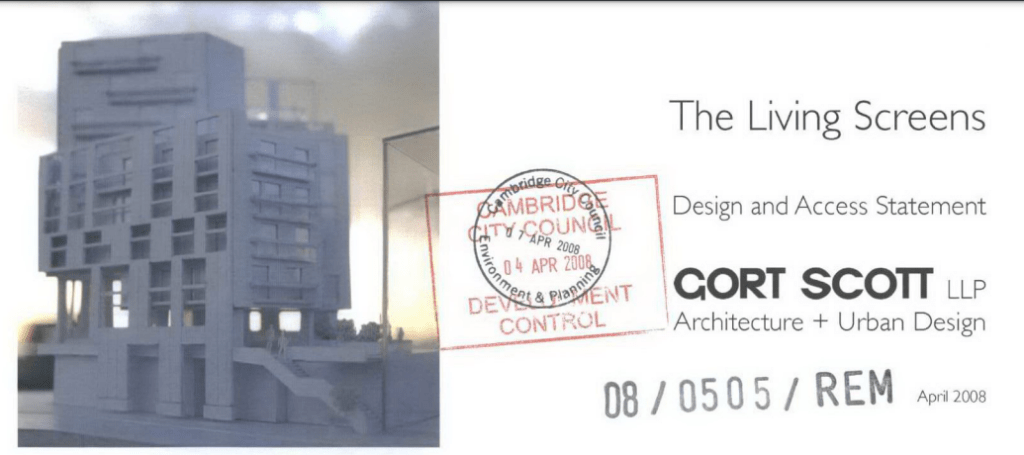
Above. “It’s Cr*p!”
It came second in the Carbuncle Cup shortly after completion.
David Jones in Hideous Cambridge ((2013) Thirteen Eighty-one) is scathing:
“This dreadful collection of gormlessly gaping voids is banal in the extreme. Equally preposterous was the original version of this gimmick, which was key to getting planning permission, proved to be unbuildable!”
David Jones in Hideous Cambridge, p244
He goes on.
“The officials who approved this outrage should feel disgraced, assuming they have consciences at all, and their manes and faces should be prominently displayed on adjacent billboards so we know who to thank. How can such architectural vandalism be permitted, and in this city of all places? Were a sign needed that Cambridge is finished, and that decency in town planning is dead and buried, this fatuous building is that sign.”
Above – maybe there’s an idea of having the names and faces of the individuals proposing and financing the applications being put on big advertising boards by the site at pre-consultation phases. In particular the executives making the most money from it.
I think Mr Jones should write a second volume only too many developers and their corporate backers & collaborating consultants seem to have looked at that and asked themselves: “How can we make things worse while making more money?!?!”
Modern Cambridge Vernacular seems to be one collective industry response!
The collapse of trust in the construction industry following Grenfell, and the rise of the ‘building beautiful’ movements are are reflection of our broken systems of governance and democracy.
In my previous blogpost I wrote about my concerns on how attempts to call out ugly building developments were being hijacked by artificially-inflated culture wars that connected building styles of different historical eras with some very menacing political movements of those ages, with a view to bringing things confined to the history books back again.
In the meantime, the Sunday Times of 09 July 2023 has this tucked in the bottom of its front page.
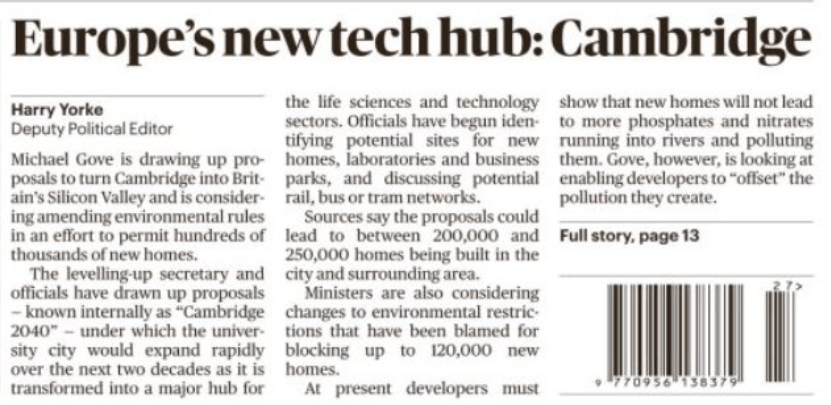
Which is all the more reason why we get the governance structures right in order to influence what gets built and not repeat the mistakes of previous decades.
Fortunately Mr Cowan explores the essentials of the planning system as far as planning applications for large developments are concerned.
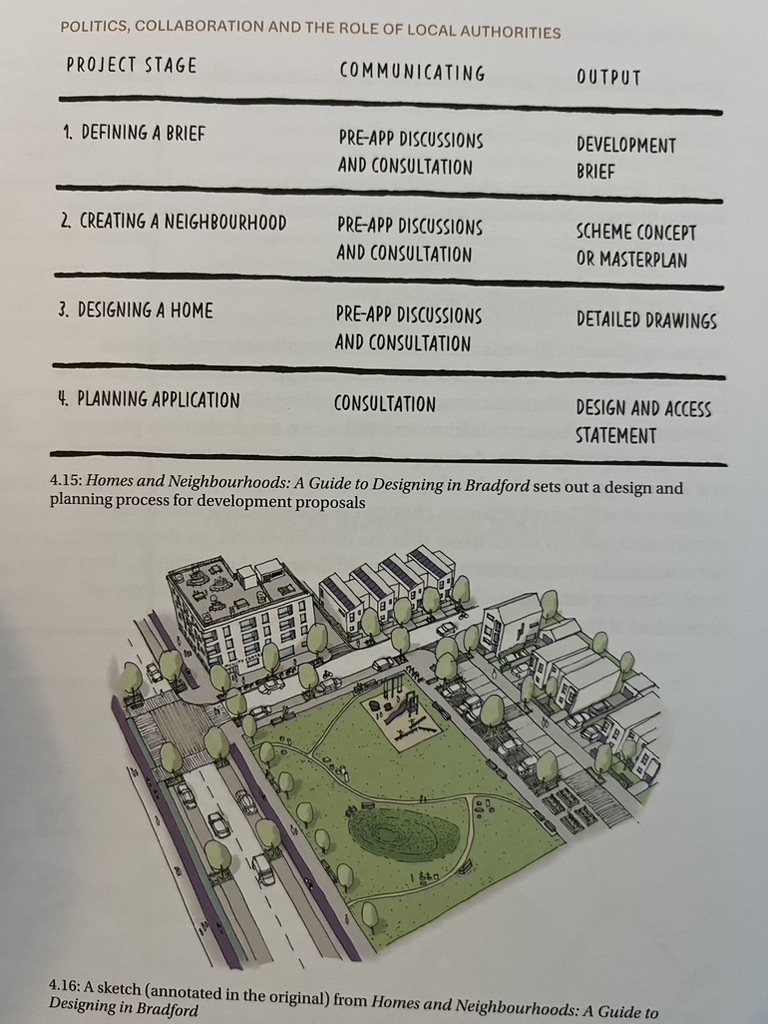
Above – Cowan (2021) p137
Mr Cowan’s style is very similar to that of Jon Harris – the Artist About Cambridge who has been around for half a century (and whose book I thoroughly recommend – you can find it at G-David by The Guildhall if you’re in town).
The complaints about local councils are not new – nor are concerns about creating large, remote unitary councils or combined authorities.
In 1969 opponents of Redcliffe-Maud’s proposals created a textbook “Strawman” example of a bowler-hatted civil servant who imposed decisions on small councils. That method was repeated about the EU with the term ‘eurocrats’. Both were artificially created to be knocked down in public.
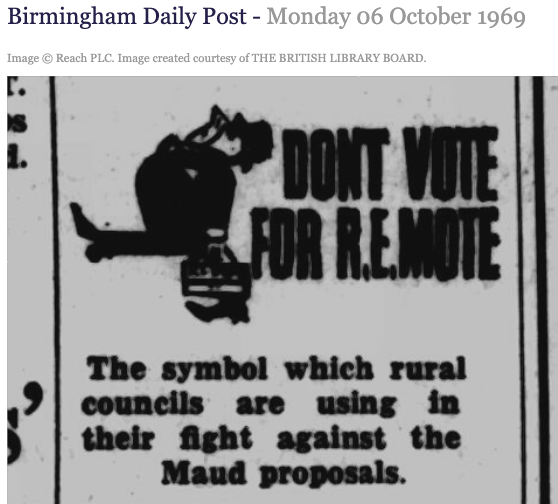
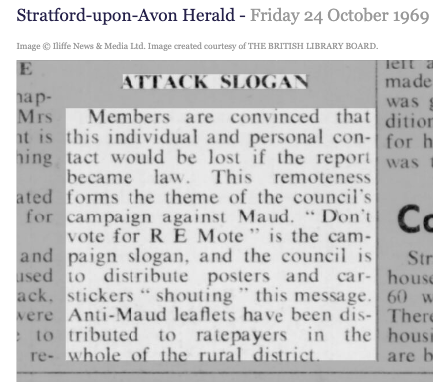
Above: from the British Newspaper Archive
Which is why in today’s culture wars, one of the better ripostes is to call out such examples and press the proponents to name some names.
Hence why in my proposals for a Great Cambridge Unitary Council I’ve included clauses covering integrating parish and town councils into decision-making systems (See here, scroll halfway down) that provides for greater devolution of powers and functions that are mainly local to the settlement (district of a city, /town/village) concerned and at the same time having the ability to escalate issues upwards as well.
“Where can anyone go to learn about local government? It’s not like anywhere runs workshops or courses on it”
Which is one of my issues with lifelong learning not just in Cambridge but nationally. For a start, the establishment of any such colleges needs ministerial approval – which is nuts. In my view, the two areas that could do with such workshops and courses on democracy and town planning are King’s Hedges and Abbey wards – not just because they are two of our most economically deprived in the entire county, but also because they are the ones outside of Queen Edith’s facing the biggest development proposals in the region. The rumour in the Sunday Times is hardly going to be reassuring at the prospect of local need and local issues being bypassed for the developments like the likes of the Great Wall of North East Cambridge. No prizes for which firm is involved in that one.
Mr Cowan encourages us to think about the big and the small – the needs of villages, towns, and cities, and their relationships to each other.
This at the same time forces politicians to consider public transport too. One of the weaknesses of Cambridgeshire County Council historically is that (for party-political reasons) it has failed to consider the needs of Cambridge the city sufficiently within its broken system of local government finance. Furthermore, it has failed to build on the interdependencies between the city and what is effectively its economic sub-region. As a result we’ve ended up in farcical situations where councillors in the north of the county who fall within Peterborough’s economic sub-region are voting on very local decisions that don’t have local consent. The poor transport links – in particular from Wisbech to Cambridge exacerbate this.
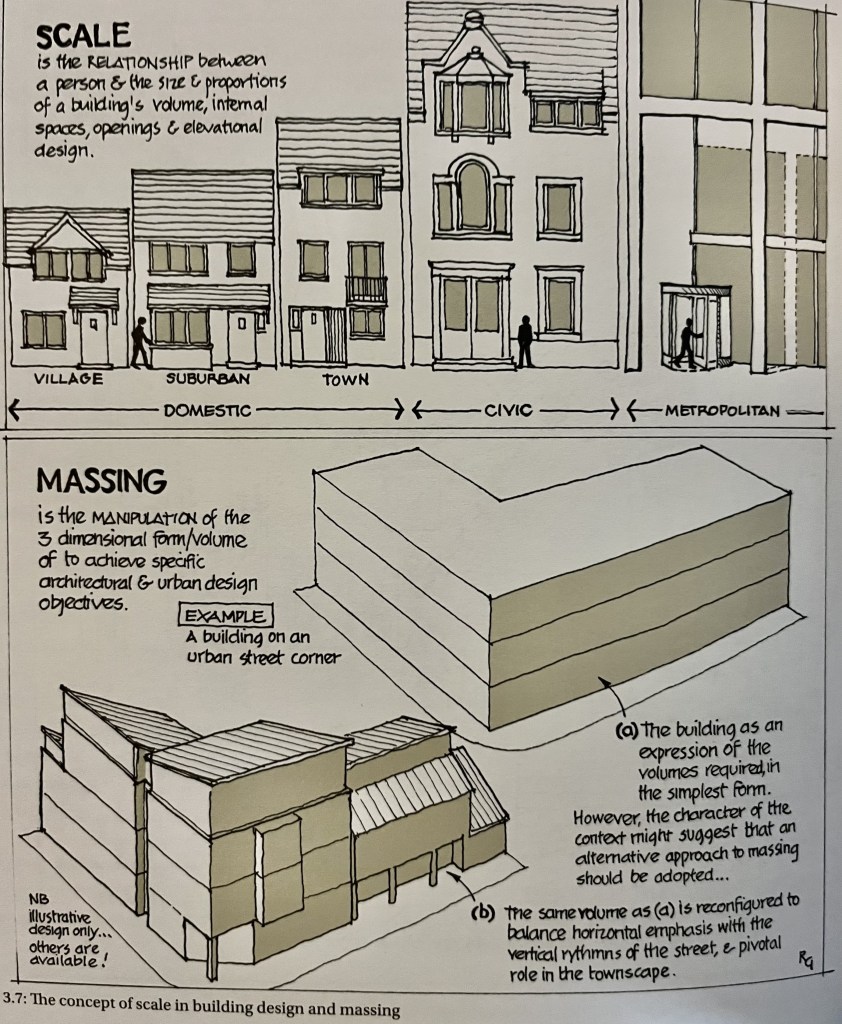
Catchment areas for essential community facilities – along with scale and massing
These two diagrams by Mr Cowan encapsulate the essentials when it comes to applied planning across the piece. From both catchment areas of things like large concert halls (my concept for a new one for Cambridge is one to serve the region), while scale and massing diagrams put in illustrated form words regularly used at planning committee hearings that can easily go over the heads of us non-specialists. Hence why the developments around the railway station proved so controversial – they utterly changed the scale and massing of the area – the developers seen to be working *against* rather than with local residents.
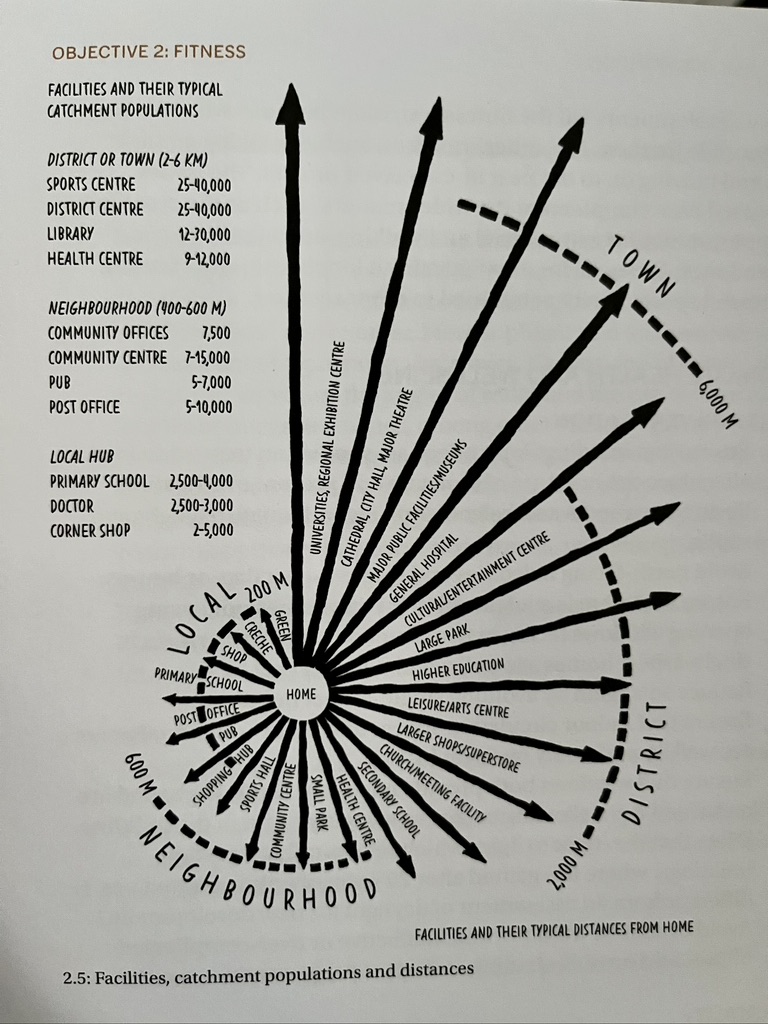
Above – at the most local of levels there should be the equivalent of a village green or small park within 200 metres of every house/home/flat/dwelling.
This makes it sound like some of the concepts of the 15 minute city – the real one, not the conspiracy theory one. Having essential facilities within a 15 minute pleasant walk from people’s homes creates an incentive to get active and not have to use a petrol/diesel-fuelled car. This is not about compelling people to stay within a specific neighbourhood with consequences in law if they don’t. That’s not the 15 minute concept.
Who has access to which green spaces?
This diagram works for me because it covers so many different examples in a manner that’s easy for the reader to understand.
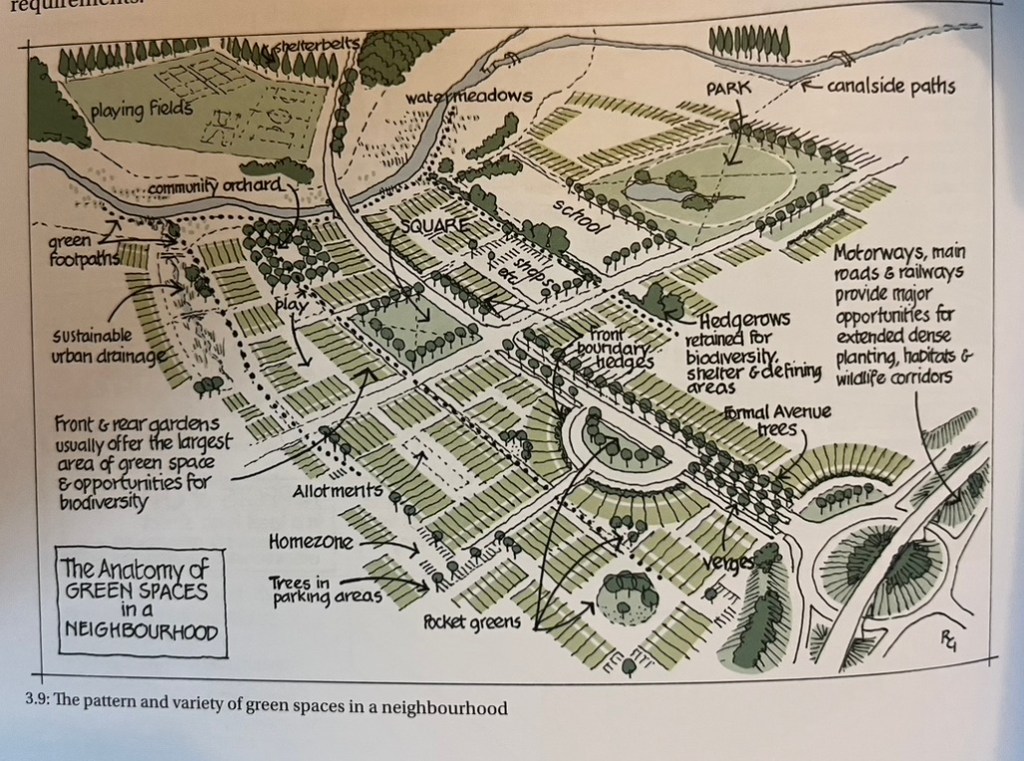
Above – Cowan (2021)
Comparing the diagram above with the lived experience of Arbury (mapped geographically here), the scandal (for me at least) that is Darwin Green’s failure to allocate playing-field-size green spaces to serve that historically economically-deprived ward in their new developments marked a real low in my view. And that was before the latest scandal. Which is why very large ‘green lungs’ north of the A14 (which I’d like to see wide green bridges built over it) need to be preserved and turned into accessible country park spaces with room for playing fields, relaxed leisure, and nature reserves. Furthermore we need to start the practical campaigning now given that ministers are making their moves.
Place-Check. Applied citizen town planning
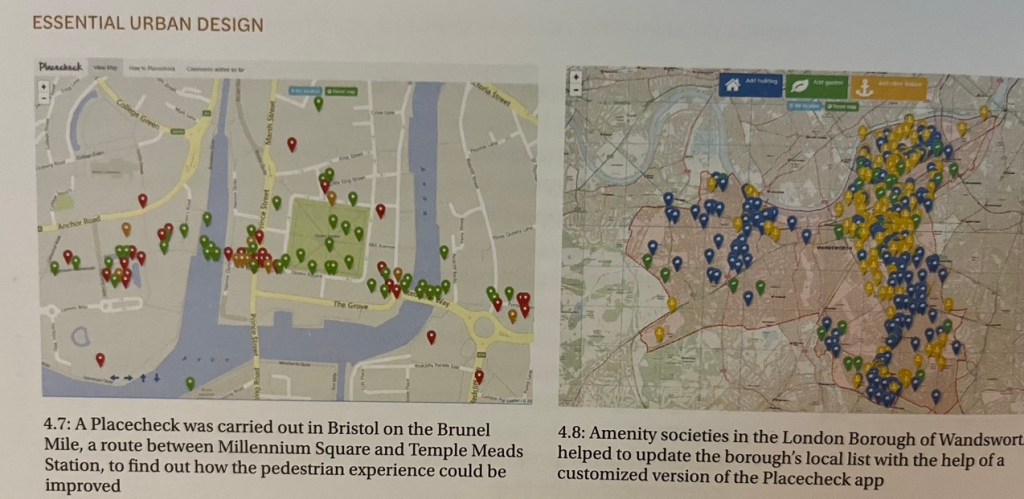
Above – could Cambridge commission a customized version of the app for schools, colleges, and community groups to use, in order to populate a wider city map?
It would be more than useful to identify what is missing and where. Not least because for future local transport planning, locating large facilities close to existing rail/transport corridors could have a much greater impact than trying to build it all from scratch. See the Milton Road Garage Site that would (in my opinion) serve as an ideal swimming pool and leisure centre not just for north Cambridge but also for villages along the guided busway.
Anyway, if you know anyone who is opinionated about town planning and building designs, this is definitely one to look at. I also want to look at Vicky Payne’s suggestions in her book about high streets in towns.
For a future post maybe?!
If you are interested in the longer term future of Cambridge, and on what happens at the local democracy meetings where decisions are made, feel free to:
- Follow me on Twitter
- Like my Facebook page
- Consider a small donation to help fund my continued research and reporting on local democracy in and around Cambridge.

 The Cambridge Town Owl