That does not give Labour a free hand – it means there is an even greater responsibility for the main opposition party to come up with credible alternatives for how England (as well as Cambridge) is governed. Furthermore, the smaller opposition parties need to scrutinise those policies in details as well as suggesting alternatives and improvements.
The mini-headline on the front page of the Sunday Times caused a lot of debate today.
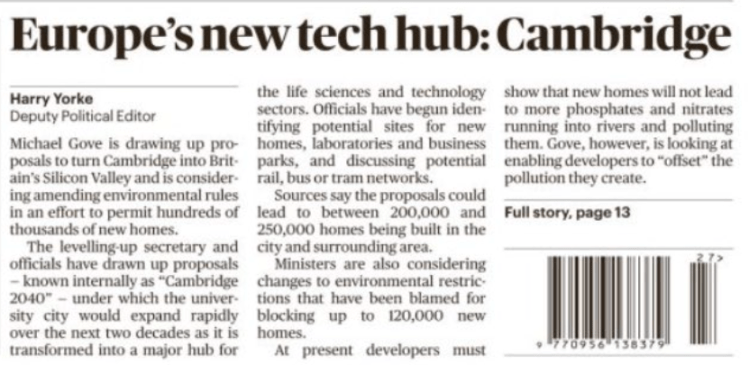
You might be able to read the full report below:
Above – failing that, see Nigel Pauley here
Cambridge cannot be all things to all people.
- University city
- Home to 150,000 people
- Regional health centre
- Regional retail centre
- Major tourism magnet
- Life sciences research centre
- Europe’s tech hub
All of the above cannot be squished into even the southern half of Cambridgeshire, let alone the 1935-era municipal boundaries.
I’m not sure what governance proposals Mr Gove has but they were not included in the article. Cambridge City Council is still a lower tier council – suitable for market towns but not for cities with a globally-recognised name.
How much time does Gove have? Not a lot.
A general election has to be called within 18 months time. Campaigning for it will really begin in less than a year – which means ministers will have less time to spend on meaningful policy-making. We’re at the end of the political and parliamentary cycle – and politicians know this. This means whatever ministers propose now, they may never have the chance to implement it. It’s too late.
Cambridge’s economy has been one of the few things in the eyes of ministers that has been seen to weather the worst that ministerial policy incompetency can throw at it. People still want to move here, firms still want to invest here, and tourists still want to visit here. And yet people still won’t vote Conservative *unless* it is in protest against controversial policies developed by institutions established by Conservative-led governments. (I.e. the GCP in Coalition, and the Combined Authority in 2016). A reminder for Labour and the Liberal Democrats that they cannot take the electorate for granted with transport policies.
“How will Cambridge City Council react?”
They already have – with an official statement this afternoon. Very rare for a local council to put out a policy statement like this on a Sunday afternoon, but given that they had not been informed about, let alone party to the policy debates inside Whitehall (taking the statement as given), I can’t say I blame them. Expect more from the Leader of Cambridge City Council Mike Davey on the Jeremy Sallis Show from 10am.
Above – given the City Council’s statement I’ve asked Mr Sallis to contact the ministerial press office to get an official statement before he interviews Cllr Davy.
It would be *extremely bad form* for the Department to decline to comment given that this is their policy area that is in the news. That said, if MPs are sharp enough they will have noticed that Gove and ministers appear in the Commons for their monthly Q&A session on…Monday afternoon. So in under 24 hours. Which means if an MP asks a Q about this, any response back has to be factually correct. Furthermore, this causes a few issues for the MP for South Cambridgeshire – who is looking to become the MP for St Neots and Mid-Cambs.
Above – from Cllr Sam Davies (Ind – Queen Edith’s)
The reason being is that a fair amount of development is already been planned for the gap between Bedford and Cambridge – west of the latter is where a lot of future development is being pencilled in for.
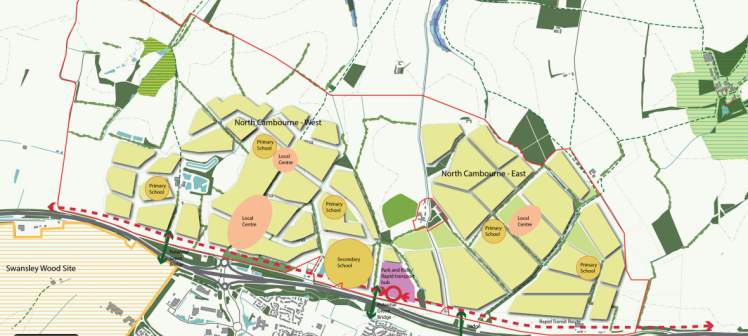
Above – speculative proposals for “North Cambourne” submitted for the emerging local plan 2031-40 which would double the size of the new town.
The announcement by The Chancellor seems to indicate that the above proposals might be brought forward should the next government adopt the concept of a much larger Cambourne. What’s really depressing about the above is that the simple existence of such plans indicate that the general public has not been involved in drawing up the plans at design stage – public involvement early on is an essential design principle as Rob Cowan tells us in his excellent book.
“Where would the 200,000+ new homes go? Noting they mentioned housing units rather than people, so the population would be much, much higher”
The sites offered up for development for the next local plan given an indication. This screengrab shows:
- Blue areas as potential employment sites
- Red areas as potential residential sites
- Purple areas as potential mixed use sites – eg the airport site

Above – part of the challenge for local council planners and councillors is to select which sites should be released from green belt restrictions.
How do ministers square up the proposed growth with the water crisis?
That’s one thing MPs urgently need to question ministers about – i.e. what conversations have ministers Gove’s department had with ministers responsible for water infrastructure and transport infrastructure? Because the Environment Agency has finally started objecting. to large planning applications over lack of water supply / water stress. And when it comes to lacking water infrastructure to support new development, Cambridge has got form – when new medium and large developments in the mid-1970s were banned until the infrastructure was upgraded. Maybe those big dividend payouts and directors’ bonuses don’t look so good in hindsight?
Several people online have mentioned that South Cambridgeshire is inevitably tied up in all of this because of Cambridge’s 1935-era municipal boundaries.
Again, the submissions for the emerging local plan 2031-40 speak volumes. In this case, the green shaded area is green belt.
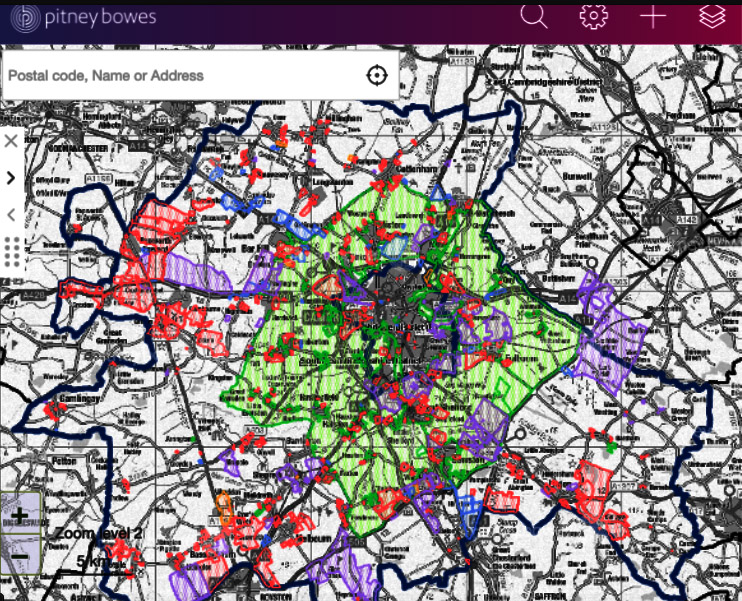
Above – from Greater Cambridge Shared Planning Service’s call for sites
The big ones include proposals for:
- North Cambourne
- Six Mile Bottom
- Bassingbourn
- Papworth
Again, it’s up to local council planners and councillors to select which ones will be most suitable, knowing that developers will instruct expensive lawyers and barristers to represent them to try to get their sites included on the grounds that demand for housing is even greater.
Who is all this proposed growth *for*?
Above – “Why should Cambridge be ruined?”
Hence the importance of regional planning – and why in that post I made the case for improving rail transport infrastructure alongside firm agreements to have firms relocating from Cambridge to specific sites in both Bedford and Northampton and other regional centres (assuming they could secure the consent of the people in those towns). Why those two? Both are historic county towns that can be connected to fast heavy rail (under an hour) and perhaps just as importantly, both have declining riverside sites that could be revamped. One question that many towns and cities will have to deal with is what happens to all of the car-friendly retail parks as petrol cars are phased out? Especially as the policy direction of travel is not a 1-for-1 replacement. (See the Nene Valley retail park in Northampton here).
“Hang on – why should the people there be turfed out just to make way for Cambridge overspill?”
A genuine public policy question – one that is not new given the post-war Newtowns policies. This is one of the reasons why if something is going to be framed as a national policy, then the benefits for local people have to be substantive and not cosmetic – eg a small cookie-cutter community room, some yoga classes and a place called ‘the hub’ serving organic oatmilk lattes for £5 a cup in every sci-tech development.
Given the sizes of the overhauls we’ll need to deal with the climate emergency, there’s also the wider issue of facilities within easy reach using public transport. This is where Rob Cowan’s principles come back in..

Above – Rob Cowan’s Essential Design Principles which you can buy here.
If the populations are going to increase, what additional facilities will be needed? Again, recalling the evaluation from 1967 over the failures of the first post-war Newtowns to build sufficient facilities for new residents.
“What will Labour’s response be?”
That’s for their manifesto. That said, they have their own issues with environmental policy – Sir Keir Starmer’s latest speech being interrupted by Green New Deal Rising protesters – their tactics being different to Just Stop Oil in that GND’s activists – all under 35 are much more about door-stepping senior politicians and asking them difficult questions wand filming the exchanges. It’s worth having a look at Ed Miliband’s speech here to the Institute for Government at their Net Zero Conference. Given the nature of the event and the audience, it was far more substantial yet it also fell below the mainstream media’s radar so did not pick up momentum in the way that the apparent split between Starmer and Miliband splashed over the papers today implied. It’s easy to forget that as well as being a former party leader, Miliband is a former Cabinet Minister (Energy and Climate Change) and also a former special adviser to Gordon Brown in The Treasury. The challenge is whether he has enough of an in-depth knowledge of local government to avoid making the policy and political errors Gove and friends have been and still are making.
“What of the Lib Dems and the Greens?”
On the LibDem vs Tories battleline in South Cambridgeshire, it has already put local MP against Secretary of State.
It will be interesting to see what the outcome of any meetings are. In one sense this is normal – whenever a government policy proposal has such a big potential impact on an MP’s constituency, this is a standard response. See also things like hospital closures. What will benefit the Liberal Democrats is the manner in which the proposals have come – as a top-down message from Whitehall. Historically the Liberal Democrats and before them the Liberals have preferred policies that strengthen local government (eg through greater legal powers) over strengthening central government (eg through creating new national agencies that can overrule or bypass local government).
Finally, there are some areas as we saw at the local elections 2023 that plumped for The Greens – not least because of their ‘anti-big developments’ policies. The newly-emerged Blue-vs-Green party political front line just got a little bit more interesting.
Food for thought?
If you are interested in the longer term future of Cambridge, and on what happens at the local democracy meetings where decisions are made, feel free to:
- Follow me on Twitter
- Like my Facebook page
- Consider a small donation to help fund my continued research and reporting on local democracy in and around Cambridge.

 The Cambridge Town Owl