Doesn’t matter whether it is suburban or light rail, the number of jobs they are proposing to create on the site will overwhelm the existing local housing and transport infrastructure
Me, Alex, and Cait (who wrote this) braved the elements to go to the latest Beehive Consultation in Cambridge earlier. CFS/ME meant I was already exhausted before I had even set out, so my mind was fogged up and not in any sensible state to ask lots of questions. Fortunately there were other members of the public who live closer to the site and had studied the proposals in far more detail than I have done – raising issues as listed by Cllr Dr Bulat (Alex) below.
Above-right – a soaked ‘me’ taking snapshots of the updated proposals – which you can browse through here.

Above – many local residents living next to the site complained about the height and massing of the buildings.

Above – Architect and author Rob Cowan introduces readers to the concepts of scale and massing in his excellent book: Essential Urban Design. If you are interested in scrutinising planning applications, it’s worth buying and reading his book. He uses diagrams to show the concepts that planners use and debate at public planning committee hearings, so you can frame your comments in the language used – making it more likely you’ll be listened to.
That’s not a guarantee you’ll be listened to – the planning system is a mess. The House of Commons Levelling Up Committee tore into the inconsistency of Government Policy in their report published yesterday (14 July 2023). Not that ministers will listen. They didn’t listen last time to the report on how local government finances are unsustainable, so why would they now? That shows how ineffective Parliament has become in scrutinising the executive – this one in particular. Which is why the policy of any future government is ever so important. Have a listen to Labour’s Deputy Leader Angela Rayner on 13 July 2023 to the Institute for Government.
RailPEN indicate they are willing to meet with public authorities to discuss a station at Coldham’s Lane Bridge – but state no proposal has been put to them as yet.
So I’m going to outline one here.
The principle comes from this blogpost – that the new sci/tech proposed developments should contribute substantially towards the upgrading of the Cambridge-Newmarket line that is likely to form part of the eastern section of East West Rail. Hence why I spent the past few weeks going to as many public consultation events as possible, and tabling as many public questions as possible to try and make the case if not secure agreement in principle for all of the interested/influential parties [including Rail Future East volunteers that have done the research] to meet and thrash out the opportunities.
I mentioned that I did not accept their modelling assumptions and proposals for managing the 5,000+ employees getting to and from the site. (See halfway down here) Furthermore, I did not see any evidence of how the timescales of building their development aligned with the construction of new homes mindful of the Environment Agency’s belated objections to planning applications on grounds of lack of water resources. As I said to the Mission Street/Land South of Coldham’s Lane/Cherry Hinton developers, I’d be far more inclined to support their applications if they dealt with the transport issues (amongst other things including responding to the concerns of residents living nearby, providing more-than-sufficient community facilities not just for the neighbourhood but beyond given the size, and to ensure teenagers in particular are properly provided for).
“Where could a station go?”
Here:

Above – note the Grafton Centre top-right, the Newmarket Road Tesco and the Cambridge Retal Park on either site of Newmarket Road, and just below TK Maxx is Coldham’s Lane Bridge. It is around that bridge I propose a rail station – either light or suburban rail.
Zoom in further and the ability for a station to serve four different sites becomes clear

The image looks southwards at the top, and northwards at the bottom. A rail station over the Coldham’s Lane Bridge could (in principle) provide for four exits. These are:
- North Romsey (residential area – top left of the photo)
- The Beehive Centre (sci-tech park proposals, around 5,000 employees anticipated plus any local residents and visitors using their facilities – top right of the photo)
- The Coral Park Trading Estate and Cambridge Retail Park – depending also on what the land owners might do if such a station were built – as this could substantially increase the land value – bottom right of the photo)
- The Centre for Computing History – which is one of Cambridge’s hidden gems, (bottom left of the photo)
The Chisholm Trail cycleway diverts from alongside the railway line under its current design but there may be a chance the developers might be able to make some more land available.
A link all the way out to Six Mile Bottom on the A11 for a Park-&-Rail, and increased resilience to the network with an additional route to Ely
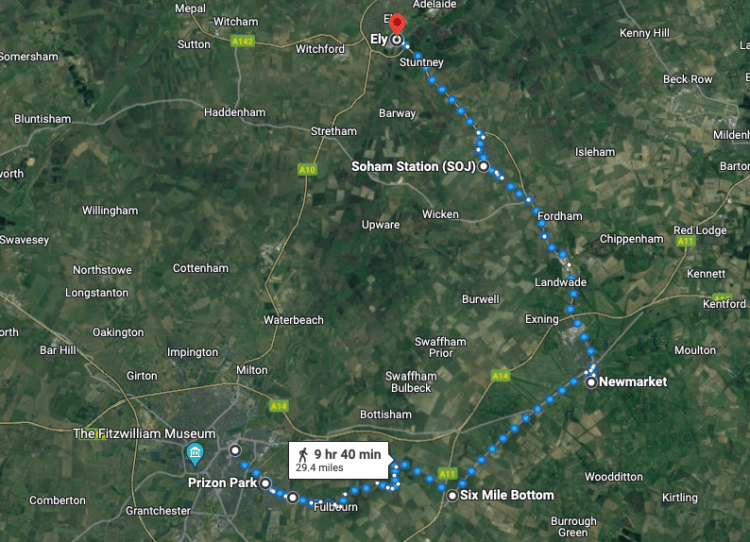
Above – from G-Maps.
As I’ve mentioned in previous blogposts, the proposals for new sci/tech parks by the old cement works between Romsey and Cherry Hinton, along with the looming proposals that will soon be published by the new owners of the Fulbourn Hospital Site (see my write-up of the consultation event I went to here) will simply overwhelm the road network. Hence it would make far more sense to have in the short term a Park’n’Rail at Six Mile Bottom and in the longer term build a garden town at that road and rail junction – which not surprisingly developers snapped up the rights to decades ago.
That in principle would be what I’d look at given the current and short-medium term economic outlook, and working within the system as is. In the longer term, I’m very much in the ***We’re doomed!*** camp (but not in a way that gets in the way of those trying out radical ideas to mitigate for the worst that the climate emergency is now throwing at us). Because the current situation is utterly unsustainable. Browsing the retail job adverts noticeboard in Grand Arcade, Cambridge, it struck me how hardly any of the vacancies paid a wage high enough for anyone to live on once rent and bills had been covered.
Above – in the grand scheme of things the staff in those shops who live with their parents are in effect subsidising the profits of the tenant firms in each shop unit, and ultimately the property owners extracting the wealth / getting a return on their investment
What would be the impact if laws were changed to ensure there were maximum pay ratios, and that minimum wages were linked to the 25th percentile of average rents in the city? What would the market do to find an equilibrium? Increase unit prices of goods/services? (What impact would that have on sales?) If no tenant could afford the rents being demanded, would land owners have to scale back their expectations? If they had borrowed significant sums and found themselves unable to service, let alone repay the debt, who takes the final hit?
Having meandered away from The Beehive Centre, the risk of firms going under is an issue. Remember the long-expected revamp of Hobson House? The old Police Station?

Above – the website is still up, but the firm it seems is not.

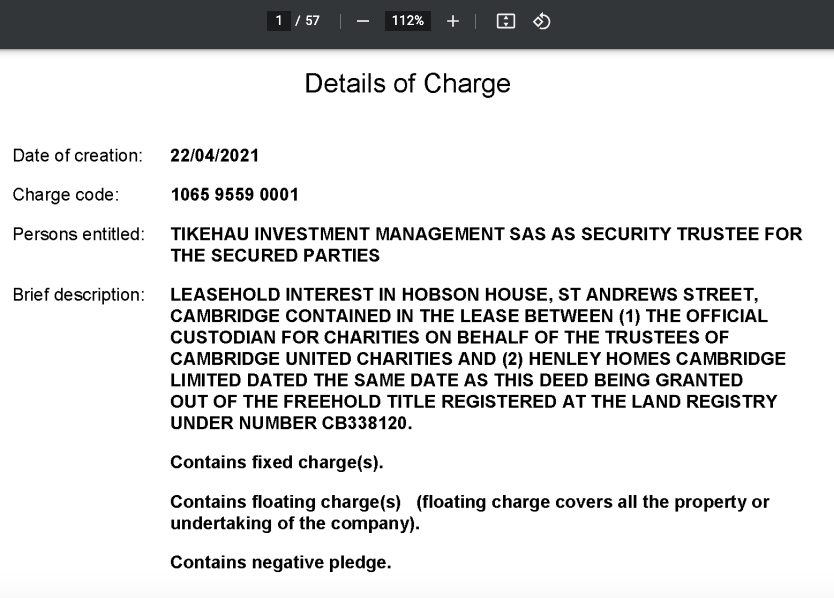
Above – from Companies House. It looks like the providers of the finance behind the project have registered a charge on the property, and the Companies House entries for the developer indicate the hotel company is now ‘dormant’
It remains to be seen what becomes of that historic building in the same way with Shire Hall, where proposals for a ’boutique hotel’ seem to have been downgraded to that of an ‘aparthotel’. No surprises which firm is involved in that one!
I hope someday we’ll be able to do something right for our city. Today is not that day.
If you are interested in the longer term future of Cambridge, and on what happens at the local democracy meetings where decisions are made, feel free to:
- Follow me on Twitter
- Like my Facebook page
- Consider a small donation to help fund my continued research and reporting on local democracy in and around Cambridge.

 The Cambridge Town Owl