
Only I’ve tried to find some but there aren’t any.
It’s a bit like the lack of variety on books introducing children and young people to things like the law, and democracy – from their perspective.
I’m from a generation (the Section 28 generation) that wasn’t taught about politics or the law at school. Hence why I’m persistent in my complaints to politicians about improving adult education and lifelong learning and massively expanding it – former Labour minister Arthur Greenwood published Education of the Citizen in 1920 (digitised here) and it still reads well today, over 100 years later. (It’s worth getting a reprinted version too)
One thing it’s also worth remembering with children’s books on the world outside is that they can help educate new generations of parents on issues that they did not cover at school either. Two of my favourite examples are these.


Above – from the Usborne for beginners series
The closest I seem to have found in terms of town planning materials for schools is from the RTPI – the Royal Town Planning Institute – see here
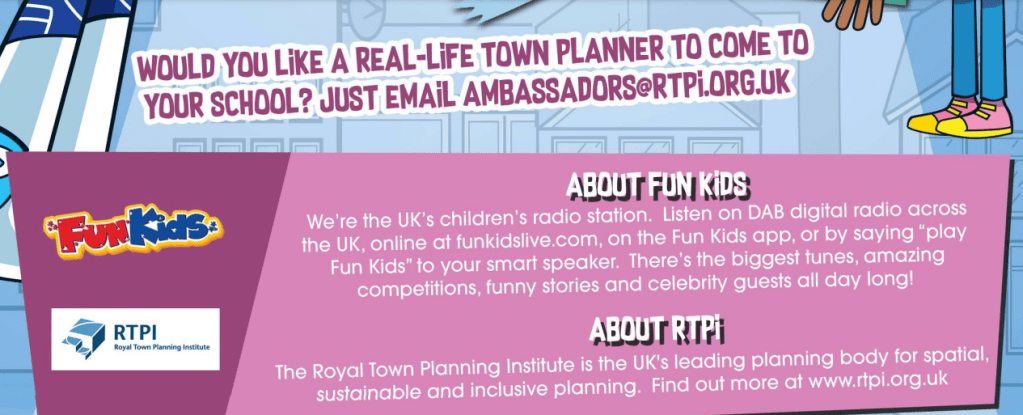
Above – Teachers, see here and drop them an email!
In the grand scheme of things, as a city we are failing to prepare our children and young people to influence the decisions being taken about the future of where they live. Furthermore we are failing the adults too by not providing any means for residents to learn about the systems by which our city is governed and managed.
The vocational focus of existing town planning courses is far too narrow, and means that few have the opportunity to find out about becoming a town planner or engaging with town planning except from the perspective of an adversary: when a wealthy developer comes up with unpopular proposals, or when a nearby resident proposes something that might have a negative impact on your property and how you live in it.
The only two routes that I can find into town planning are either in higher education (where there are books *about* designing cities with children in mind – eg here) or through an apprenticeship. The latter is all well and good but it requires a supportive employer to provide the placements. That might be find in somewhere like Cambridge, but isn’t so straight forward in a part of the country experiencing a longterm downturn in the building industry with few applications forthcoming.
“But town planning is complex by its very nature!”
If it’s something that affects the day-to-day life of children in their communities, it should be possible to explain the essentials to them. i.e. who built it, how it got there, and who decided it should go there.
After all, how did King’s College Chapel get there? Because King Henri VI rocked up to Cambridge and said:
“That’s a lovely riverside you’ve got there! I think I’m going to have a new large chapel built and call it mine!”
An imagined conversation – here’s the official line from the College.
It was controversial because there was a riverside community that was cleared to make way for what would later become Oliver Cromwell’s barracks and even later, one of the world’s most famous tourist attractions that has the odd sing-song in December that people like listening to and watching on telly.
“You couldn’t do that today”
A bit of a loaded question given legislation around a range of issues from accessibility to climate change. Also there’s that eternal debate on whether trying to recreate an older building style/vernacular is authentic or pastiche in the pejorative sense.
During my school years, major building works were a constant – which seems strange given that it was also an era of austerity. Actually it reflected how out-dated some of the buildings were that even under a Conservative government they had to find the money somehow to pay for it. At primary school I remember not liking the look of some of the plans and being horrified at the way huge holes in almost century-old walls were being torn. But no one was around to explain the essentials of the politics or town planning to us. It just…happened.
And not without consequences – in particular for local playing fields.
Take this detail from a map of Cambridge in 1990 with “Sch” being Hills Road Sixth Form College, and just below it, Homerton College Cambridge.

Above – detail from a Cambridge Map 1990
Both of the playing fields – which I played on during my primary school years, have since been built on. The Hills Road Sports & Tennis Centre was completed just before I arrived, and the Homerton College Playing Fields had the Mary Allan Building and accommodation built over much of it.
As I’ve mentioned in previous years, the plot of land labelled 9.19 should be converted into a publicly-accessible park, linked through to the playing field to the south of it to create a cycle/pedestrian route to Long Road and the railway bridge.
Also in that part of my neighbourhood is the Faculty of Education. Which got me thinking about whether there are any researchers there that want to come up with proposals for town planning learning materials aimed primary, secondary, and sixth form students. The reason being that for Cambridge at least, this growth isn’t going to go away anytime soon short of a cataclysmic climate event that results in a massive cutback of activities that release lots of climate gases – not just the CO2 type either.
This matters because if you can make these complex issues accessible to children, you are making them accessible to adults as well – perhaps more than you realise.
Food for thought?
If you are interested in the longer term future of Cambridge, and on what happens at the local democracy meetings where decisions are made, feel free to:
- Follow me on Twitter
- Like my Facebook page
- Consider a small donation to help fund my continued research and reporting on local democracy in and around Cambridge.

 The Cambridge Town Owl