
TL/DR: Developers have submitted their planning application. See Gemma Gardner’s summary in the Cambridge Independent here.
Before I start, if you find any of this useful, and are also able to, feel free to help feed the Cambridge Town Owl / donate to my research costs here. Sadly long-term ill health means I am far less mobile than in times gone by, and much of what you read sourced mainly online using knowledge I’ve gained from both my civil service days, and scrutinising local government meetings in the years that followed after my health imploded.
Background reading.
If you are familiar with the planning portal and want to get stuck in, see https://applications.greatercambridgeplanning.org/online-applications/ and type in 23/02685/FUL into the box on the simple search dropdown. Click on the documents tab and explore away – starting with Design and Access Statement documents.
If you want to read the in-depth story of the neighbourhood, visit the Cambridgeshire Collection on 3rd Fl Lion Yard, Cambridge and ask the local studies staff about “The Kite Redevelopment”. They can give you chapter and verse. Alternatively, browse through the Kite Conservation Area Appraisal by Cambridge City Council 2014 here.
Now: a crash course in commenting on the application:
Read through the council’s guide here
AKA The guide from the Greater Cambridge Planning Service. To get to the actual planning portal itself, click here.
If you want to comment on any planning application you have to be registered – see the guidance here.
The Councils’ Planning Committees can only take into account certain matters when deciding on a planning application
You can read the list of things you can comment on here
The other thing they should have mentioned is that all planning applications have to comply with both the Greater Cambridge Local Plan (which you can browse through here, but it’s heavy reading!) *and* the Government’s national planning policies – ***Unless there are exceptional reasons*** to ‘depart’ from those standards.
There is also something called a Supplementary Planning Document for the Grafton Centre which you can read here.
“So, what’s what then?”
This is an incredibly controversial development for a whole host of reasons including:
- Local history – the areas The Grafton was built in is known as ‘The Kite’ – and local residents fought a very long campaign to oppose the comprehensive redevelopment, even coming up with their own plans in 1976 – which I wrote about here.
- Declining shopping facilities for working class Cambridge – Because of its multi-storey car park and proximity away from the University areas, the shops that established themselves at The Grafton included a number of former High Street giants – Debenhams, BHS, C&A, HMV, Next, Boots – they all had a presence.
- The Sci-Tech bubble is seen to be swallowing up many of the medium-large development sites that become available at the expense of much-needed sports, community and leisure facilities – which is not good for the overall balance of the city
There are a whole series of issues that arise from this application that you may wish to comment on regarding the application.
Are the proposals compatible with the Local Plan?
The first place to look is the Cambridge Local Plan 2018, which you can see here. Click on the link that says Cambridge Local Plan (adopted October 2018) and then scroll down to “Policy 12”
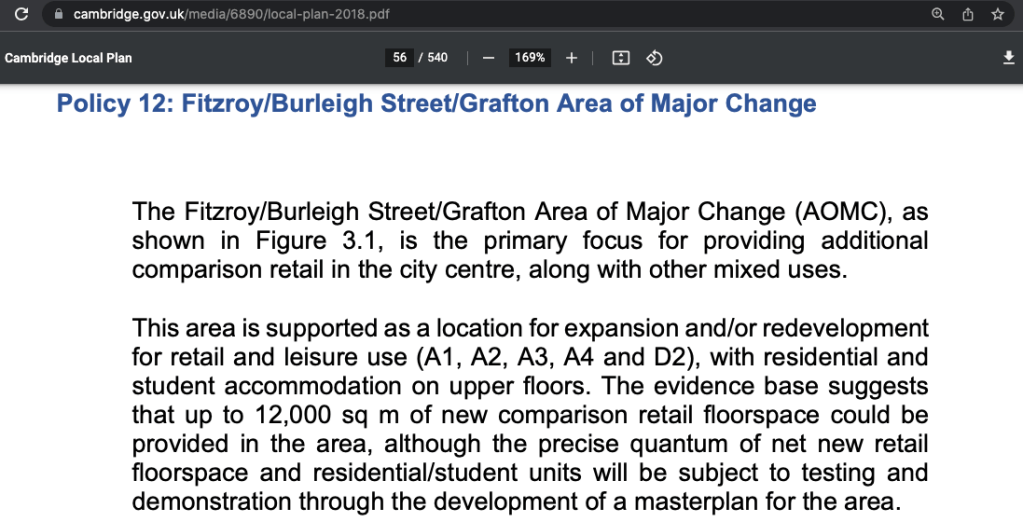
Above – from p56 (of the PDF) of the Cambridge Local Plan 2018
It says that any developments should:
- “a) be of a high quality, with well-designed edges securing significant townscape improvements to Burleigh Street and East Road;
- b. be sensitive to surrounding residential areas and the character and setting of the historic core and heritage assets;
- c. improve the bus interchange, including an increase in capacity and better waiting facilities for passengers;
- d. be focused on providing access by sustainable modes of transport including improvements for pedestrians and cyclists such as a managed cycle parking facility, and with no increase in car parking above current levels;
- e. improve the public realm along Fitzroy Street and Burleigh Street, by removing unnecessary signage and street furniture, and using a simple and durable palette of materials; and
- f. promote linkages to the historic core.”
Above – CLP (2018) p57
***If you think the development does not meet any of those standards (and can explain why), you can put in an objection to the development stating that the development contravenes Policy 12 of the Local Plan – along with your reasoning***.
Are the proposals compatible with the Supplementary Planning Document on The Grafton Centre appended to the Local Plan?
You can read the document here. This too is a material consideration – i.e. developers and planning committee councillors [who act in a quasi-judicial function, so their remit is highly-restricted in law] have to take notice of what it says.
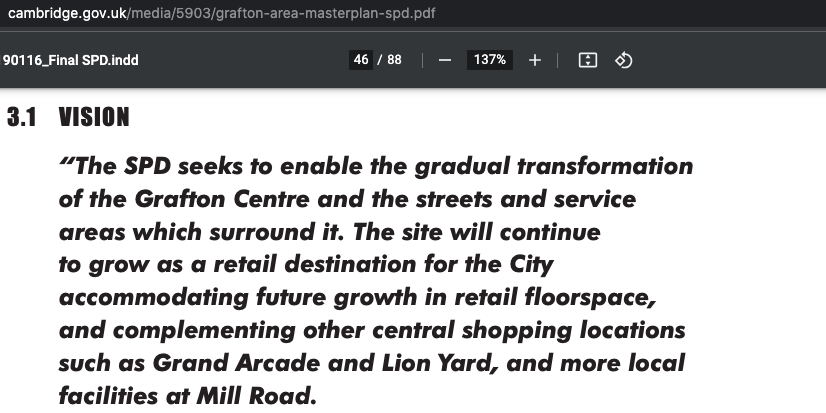
On the face of it, it looks like the proposals are incompatible because the retail space is contracting significantly. That said, the developers will point to the significant number of vacant shop units. The political debate is whether the developers/new owners have set the retail rental level at such a rate as to be unviable for more potential tenants and retailers to come forward. At the same time, we might simply be at a very low point in the business cycle and may find that the loss of these vacant units may come back to haunt the city should a retail boom return.
“Proposals for the Area of Major Change should seek to create a positive and attractive environment to support the vitality and viability of the area for retail and associated activity. Crucial to this objective is to understand and positively integrate the historic environment into proposals”
Para 3.2.5 SPD (2018)
Can we have a bookshop please?
Ages ago I called for a new large bookshop to open at The Grafton following the collapse of Debenhams. There were two reasons. The first was the presence of Anglia Ruskin University almost over the road. The second was the opportunity to create a space for families that might otherwise not get the chance to go / take their children to bookshops to have somewhere that is large and exciting enough to keep children occupied – and also be more accessible than the bookshops in the old town centre. Personally I think councillors and planning officers should explore making this a condition of planning permission.
“Integral to this future-proofing, is the introduction of a broad mix of town centre uses including retail, food and drink, and leisure. Proposals will bring life to the centre through the introduction of new homes, student accommodation, hotel space, university accommodation and offices. The SPD encourages the strengthening of the area for retail, and greater diversification as a destination for the city – for residents, visitors, workers and students.”
Para 3.2.7 SPD (2018)
This is something that can be contested too – can the developers demonstrate that their proposals would withstand the implosion of the sci-tech bubble? History tells us that it is very difficult to predict the exact point at which speculative bubbles burst, and as bubbles go, this one’s a big one. The developers have a massive financial incentive to turn over as much space as they possibly can for sci-tech purposes, and minimise the amount of ‘community space’ as possible. This is where councillors and planning officers must push back – supported by us, the people of Cambridge (both resident and commuter).
Are you a regular bus passenger? Please read p53 onwards
“Development proposals should incorporate an integrated approach to buses with a view to improving local walking routes from bus stops to the Grafton Area and key shopping streets.”
Para 4.2.11 SPD (2018)
Do the plans do this?
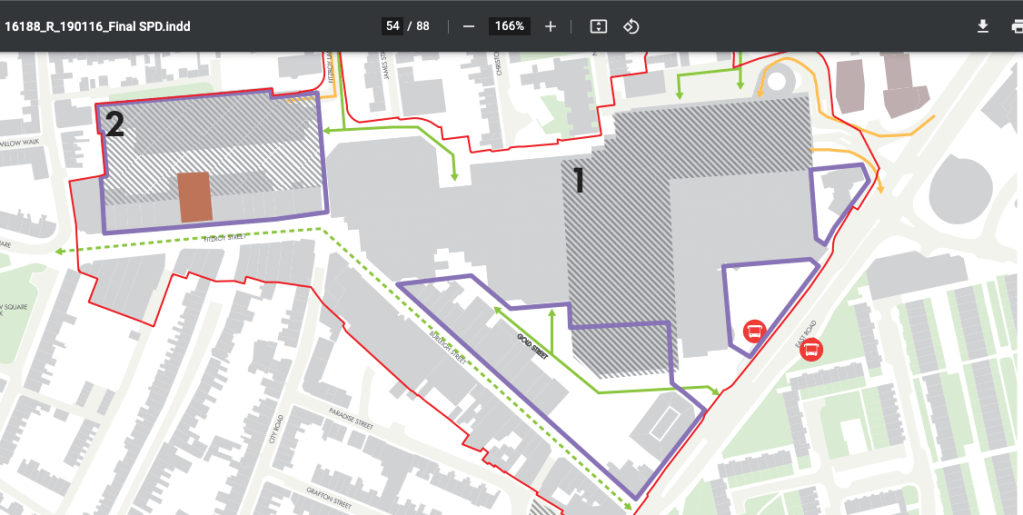
Above – the map from p54 of the SPD
“It is important that proposals are future-proofed to allow for the potential future expansion of bus services in the city”
Para 4.2.14 SPD (2018)
***If this is an issue for you, get in touch with Richard of the Cambridge Area Bus Users Group here***
Community uses – that classroom is far too small, surely?!?


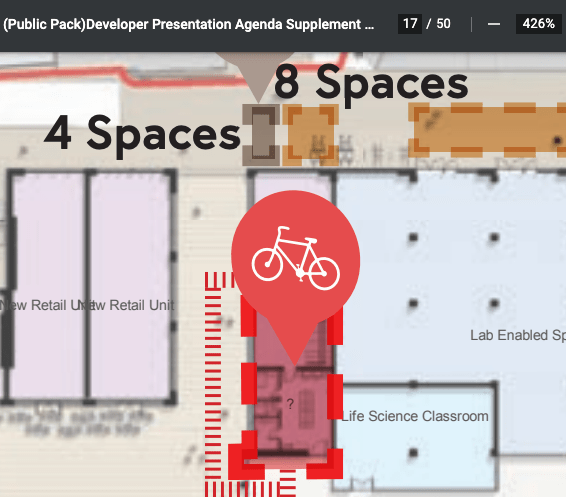
Above – I’m surprised the developers did not seek to expand the so-called teaching space given that the number of chairs around. thetables is smaller than the average class size of a secondary state school.
“Any planning application for the Grafton Area will need to be informed by an appropriate assessment of demand and capacity. The assessment should be in line with Policy 73: Community, sports and leisure facilities in the Local Plan.”
Para 4.2.21 SPD (2018)
Let’s have a look at Policy 73 then!
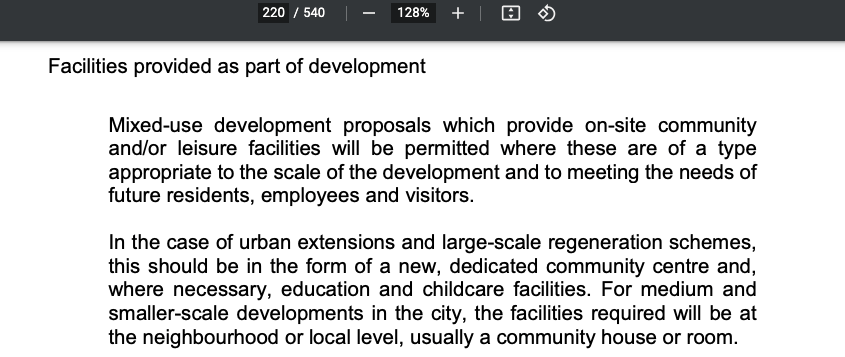
Above – CLP (2018) from p219 of the PDF
Is this a large regeneration scheme? If so, then there needs to be a dedicated community centre in it. Is it a medium one? How many people will the developers expect to be on the site during the day and during the evening?
Overall?
I have huge, huge issues with the application – even though their heritage statement references Lost Cambridge, which is a first! Talking of heritage, the county’s archaeology service has got back with a set of conditions given the history of the site:

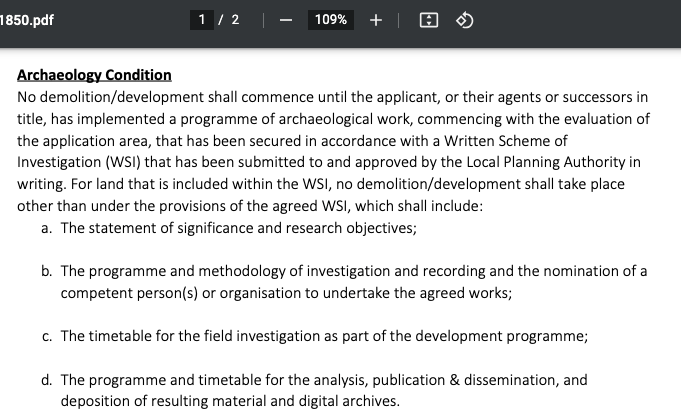
This means they will have to commission a firm of professional and qualified archaeologists (as is standard for something like this) and fund a programme of activities to share the results with our city – including publication in the Cambridge Antiquarian Society’s annual bulletin. You can browse through their digitised back catalogue here.
Impact assessments:
These are important too. Take the local economy.
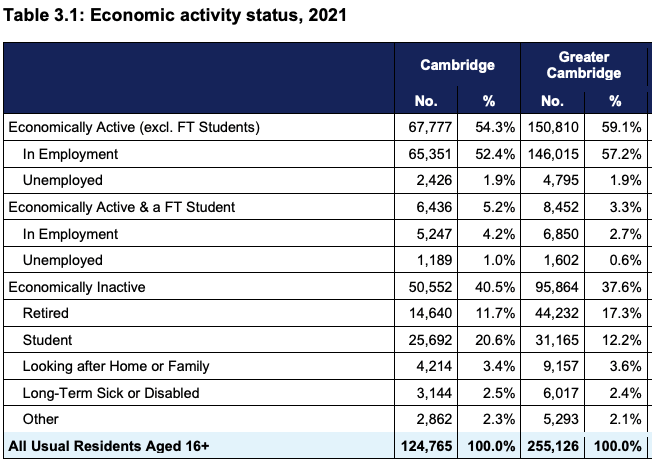
Above – from Bidwells table 3.1 Economic Impact Assessment.
Note that very low unemployment figure. Which implies a large number of new staff are likely to have to commute in.
Transport Assessment
These are towards the bottom of the submitted documents – and those of you worried about public transport need to look at these pages.


Above – Transport Assessment
The developer’s consultants have summarised:

Above – 116 bus trips and 46 rail trips in the peak rush hour?
I hope someone does a post-development analysis on those estimates!
….Turns out someone will be. But who will remember to check? And has anyone assessed and evaluated the travel plans and estimates submitted by consultants from previous developments? There’s an extended project-and-a-half!

Above – note the submissions of the travel plan reviews post-construction.
I’m not sure about those additional generated vehicle trips either!
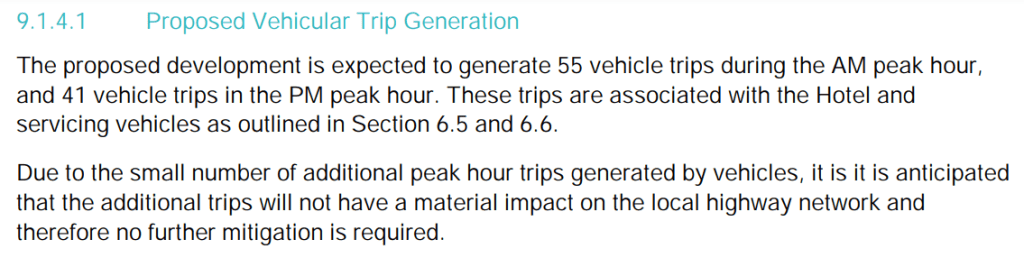
Only 55 generated in the peak morning rush hour?
I don’t know about you but I don’t buy those estimates at all. Hopefully someone with more knowledge, expertise and headspace than me will be able to scrutinise the transport proposals in much greater detail. Because otherwise East Road – which has a long and controversial history of traffic schemes of its own, could end up with even more problems in the future.
Food for thought?
If you are interested in the longer term future of Cambridge, and on what happens at the local democracy meetings where decisions are made, feel free to:
- Follow me on Twitter
- Like my Facebook page
- Consider a small donation to help fund my continued research and reporting on local democracy in and around Cambridge.

 The Cambridge Town Owl