
tl/dr? We must create the discussion and learning spaces for this autumn and next spring given the scale of the Government’s proposals (and the climate emergency / water crisis that is also already here)
In Case You Missed It (ICYMI) I’ve tried to summarise some key issues regarding Michael Gove’s proposals to ‘supercharge Cambridge’. Also note Mayor Eva Hartree’s cautionary note for planners and politicians from 99 years ago.
In a nutshell:
- There is too much in the Secretary of State’s announcement for one person to take on board.
- There is too much in the Government’s announcement for most members of the public to comprehend without either having pre-existing expertise/knowledge/experience or having the opportunity to learn some of the essentials about how political institutions function in the context of town planning.
The political, economic, and industrial systems that humanity has built over the last 200 or so years means it is impossible to turn the ‘off switch’ in the face of the climate emergency. Too much momentum from past emissions has already been built in, causing some nasty feedback loops. Similar can be said with the sci-tech bubble in/around Cambridge. There is no ‘off switch’ to speak of. Not one that will involve some painful economic, social, and environmental adjustments – but then we need to go through those anyway because of the climate emergency. And I’ve not seen anything from ministers or senior opposition politicians that indicates they understand the magnitude of the tasks ahead.
“So…where does that leave the rest of us?”
Worried? Anxious? Concerned? Excited?
I don’t know – I haven’t asked. That said, if community groups can self-organise meetings to discuss things like the Greater Cambridge Partnership in its early days (see the video playlist here from November 2015 and compare with today…), we can surely do the same for this huge announcement and the proposed new structures that ministers want to add on top of the existing ones I’ve complained about!
“A Cambridge Delivery Group, chaired by Peter Freeman and backed by £5 million, will be established to begin driving forward this project. The Group will work to turn this vision into a reality, taking a lead on identifying the housing, infrastructure, services and green space required.”
GovUK Press Release 24 July 2023
Above – who gets to decide who gets a seat on that delivery group?
What are community attitudes towards the above? Back in 1969 the Royal Commission on Local Government commissioned an extended weighted opinion poll on community attitudes towards local government – which you can browse through here. How different/similar are the attitudes to today?
Meetings across Cambridge and the surrounding towns and villages affected?
Using existing governance structures: These could be organised by local parish and town councils relatively easily. In principle. How it would work in Cambridge where we’re not parished, I have no idea.
Independently-organised community meetings with dates/details collated onto a single web page: Is there a federation that has both the local legitimacy and the capacity to do the co-ordination and maintenance?
A centrally-organised ‘roadshow’ of meetings and events that go across the city and county: Same question applies – Is there a federation that has both the local legitimacy and the capacity to do the co-ordination and maintenance?
A pre-arranged agenda or an unConference/open space event where those who turn up decide what they want to discuss on the day? (Here’s an example from UKGovCamp 2016 of people given 30 seconds each to pitch an workshop)
While I lean more towards open space events that enable multiple conversations rather than death-by-powerpoint, I appreciate there will be a large number of people who will feel more comfortable at a traditional conference event with a structured agenda. There may be some places residents and participants want something like this in advance. Either way, I cannot organise the proverbial in the brewery. So I’m not going to tell others how to organise what’s right for their community. The one thing I hope we can avoid is #DiversityFail – how do we ensure that the people who don’t normally turn up to such gatherings come along and take part? (Here’s me asking a similar Q back in 2015).
Going beyond a talking shop
“Have we been here before with events on the future of Cambridge and its rapid expansion?”
Yes – have a browse of the playlist at Supersize Cambridge 2016 noting the wake-up call from the now late Allan Brigham on how previous generations dealt with rapid growth and the problems they faced – out of which arose the women who made modern Cambridge..
At the end of community events where everyone is invited to ‘have their say’ I often encourage organisers to challenge attendees at the end to commit to one small one off action or small behaviour change as a result of taking part. Otherwise nothing changes.
Beyond that, there are some things that different groups and organisations may want to run with. A couple principles might include:
- No one individual can learn everything there is to know and be an expert in all of the issues associated with the Government’s proposals, (hence consultants) so don’t feel the pressure to try (Instead trust the wider community to have individuals to have the other issues covered)
- It will take time to learn the essentials and, where people want to, to focus and specialise on a particular issue, theme, or area.
Again, the scale of the proposals from ministers is overwhelming, and trying to keep track of them is utterly exhausting.
Don’t feel the need to do things alone.
The main Civic Voice institution that will be scrutinising the proposals is Cambridge Past, Present, and Future – formerly the Cambridge Preservation Society (you can read their annual report 1963 here when they faced the redevelopment of the Lion Yard). You can join Cambridge PPF here and/or go and meet them at the Stourbridge Fair at the Leper Chapel near Cambridge United FC on Sat 02 Sept 2023.
Reading and learning
I mentioned this earlier about a one small one-off action. That might be buying and reading a book about:
- politics
- the law
- town planning


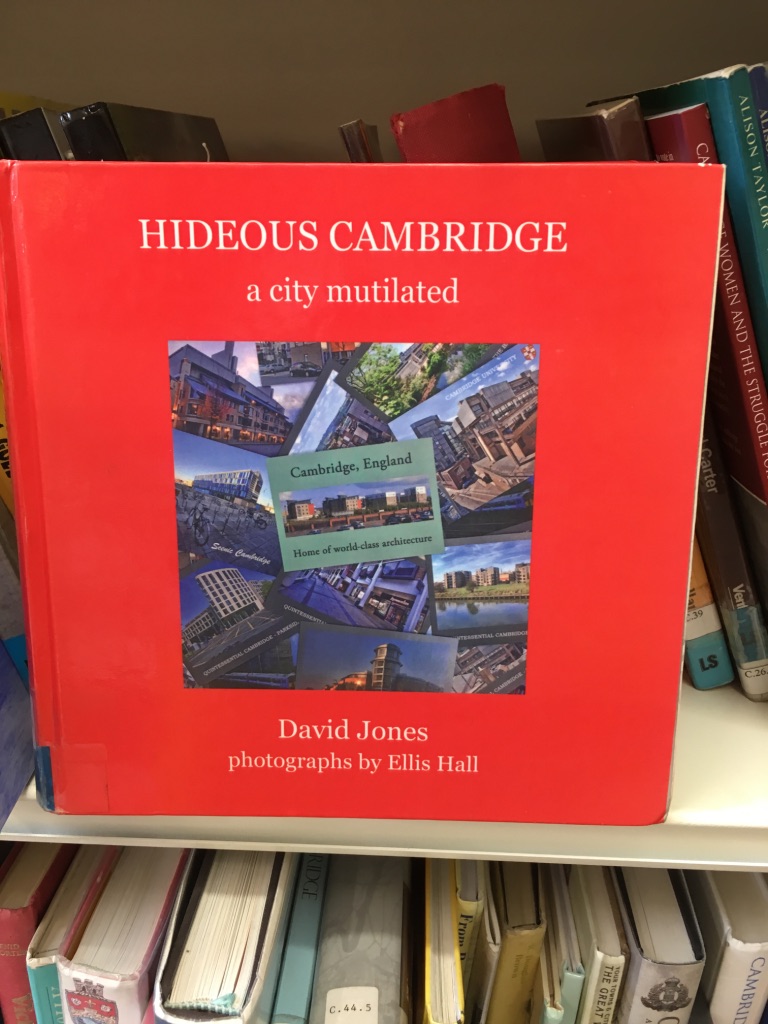
And if you’ve not read Hideous Cambridge you can find it in Cambridgeshire’s public libraries.
Workshops and part-time courses are not easy to find for complete beginners on all of the above, so it’s something that you may want to ask your local councillor to lobby the Combined Authority on, only their lifelong learning programmes don’t seem to cover what might me some very popular courses in the current age. It puts my submission for an Open Cambridge event into a different perspective – something that at a very broad level simply informs the visiting public of what is being proposed and where.
School projects, further education extended projects, and undergraduate theses
Many of you will be familiar about my continued blogposts on this.
- How might we go about commissioning new learning materials for schools and colleges on the future of Cambridge and Cambridgeshire?
- How might we go about commissioning such materials for basic skills courses for adult learners?
- How might we go about educating the teachers many of whom don’t live within the city because of the housing crisis, and some of whom live over county boundaries?
- How do we make it easier for teachers to incorporate the essentials into their annual schemes of work? In particular informing them of local museums that tell the history of city and county?
- How do we inspire younger generations to choose local history or contemporary local issues as subjects to research, and present back to their local communities?
Do we need to reinvent the wheel or are there already community structures, gatherings, and meetings in place where these issues can be unpicked?
If change is inevitable, what things are we happy to encourage and under what conditions? What things would we like to see limited and to what extent? What are our red lines – ‘Thus far and no further’? Again, these will be different for all of us. What is the process for coming to collective decisions? InvolveUK has a host of community action methods you can experiment with. Some might involve co-operation with university research students.
Trust in political institutions and politicians
Ipsos Mori has been running a long term research study on this.
“The 25th edition reveals a significant decrease in public trust in politicians, with trust falling to levels last seen after the expenses crisis of 2009.”
Ipsos Veracity Index 2022
Question to put to ministers: Given the impact of the Greater Cambridge Partnership on trust not just in politicians but in governance processes, how will this new policy *improve trust* between people and decision-makers?
Ultimately, I hope whatever we come up with is something that people find helpful when it comes to scrutinising the candidates and parties that stand in the looming general election.
Food for thought?
If you are interested in the longer term future of Cambridge, and on what happens at the local democracy meetings where decisions are made, feel free to:
- Follow me on Twitter
- Like my Facebook page
- Consider a small donation to help fund my continued research and reporting on local democracy in and around Cambridge.

 The Cambridge Town Owl