Furthermore, they should incorporate suitable learning materials from citizenship courses designed for schools, tailored for lifelong learning audience into their basic maths and english courses. (Image = cover of How to be a global citizen)
TL/DR? The Combined Authority has a meeting of its Education & Skills Committee on 04 Sept 2023. As I already have a PQ lined up for this meeting, I’d be grateful if someone who is genuinely interested in learning more about how we are governed could table a PQ to the Committee asking them to consider commissioning democracy workshops, short courses, and/or evening class GCSE Citizenship as part of their lifelong learning offer in Cambridgeshire & Peterborough. (See here on asking a PQ – you can ask the CPCA to read it out on your behalf if you cannot make it to Huntingdon where the meeting is)
I’ve written previously about citizenship and democracy:
- Citizen engagement with political power – democracy education
- “A city-wide sequenced programme of citizenship and civic action for secondary schools”
- Pilot democracy & citizenship workshops in South Cambridge
…So I’m not going to cover old ground.
This blogpost stems from my recent purchase of the 2023 edition of Jenny Wales’ excellent GCSE Citizenship book.
You can buy the book from independent retailers online on Hive
The chapters speak volumes on setting strong foundations *before* getting into the existence of political institutions. It starts with where the children and teenagers are: The communities where they live.


“Haven’t previous generations been here before?”
We have. Here’s former Cambridge student John Howard Bertram Masterman – later Bishop of Plymouth, writing in 1920.
“An uneducated people is in constant danger of being deluded by false ideals. It will respond to the appeal of self-interest, and judge political questions from the standpoint of the present, rather than from their larger aspect. In a word, it will lack imagination, and will prefer the astuteness of the noisy demagogue to the far-sighted wisdom of the true statesman.“
Democracy and Adult Education, Masterman, J. In Essays on Adult Education St John Parry, R (1920) Cambridge University Press – See Masterman’s essay which I’ve transcribed here.
In 1932, C.S.S. Higham published The Good Citizen – an Introduction to Civics. What’s striking about his guide is the incorporation of the League of Nations in citizenship. Interestingly, he starts with taxes!


WE have all heard about Rates and Taxes, and know how unpopular they are. People seldom pay them willingly, for they do not realise what they get in return. Yet we do receive many services for this money, though we are so used to them that they often escape our notice. This book will try to describe a few of these many services, so that we may understand how our money is spent.
CSS Higham (1932) p11.
Fast forward to the end of the Second World War and we have Sir Richard Livingstone (VC of Oxford 1944-47) writing the following in a foreword for a pamphlet on citizen centres adult education.
Opportunities for systematic adult study are needed on a wide scale, and these must not be limited to lectures or classes given in any hall or schoolroom that happens to be available. They must have a “local habitation ”’, a focus in the Latin sense of the word, a hearth where the fire remains continually lit, and where education can be more than isolated individual study and becomes a life shared with others.
Sir Richard Livingstone (1944)
In the introduction of the pamphlet itself, there is this striking note.
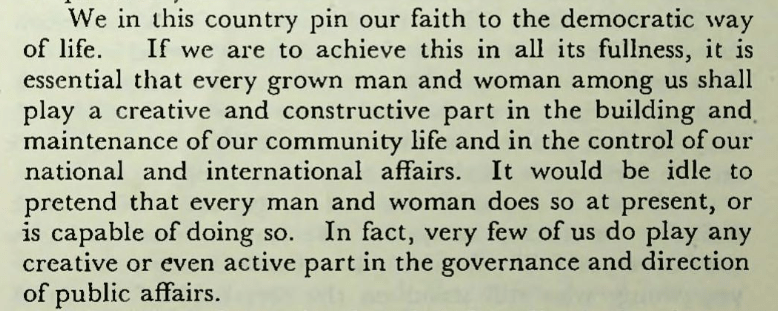
How many of us play any creative of active part in the governance and direction of public affairs? How many of us have felt frozen out or blocked by institutions despite attempts to engage? [Welcome to my world!]
The drive to improve lifelong learning – and with it democracy education, has a long history.
Yet somehow we seem to have neglected it. Until fairly recently and only then the target audience has been children and younger teenagers. Yet going through the GCSE textbook written by Jenny Wales (2023 version), we from the contents that it covers local government and even makes a brief mention of mayors of combined authorities. In fact, it covers local government before it covers Whitehall and Westminster!
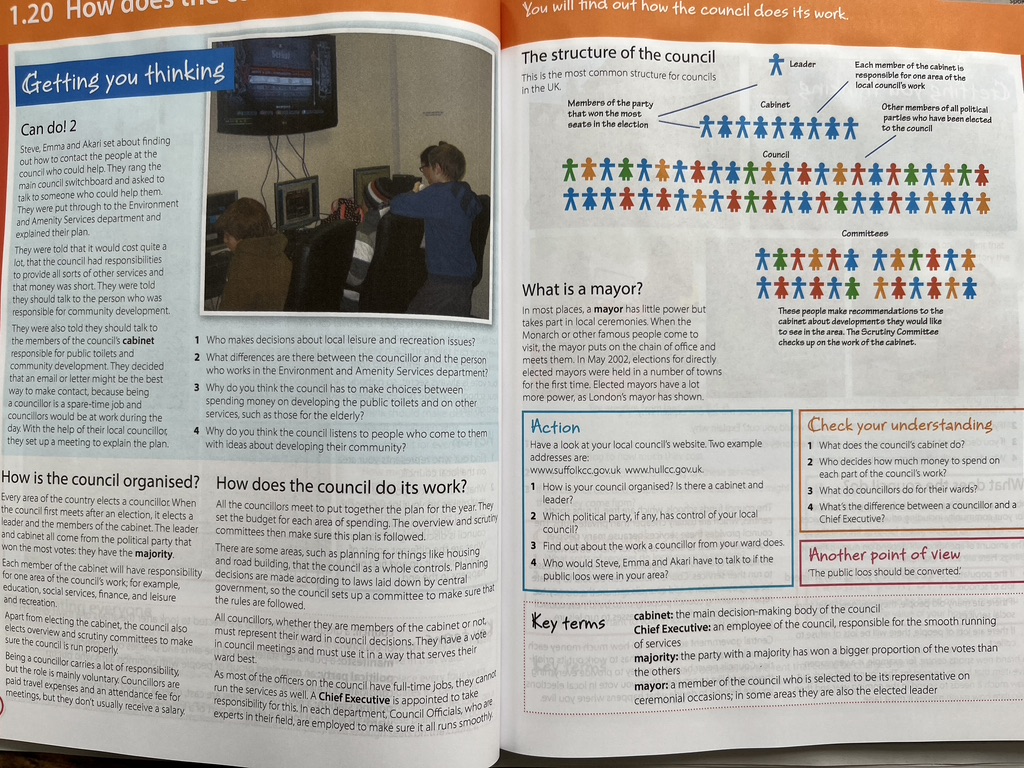
Above – Citizenship by Jenny Wales (2023) Collins pp46-47
The book even covers the aftermath of the EU Referendum – far better than what contemporary politicians and current affairs programmes are doing today!
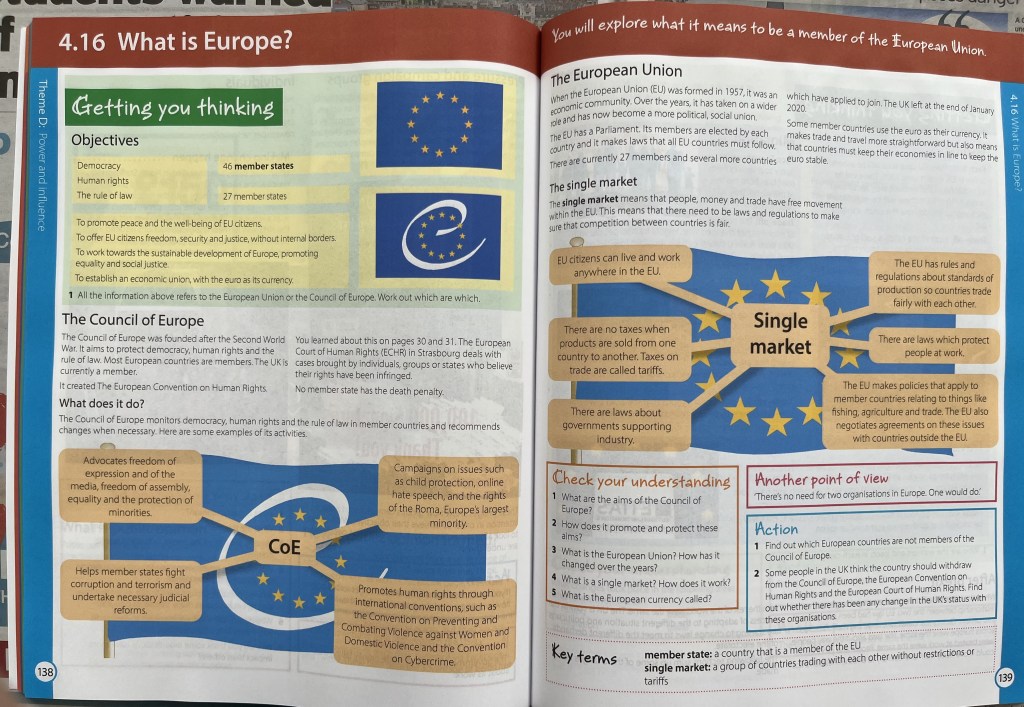
Above – Citizenship by Jenny Wales (2023) Collins pp138-139
Note that the book is for a two year course – which is why it might feel quite intense just looking at the contents pages. That said, the framework is there. On top of that, there is membership of the Association for Citizenship Teaching, and the additional resources. that they have.
Much as I’d like to run democracy workshops, I don’t have the mental capacity to organise them. Furthermore, there’s only so much one person can do. We should not rely on unpaid volunteers to teach society how our democracy functions. Nor should we rely on volunteers to fill the gaps in our collective education that were the result of previous policy failures from governments of previous generations.
Given the changes in social and cultural attitudes over the decades – ones that continue to evolve, there’s something to be said for what the previous generations wrote. Can we heed their warnings and start improving & strengthening our democracy from within our communities now, rather than waiting for Westminster to do something?
Food for thought?
If you are interested in the longer term future of Cambridge, and on what happens at the local democracy meetings where decisions are made, feel free to:
- Follow me on Twitter
- Like my Facebook page
- Consider a small donation to help fund my continued research and reporting on local democracy in and around Cambridge.

 The Cambridge Town Owl