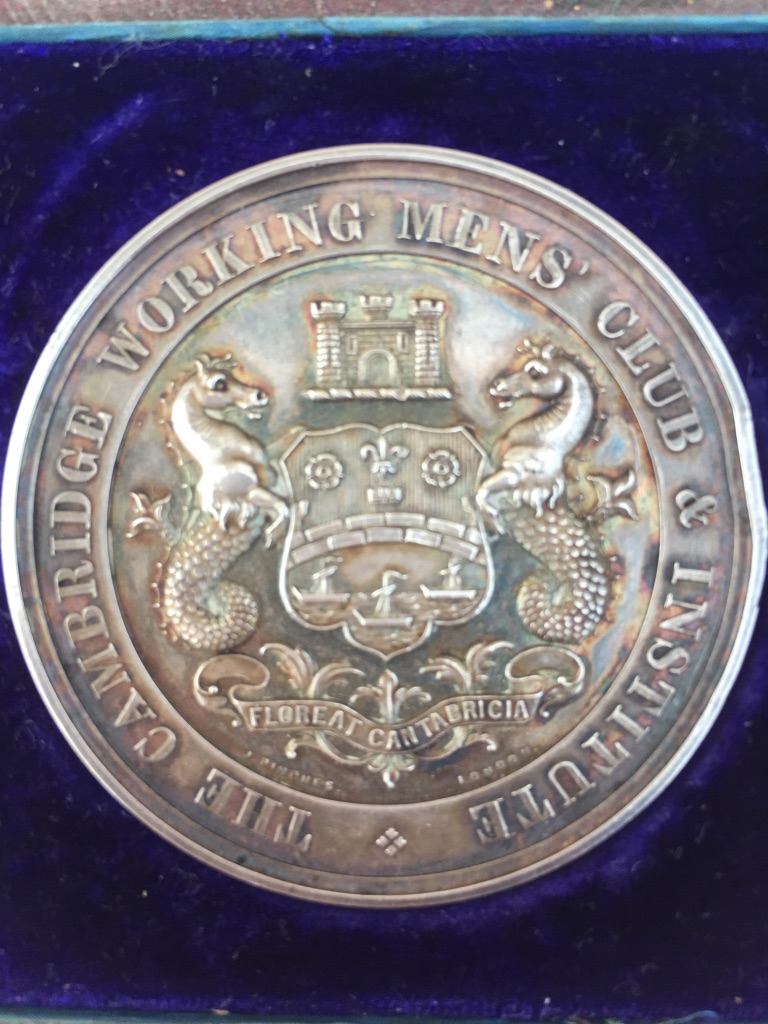
Cambridge City Council’s Citizenlab website (where council consultations are hosted) has just announced proposals for a North Cambridge Design Code for new and revamped buildings. But doesn’t the council need to ensure more residents know the essentials about how our city functions – and our place within it as individuals and collectively, in order to get the best out of such consultation?
What I’m going to moan about discuss in this piece is the proposed new design code for Arbury & King’s Hedges – two of the more economically deprived wards in Cambridge. Or rather the missing introduction.
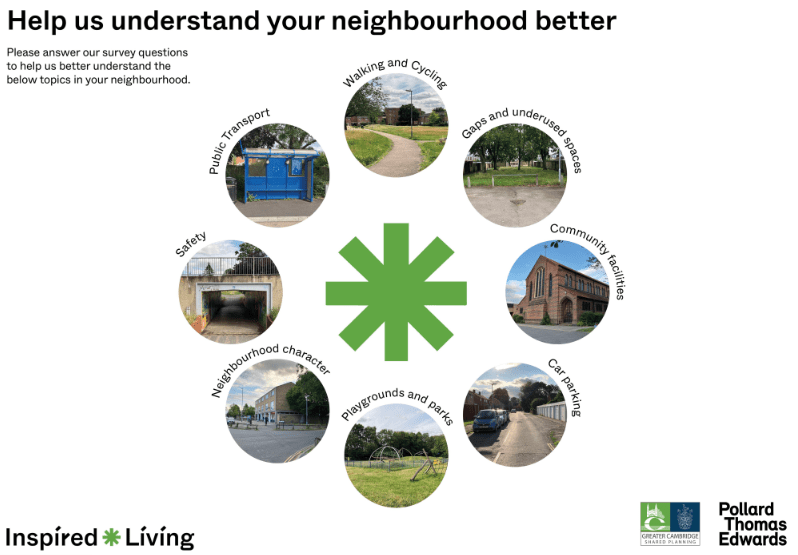
Above – from Cambridge City Council here
Which is all very well – but most people don’t live their lives by local authority ward boundaries (See Cambridge’s current ward boundaries here), If councils and public sector organisations assume that they do, the world of disinformation can have alarming consequences as Liverpool found out the hard way recently. Which is why democracy and citizenship are ever so important principles to embed within anywhere where groups of people live. It’s also why the study of local history is so important – and at the moment under-appreciated. Want to know the essentials about Arbury’s history? Have a look at https://www.arbury-cambridge.com/ or pop into either Arbury Court Library or the Cambridgeshire Collection in the Central Library and ask the staff there about the history of Arbury and King’s Hedges.
“So…what should the council be doing that they don’t have the budget for?”
Good question. But before we go there, we need to ask: “What?” and ‘Why?” Several times.
“What is a design code?”
“Design codes are illustrated documents that are informative and inspiring, providing design requirements that guide the physical development of their neighbourhoods.”
Cambridge Citizenlab 04 Aug 2023
“Why do we need a design code?”
Because Michael Gove said so. In his speech last month that got everyone talking about Cambridge, he also mentioned creating a new Quango (Quasi-Autonomous Non-Governmental Organisation).
“Establishing the Office for Place in Stoke-on-Trent, a new body to lead a design revolution, ensuring beautiful new homes are built according to a simple design code supported by local people”
Gov.UK – Longterm Plan for Housing, 24 July 2024 – Statement Michael Gove
So this means that the Arbury and King’s Hedges design code work is a pilot scheme – with a view to extending it to the rest of the city because ministers are requiring it as part of central government policies.
“Why does this matter?”
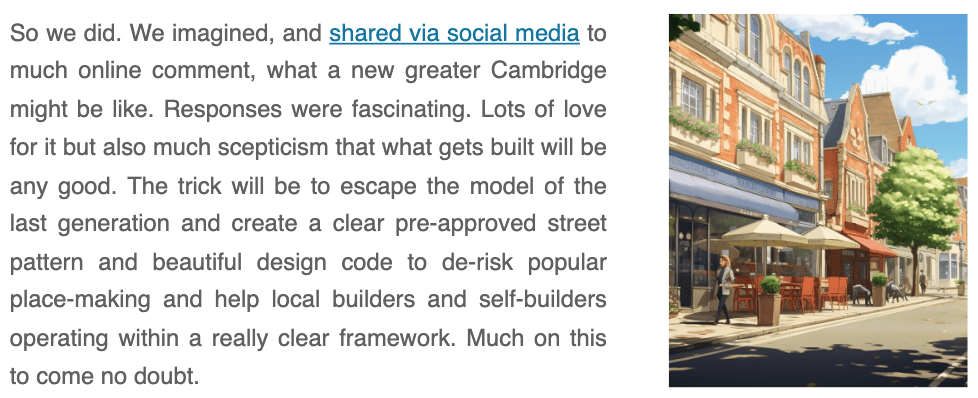
Because if we don’t produce our own design codes, someone else will – in fact some have already started. Here’s Create Streets from their newsletter. This following on from a paragraph quoting Michael Gove inviting his audience in ‘not Cambridge’ to imagine a new beautiful urban quarter ‘in Cambridge’. (Without asking the people of Cambridge to do so first. Which was nice.)
“What if we don’t want one?”
“In the absence of local design guidance, local planning authorities will be expected to defer to the National Design Guide, National Model Design Code and Manual for Streets”
National Model Design Code 2021
“So basically: “Come up with your own, or look like Poundbury“?
Something like that.
Town planning is one of the most heavily-lobbied areas of public policy – there’s ***a lot of money*** to be made from land and property deals.
Which means it’s both a very complex policy area to get your head around, and made even more complicated by the demands of lobbyists and wealthy interests trying to get concessions from ministers – for example providing ‘flexibility’ for developers on whether to provide social housing, or imposing restrictions on councils on what constitutes a valid and watertight reason for refusing planning permission – which all too easily can be overturned by a planning inspector acting under ministerial authority. All of that inevitably puts people off democracy and local government.
Start where the people are at: In their own communities.
This is something I want to re-pilot in Cambridge anyway (I tried it with a group of people in Romsey, Cambridge in the mid-2010s and it seemed to work but I did not have the capacity or capabilities to upscale it at the time) with the aim of helping people find out how their/our city functions – in order to influence future decisions made about their area. What makes today different from the past decade or so is:
- We have a local plan in place
- We have a series of very firm, large developments setting the theme of Cambridge’s economic future (i.e. sci/tech)
- The climate emergency is here
- The UK has left the EU – and is in the middle of a painful readjustment which has exposed a massive range of shortcomings in our political, legal, economic, social and environmental systems
- CV19 and the lockdowns in particular completely transformed the public’s relationship with the state – and politics. For the first time since the Three Day Week half a century ago, the public *was compelled to watch the news and familiarise themselves with current affairs*.

Above: 03 Jan 1974 in the Cambridge Independent Press: The impact of an extended strike by coal miners at a time when UK electricity was generated by the burning of coal. From the Cambridgeshire Collection’s microfiche archive.
So when it comes to the debate about energy security and ‘will the lights go out’, anyone who is over the age of 65 and who was living in the UK at the time is more than likely to have memories of that era – in the same way that in my own childhood people of that age had memories of living through – and fighting in the Second World War.
A citizenship crash course? That’s a lot to take in for just a single workshop!
Remember the aim is to provide interested residents with the essentials for them to participate meaningfully in creating a design code for their neighbourhood. I.e. it’s. nota degree in politics we’re getting them to do. That means in the space of a couple of hours we’d need to cover:
- What does the community/neighbourhood/ward look like *from the perspective. of residents*? That means starting with the individual resident standing on the doorstep of their house. How does it look, feel, and function day-to-day from that perspective?
- Where does the community/neighbourhood/ward sit within our wider city? What are. the essentials that are within easy access? What are the things that require a longer journey? What do we do when things go wrong? Where do we go to get things remedied/repaired/sorted out?
- Where does our city sit within the wider governance structures of the UK? What are the things that ‘the council’ can control? What are the things that they cannot control or do anything about? Where are the blurred lines?
- What is our relationship with our elected representatives? What do we think our relationship is? What does the law say our relationship is? What are the shortcomings? How might we improve things?
And that’s about it.
We could leave it there and say it’s up to participants to decide what they want to do next with that knowledge. (What three top lines would you want people to take away from such a workshop? (Mindful most of us forget at least 70% of the content at such events – read on the internet/had it told to me at a civil service workshop so must be true)).
“What in the world makes you think people would want to spend a Saturday morning or a Sunday afternoon discussing local politics?”
Cake.
“Cake?”
Yep. Cake. Free cake. Offer free cake. It normally works.
(There is a much more serious issue about childcare and creche facilities if you want parents to go along. That or at least undertaking local residential research on the things that put off people from participating – things that will vary in magnitude depending on the make up of your neighbourhood).
There are alternatives
These include but are not limited to:
- Video guides – See Cambridge City Council’s youtube channel and within that their playlists. I’m not going to over-state the impact that the present set of videos have – or those on my own channel. The data tells us we’re lucky to get viewing figures into triple figures. Such low take-up is not the stuff that transforms communities, let alone cities.
- Reading lists – For the design code pilot, one of the things on any reading list should be the National Model Design Code simply because it demonstrates to the reader the sorts of things to look out for in their own one, and also manages their expectations in terms of output (the document) and outcomes (whether it results in any noticeable improvements in new buildings, streetscapes, and local urban design generally).
- Informal discussion groups – North Cambridge has a completely revamped community centre – The Meadows Community Centre has re-opened! <<– Click here and scroll down to see the timetables of groups that are already using it! (Other community centres owned by the council are also available). Could regular weekly/fortnightly/monthly discussion groups be established that focus on the future of Cambridge and where the local community around each community centre fits in with it (and vice-versa) be established? If so by whom? Are there any established community groups that could help organise these? (See https://www.cambridgecvs.org.uk/).
- Formal, structured programmes and courses as part of the adult education offer for residents, funded by the Combined Authority or other institution?
On the last point, in the run up to, and following the introduction of Universal Equal Suffrage in 1928 (equal votes for men and women), there was a surge of interest in educating the population to be good citizens – such as Arthur Greenwood’s Education of the Citizen in 1920 (digitised here) – which still reads well today (and is available in reprint). One from 1932 by C.S.S. Higham digitised here very much separates local government from national government.
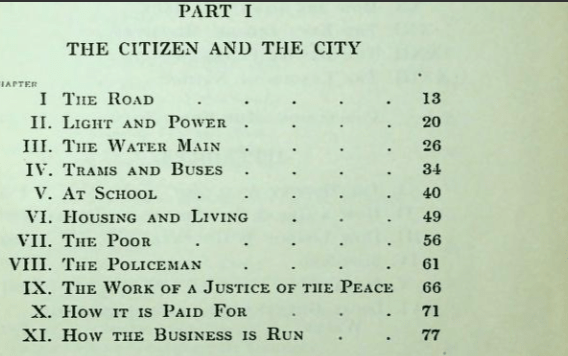
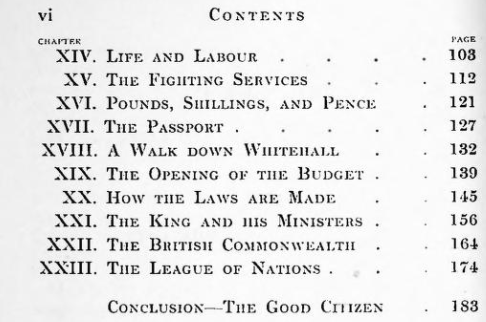
Above – An introduction to civics by C.S.S. Higham (1932) – what’s different about ‘the city’ compared with what we’re familiar with today?
Compare the above with the chapters in Jenny Wales’ most recent course book on GCSE Citizenship (2023) that many of our city’s teenagers will be learning about. (There are much cheaper, slightly older versions of course books and shorter revision guides going for under a fiver on ABE Books)

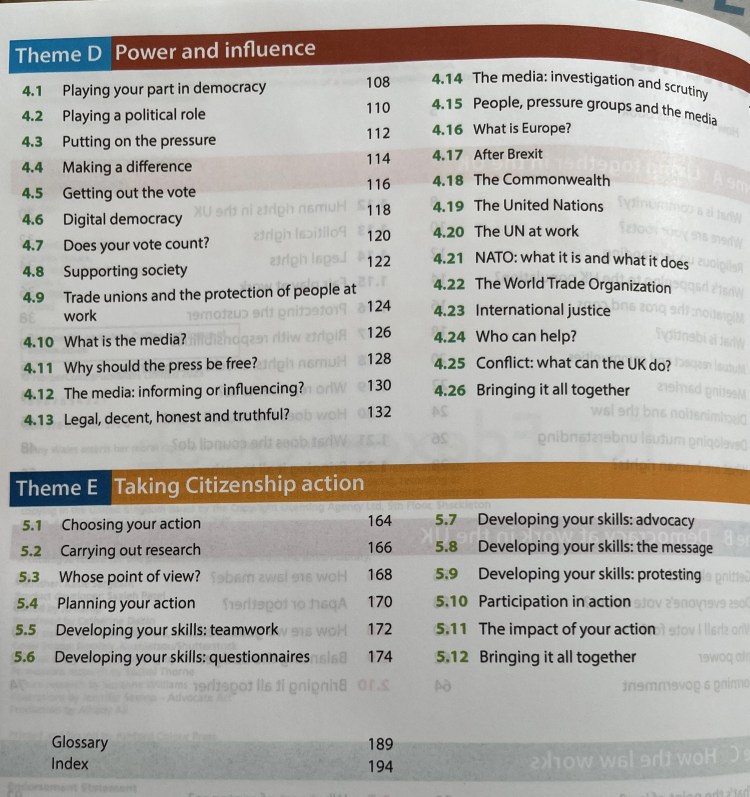
Above – would you be willing to take a citizenship course for adults similar to the ones that our city’s teenagers might be taking?
- Yes – and I’d take the GCSE exam too!
- Yes – but I don’t want to take the exam
- Maybe – if the course was for a term rather than a year or two – and didn’t involve any marking
- No
At present there are no local evening classes that cover citizenship and democracy other than those aimed at people applying for citizenship via [the very Politically-loaded] ‘Life in the UK’ tests. I’ve not seen anything that helps residents learn about how our city functions. (At least in the olden days there were annual directories that covered the essentials of who was responsible for what – see the Blue Book Directory of Cambridge from 1937 here)
Is this something we could change? Is this something we should change? What positive difference might this make for our city and county?
Food for thought?
If you are interested in the longer term future of Cambridge, and on what happens at the local democracy meetings where decisions are made, feel free to:
- Follow me on Twitter
- Like my Facebook page
- Consider a small donation to help fund my continued research and reporting on local democracy in and around Cambridge.

 The Cambridge Town Owl