
…with the big stick of ‘If we do nothing, Michael Gove gets to turn Cambridge into a theme park where on the outside you have pastiche buildings and on the inside you have sci-tech things only, making money for developers but where no water flows out of the taps.’
Sounds reasonable?
Actually, I was writing up some more ideas at 3am (It happens) and was thinking about what success might be like, and all of the things that could possibly go wrong – including everyone ignoring everything because…exactly.
Cambridge Resilience Web
First things first, take a look at what is already happening, and what people are already doing in and around our city.
I don’t need to re-invent the wheel. Cambridge Resilience Web have already mapped our city’s activist scene. <<– Have a browse. Note the list view and the map view – the latter putting the various groups into clusters based on shared interests amongst other things.
Now, I summarised a collective aim/outcome/what success looks like as:
“An actively-engaged & democratically-knowledgeable society that makes our city greater than the sum of our parts”
I also wrote down what the above ***does not*** mean:
- Everyone has to know everything about politics
- Everyone has to go to boring meetings
- Compulsory democracy classes like at school but worse
- Everyone will be indoctrinated in democracy and citizenship like it’s a religious/political cult
- Dissent will be stamped on
- Involvement is compulsory!!!
Above – what my ideas want to avoid!!!
That means we accept:
- This *includes everyone* (i.e. whatever happens to the future of Cambridge, everyone is going to be affected somehow – even if everyone ‘does nothing’. In public policy world, do nothing is always an option, but it is not one without its own consequences – as the UK found to its cost in the 1930s when it could have stopped the rise of fascism).
- Including everyone does not mean everyone has to be involved at the same time – and especially not on the things that they really don’t want to participate in. Again, think back to school and your learning when you were in a class with people who really did not want to be there – to the extent that your own learning got disrupted. That’s a scenario I want to avoid too.
- Instead I’d rather have a series of actions and events that inspire people to get involved. Furthermore this means we identify and take on barriers to involvement – which could range from:
- Timing of events
- Costs of participation
- Childcare facilities / caring cover
- Access to the internet
- Knowledge of how to use specific programmes/software packages
- Public transport / transportation to venues
- Things not advertised in places where target audiences eg under-represented groups can see them
- Untrained facilitators struggling to deal with a disruptive person/people
Extinction rebellion’s early workshops in Cambridge in the late 2010s demonstrated brilliantly what well-run and well-facilitated workshops are like. Can we apply that learning from five years ago to today?
Helping the people of Cambridge understand how our city functions and malfunctions
I covered it in my previous blogpost outlining what. a2 hour workshop might be like. Furthermore I also noted how the context had changed dramatically including the shared experience of the lockdowns (where *everyone* had to pay attention to ‘the news’ lest they broke the new lockdown laws and found themselves prosecuted as a result – as some did!)
How do we ensure town, gown, and surrounding villages are covered?
I repeatedly make the case that the people of Cambridge include residents, students, commuters, and regular visitors. It’s not just those that live within our municipal boundaries that were last changed in 1935. And they are going to need to change soon because of the large housing developments happening on the edge of our city. It makes no administrative sense to have Orchard Park and the eastern edge of Cherry Hinton sitting outside Cambridge City Council’s boundaries when geographically they are incorporated into the city. (i.e. Having people living on the eastern edge of our city in homes built in the late 1980s having to complain to an institution located 10 miles west of the city with no direct public transport from Cherry Hinton (i.e. South Cambridgeshire District Council) when a simple redrawing of the lines would change this to the city council. Not that they have. the resources either, looking at the state of the Guildhall. (One local bookseller complained to me about the lack of civic pride that the underfunding of local councils reflects).
“So…we have these 2 hour workshops. Then what?”
Hang on – take a step back. As mentioned in my previous blogpost, those workshops need to cover some of the essentials – and that means people being able find out for themselves through interactive exercises and multiple conversations what our city looks like from their perspectives. This is the opposite a course that say introduces politics and starts with Westminster. Or introduces local government and starts at the guildhall.
One of the reasons why I’ve been recommending buying a GCSE Citizenship course book to adults (whether a 2023 version such as the snapshot from Jenny Wales’s book below, or an older version at a as little as a tenth of the price)

Above: from Citizenship Today (2023) by Jenny Wales published by Collins
The ****big barrier**** I have to trying to develop the ideas from the above into anything like a course or series of cumulative workshops beyond the basics is that the teacher’s guide costs £170 and is only available to order through institutions. Which excludes me several times over. (It’s the photo-copyable worksheets that are particularly useful).
The essentials delivered by different community groups in Cambridge, each delivering it through the lens of their own group’s interests.
Back to Cambridge Resilience Web again – have a browse through their list of groups, collectives, and organisations. Although the themes may be the same, how I might tailor a workshop will be different for each group. Ditto my level of involvement which might range from organising and running it (which would burn me out at the same time!) at one end, to inviting an organisation to run one, providing them with basic materials, and leaving them to get on with it. Unlike in times gone by, I no longer feel the need (let alone have the health capacity) to be involved in the opening of every front door or filming the opening of every civic envelope! Furthermore, the variety of issues that may come up will inevitably be different. For example.
- Abbey People in Abbey Ward, Cambridge. Their context? One of the most economically deprived wards in both Cambridge *and* Cambridgeshire. Furthermore, they are going through a long-awaited revamp of their ward’s community facilities. On top of that, they have to cope with both the ongoing Marleigh development and now the Marshall’s relocation which means the long-awaited redevelopment planning of the airport now begins. All of those will significantly impact the lives of the residents there.
- Eddington Residents’ Association. Whatever our views on the architecture and urban design, people have now moved in and are trying to make things work. The challenges they face as a very new community whose residents are attached to the University of Cambridge one way or another brings its own challenges.
- Friends of the River Cam. Given our very prominent water supply crisis, and the sewage discharge scandals, they are one of the first to spot the pollution of our waterways. Interests of their members as a community of interest as well as geography may well involve greater scrutiny of institutions and the legal / financial powers and responsibilities they have, compared with other groups
- Living Streets Cambridge – formerly the Pedestrians’ Association. Founded in the inter-war era and prominent nationally in response to the high injury and fatality rates from motoring incidents, this community of shared interest (which could do with some more people getting involved!) may have a lot to input into conversations about urban design of new communities, and retrofitting of existing communities in the face of the climate emergency. Which again may mean discussions lean towards scrutinising institutions.
Once those workshops are up and running, and we start getting feedback or people get going with their own actions (I don’t feel the desire to micromanage anything!) we can look at specific things raised in more depth. I’ve used the “Must/Want/Would like” framework from the civil service that I learnt in my old policy days.
“What *must* people know?”
It’s one of the reasons I’ve taken guidance from the most recent set of GCSE citizenship books because – as the contents of Jenny Wales’s book show (that’s only the first half – there are more over the page!) those editions will have evaluated and reflected in the previous decade or two’s worth of citizenship courses and changes in government policy. At the same time, there should be enough flexibility in an essentials workshop to cover
- What a community looks like from the perspective of participants
- What local public services look like from the perspective of participants – and how to go about talking to them / complaining / praising / holding them accountable
- What Westminster and The Government look like from the perspective of participants – and how to engage with public policy and go beyond simply ‘having your say’ when. itsuits ministers.
- Actions following the workshop: What is the one small behaviour change or the one small one-off action each person is willing to commit to as a result of participation? It could range from:
- Meeting up later with a group of people you met at the workshop for the first time
- Buying a new/second hand book introducing you to a specific topic
- Subscribing to a publication (local newspaper or specialist magazine) so as to stay in touch with what’s happening in your locality or within a specific policy area
The actions don’t have to be major and certainly don’t want to be massive commitments that either put people off or risk activist burnout. (Re the latter, welcome to my world!)
From general issues to specialist – where different groups can focus in on the detail
Using the civil service model mentioned earlier, I took the ‘draw your city’ exercise and teased it out into more detail.

Above – scribbled at long past 2am last night.
The ‘draw your city’ exercise enables people to identify what is within their city. In this case I’ve focused on city functions. It doesn’t have to. It can focus on geography or environmental features. In this example, there is enough demand from people for a session. on how a city functions. Because at secondary school in the 1990s we weren’t really taught this from a local perspective. Certainly not for us 1990s children if it involved anything remotely to do with politics! Therefore there is a huge public interest to help that generation (i.e. my generation) to learn about the stuff we were not taught at school but perhaps should have been!
Following the exploration of city functions, this example then looks at a specific function that is in the public eye regularly: The provision of health services.
In the third column under (‘would like to have’) because this is the next tier of detail, the model looks at the more detailed functions and provisions of healthcare services – and the issues relating to them. Note this assumes that:
- People will be familiar with the essentials of where healthcare fits within central government and democratic accountability in the first workshop
- People will be familiar with healthcare as one of the essential civic functions – with any workshop on city functions covering some of the essential histories how we ended up with hospitals, pharmacies, and doctors surgeries.
In the third tier, people are then in a position to explore in more detail the lines of accountability, the legal framework they are set within, and how as citizens they can make use of those systems (as well as learning about the limitations – such as explained in the case study of Dentists in Cambridgeshire by Healthwatch Cambs)
Over time, we can build up a huge volume of collective knowledge of how our city functions. And thus get somewhere to achieving the aim at the top.
Does it sound original and radical? Splendid! Because it isn’t.
Someone got there first. Over a hundred years ago.It was the National Adult School Union Movement which introduced me to the concept of a national scheme of work / curriculum of civics, citizenship, and democracy learning. It peaked in the early interwar period as Mark Freeman explains in his 2018 thesis here, before starting a slow decline – a victim perhaps of its failure to adapt to a society less deferential to established institutions and in particular to institutionalised religion. Hence why their handbooks from the past sometimes read as archaic to the 21st Century reader who may not be familiar with the religious references and articles interspersed throughout the books.

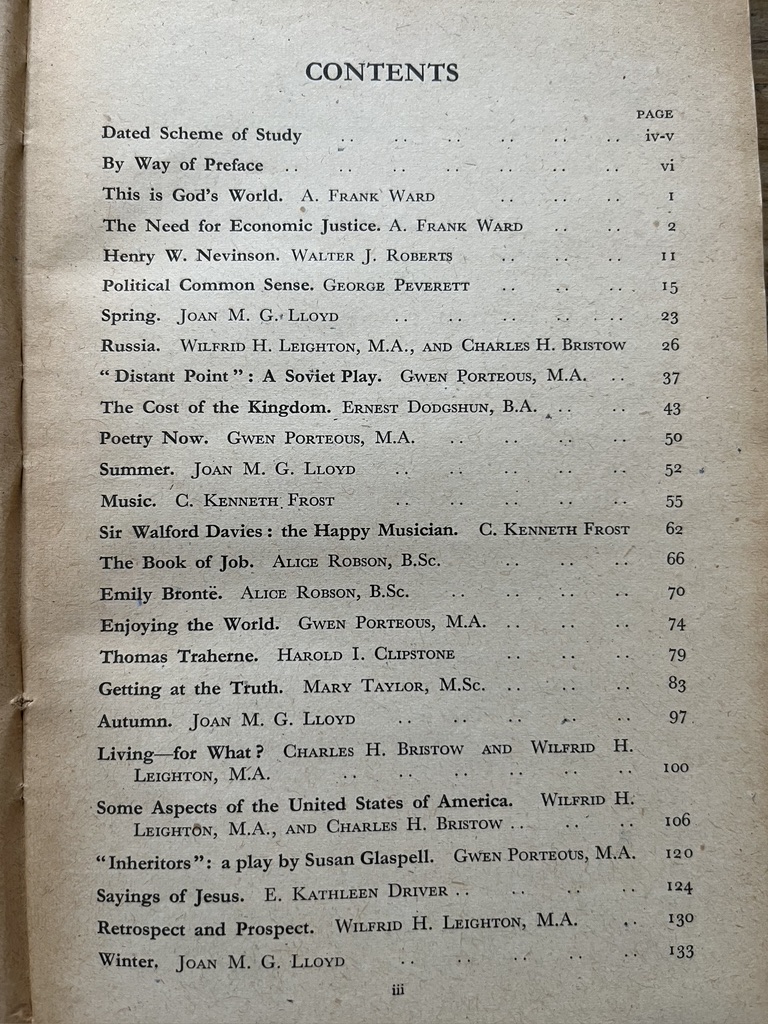
Above – this arrived recently (I’ll digitise it soon!) – Imagine doing evening classes in war time
Below: A proposed schedule for learners. Note this was at a time of no television or internet. Furthermore, in the opening classes, note the religious framing of political issues.. Furthermore, note the context of thinking about life after another major war. What would you be feeling having lost friends in action, as well as having friends who had lost parents in the previous world war a generation before? What would you be feeling towards the political establishment of the day?
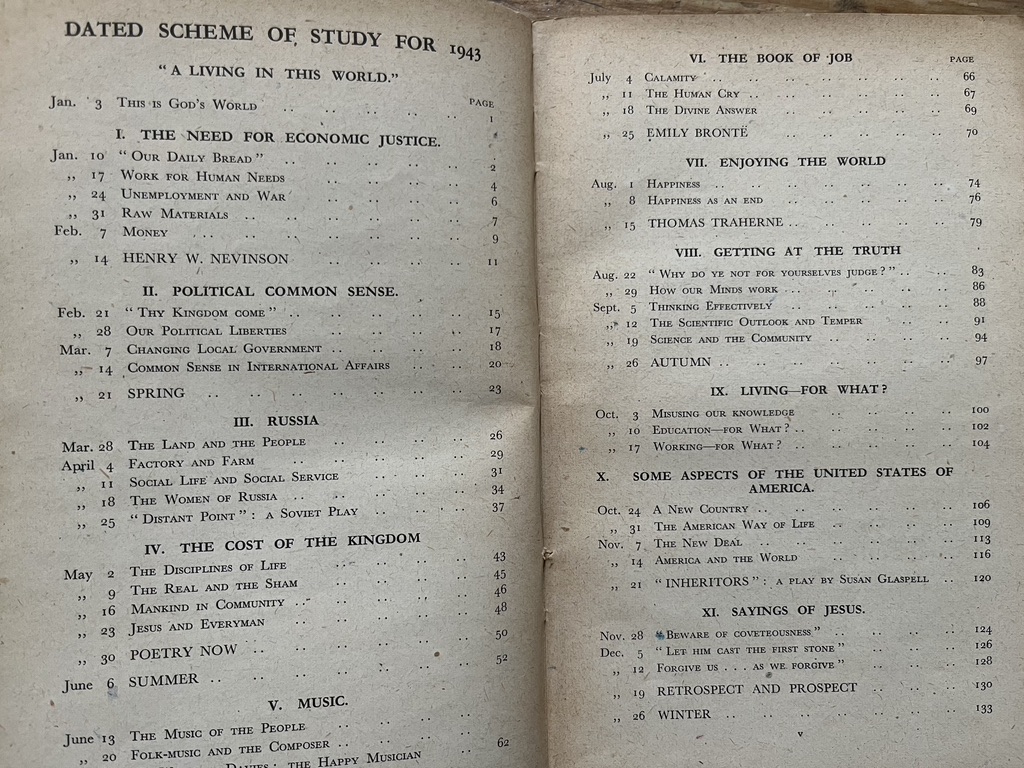
Above – Living in this world, by the Adult School Union, 1943
And yet…they were still willing to scrutinise local government, and debate its overhaul!
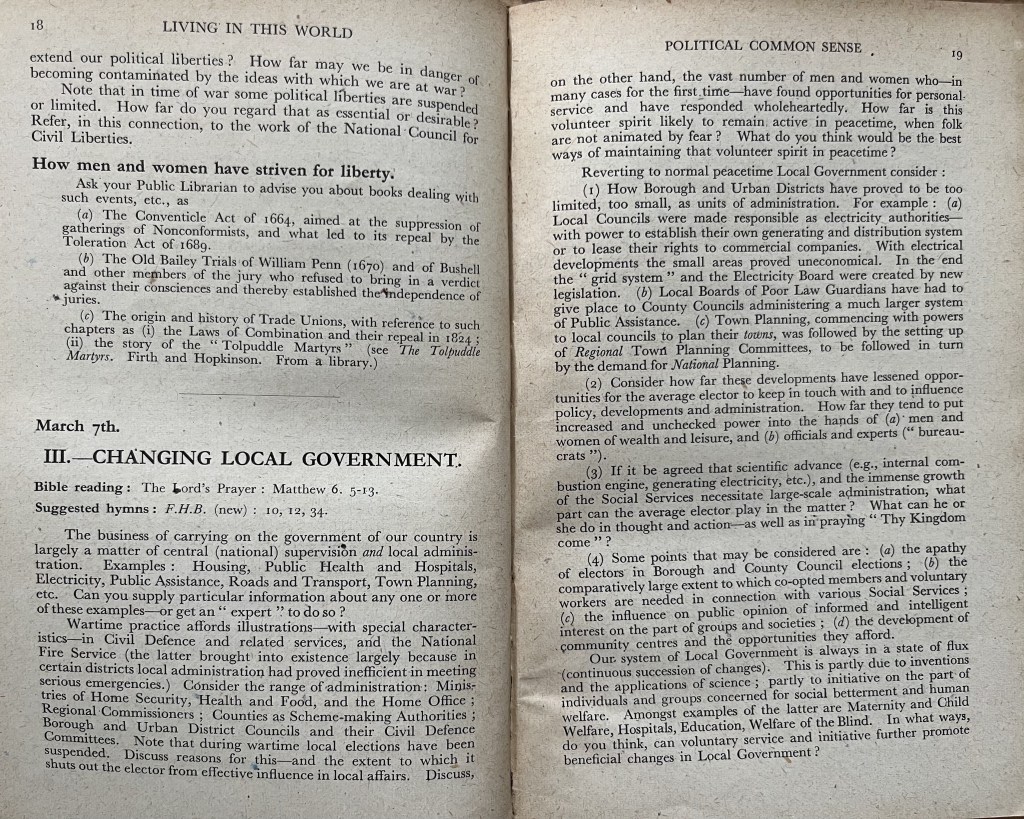
Above – Living in this world, by the Adult School Union, 1943 pp18-19.
In Cambridge and surrounding districts, the size of councils were a serious issue. Was Cambridgeshire County Council too small? (i.e. the pink-shaded area, which we ended up keeping until the early 1960s). Did it make sense to have three under-funded rural districts surrounding Cambridge? (In the end South Cambridgeshire District Council that we know today was formed out of the old South Cambs Rural District, and the old Chesterton Rural District)

Above – you can browse through the maps here, showing a history of how our city and county boundaries changed from the early 1800s to the late 1950s.
Is the debate about overhauling local government new?
No – and this isn’t the first time that long term austerity has brought the sector close to breaking point. The Commission on Local Democracy published its recommendations in 1995 (you can browse through them here by ‘borrowing’ the book online for an hour) – many of which will sound painfully familiar to followers of local government today.
One of the reasons why the next couple of years could be so significant for our city is not just because of the looming general election. It is because of the collective experience of the pandemic (Which still isn’t over – we just hear less about it, but see the latest update here), and because of the smashing of many of the conventions that the Westminster system relied upon in order to function. And functioning it isn’t. And neither is local government. Both are malfunctioning.
There are competing visions for the future of Cambridge. Not all of them are in the best interests of our city or the environment. The minimum I hope these ideas might achieve is to encourage more people to scrutinise the proposals being put forward by others, and to speak out on the issues that matter most to them. Beyond that? That’s up to each of us to decide how much we are willing and able to do. It might feel like you’re alone with your concerns – especially on a rainy day like this and are not actively involved in any group or society. By meeting up with others nearby we might be able to get a sense of how many people have concerns and want to do something positive about the future of our city – but are not entirely sure how. I’m in a similar situation. This is my tuppence-worth’s on how we might figure out how to respond.
Food for thought?
If you are interested in the longer term future of Cambridge, and on what happens at the local democracy meetings where decisions are made, feel free to:
- Follow me on Twitter
- Like my Facebook page
- Consider a small donation to help fund my continued research and reporting on local democracy in and around Cambridge.
 The Cambridge Town Owl