
TL/DR? Broken systems of governance
You can:
- read the thread from Twitter here by the IFS
- read their report
- play with the data for Cambridgeshire and other counties in England
In Cambridgeshire, the picture is grim.
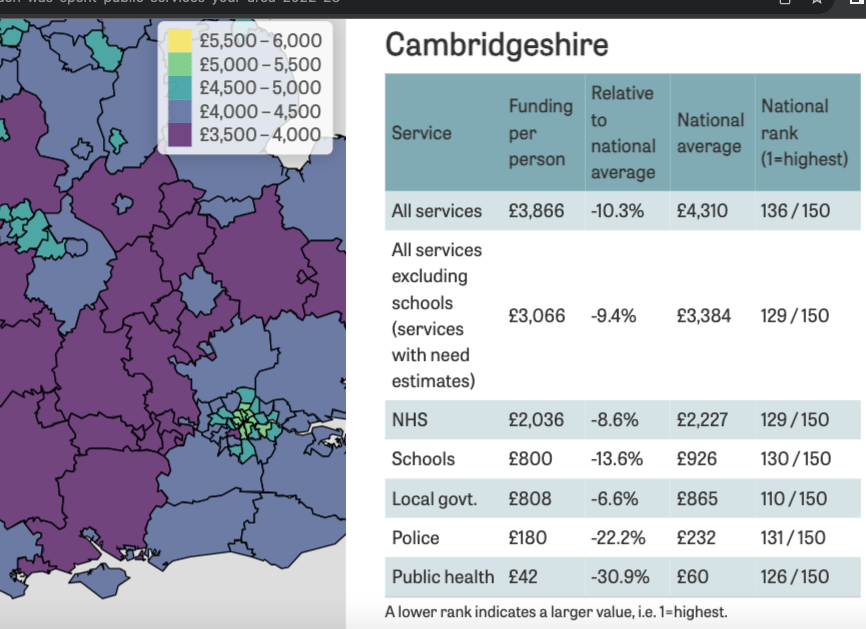
You can see us in the dark purple separated by greater London by the grey-purple patch of Hertfordshire.
Cambridgeshire is in the bottom 15% of funding for public services in the country. Which is rubbish.
“But Cambridge is full of rich and brainy people and all that investment and scientists and stuff and the GCP funding! Michael Gove said so!”
Or was it the international property sector trying to sell the city again with talk of ‘the magic of Cambridge’ without actually looking at the miserable and poorly-maintained street scenes? Or the bland and featureless new buildings that resulted in a book called Hideous Cambridge a decade ago?
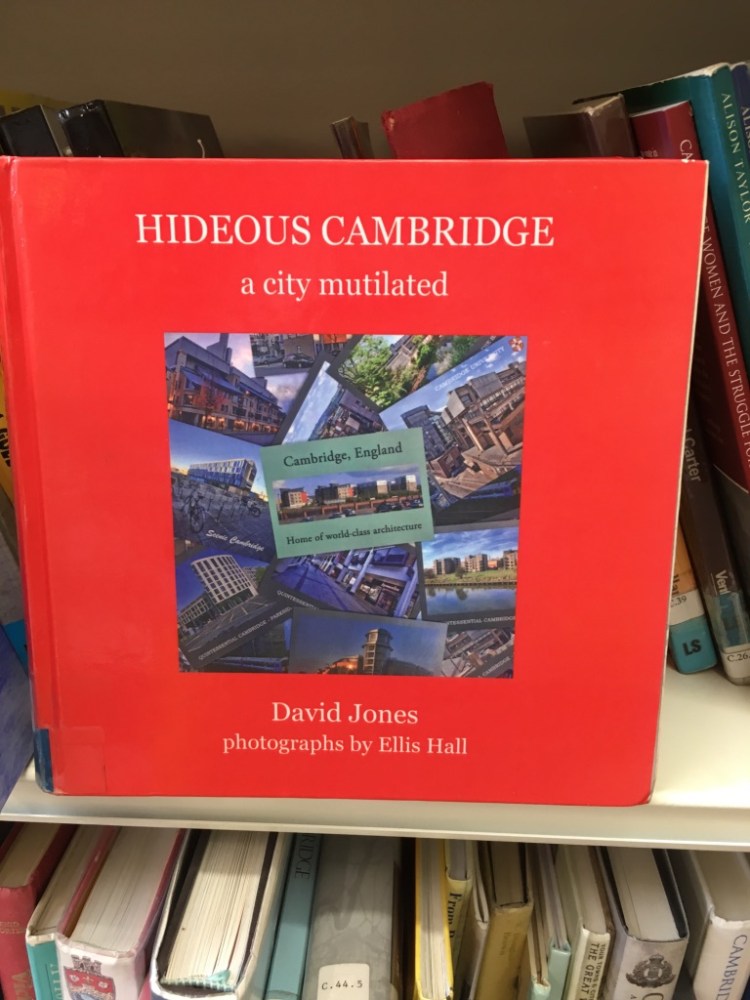
Above – Hideous Cambridge – grab it while it’s there.
Most of you are familiar with why things are the way they are.
The incompetocracy in Downing Street / CCHQ that is chugging along until the inevitable general election is more than aware that:
- council finances are unsustainable
- the system of local government needs an overhaul
- the NHS has longstanding problems that ministers are not addressing
- finding a GP/doctor or an NHS dentist is all but impossible – and yet still the houses get built
- Cambridgeshire has a water crisis meaning that the taps will run dry in the new homes and science labs unless ministers and water companies pull their fingers out.
By the time that catastrophe has arrived, those who have made their fortunes from the city will have been long gone. And most of the ministers responsible will be on the boards of some faceless corporation that most of us have never heard of – only hired for their contacts books rather than any talent or competence in running large organisations.
“The grinding poverty in which some residents in our unequal city live would be genuinely shocking to many whose prospects are rosier.”
Cllr Sam Davies MBE (Ind – Queen Edith’s) – 23 May 2023
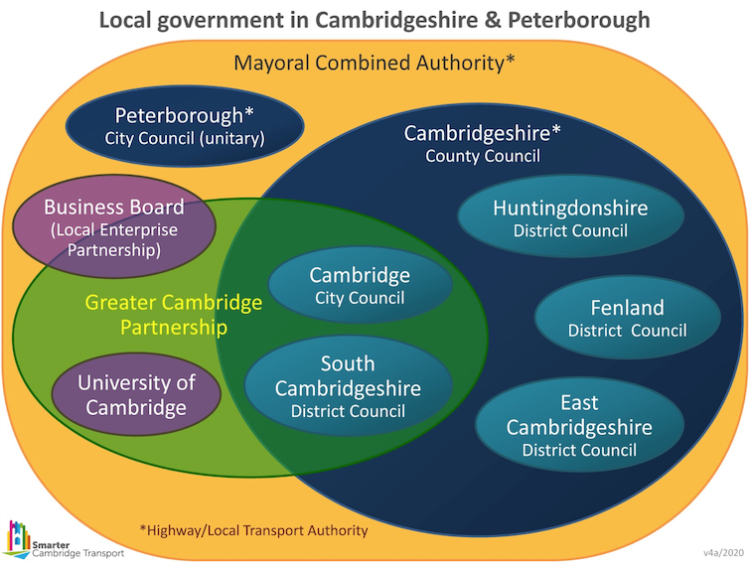
You’re more than familiar with how fragmented our decision-making structures are. We also know that Victorian-style charity isn’t working either.
“A quarter of key worker households in east of England now have children living in poverty as inflation spirals”
Cambridge Independent 16 Aug 2022
How is that sustainable? How in the world is that sustainable? How can a city function properly if its governance mechanisms do not allow it to tax the huge wealth being made here (or that we’re told is generated here) to pay for the very services needed for our city to function? And that includes the wealth-generators. If all of those key workers stopped working as they did in the general strike of 1926, we’d know about it. In fact, the first lockdown taught us the hard way of what happens when a city has to lockdown. Applause does not pay the bills.
“This is why I believe it is so important for all of the those individuals and organisations benefitting from being in Cambridge to make a really concerted effort to share the proceeds of their success.”
Cllr Sam Davies MBE (Ind – Queen Edith’s) – 23 May 2023
Part of the problem is also the global nature of the life sciences world – where short-term contracts mean that people have to move not just to other cities, but often to other countries and other continents if their contracts are not renewed. This is critiquing the structures. That might be beneficial if you’re in your 20s and are both willing and able to move. But if you want to stay and settle, that system does not work.
Furthermore, don’t think that such a system doesn’t have society-wide impacts. I’ve lost count of the number of people I’d loved to have stayed in touch with or have had part of my life over the past 20 years – people whose working contracts were not renewed and were effectively coerced into looking elsewhere. i.e. if given the choice they would have stayed.
Don’t think that doesn’t have an impact on public services – and on children who find some of their friends moving to somewhere far away because their parents got new jobs (or had to find new jobs that only existed in their specialist field in a handful of cities far away from each other). Again, it’s the lack of options to stay and settle that has the negative impacts on communities – one where the communities are unable to say to the wealthy and influential decision-makers (in particular central government/ministers, the University of Cambridge’s senior executives and college finance committees), and that the structures, systems, and processes that they’ve put in place are ones that have significant negative impacts on those lease able to deal with them. Furthermore, mitigations for those negative impacts are not being put in place by said decision-makers who, all too often seem so far removed from the communities that. are most affected.
Cambridge: An inclusive city or an exclusive city?
A question I asked back in February 2022.
Only there are people and institutions who have a very strong financial incentive to market our city as the latter, while the people who live and work here – in particular those that want to improve our city for the many, would quite like to make it a far more inclusive one.
Whichever way Cambridge goes, the decision won’t be made here. It’s be made round the Cabinet table – irrespective of which political party is in power. Which is why opposition parties need to come up with comprehensive alternatives not just for Cambridge but for our cities generally. I remain to be convinced that they have the collective imagination, competence, and drive to come up with that positive vision and then deliver on it.
Rant over.
If you are interested in the longer term future of Cambridge, and on what happens at the local democracy meetings where decisions are made, feel free to:
- Follow me on Twitter
- Like my Facebook page
- Consider a small donation to help fund my continued research and reporting on local democracy in and around Cambridge.
 The Cambridge Town Owl