
You’ve seen the headlines, but how can local government tax the one-day coach tourists? Cambridge Connect Light Rail provides part of the answer.
It was the leading headline in this week’s Cambridge Independent. See the article by Gemma Gardner here. Essentially the proposal is for a levy on visitors staying in overnight accommodation, similar to what Manchester brought in last April. (Further details are at https://manchesterabid.com/ Part of the problem with Manchester’s scheme is the Air BnB exemption that ministers are yet to table comprehensive legislation in Parliament to deal with. (See this explainer here by one of the firm’s partner organisations). In May 2023, the House of Commons Library produced this briefing on the impact of increases in AirBnB-style short term lettings. Essentially Manchester has used powers in legislation for Business Improvement Districts (powers that CambridgeBID was established under) to create an industry-wide levy within the city to pay for things that those paying the levy then vote on to benefit their sector. Hence one for visitor accommodation. (Wouldn’t it be better just to overhaul local government revenue raising powers without having such convoluted processes and work-arounds?)
The risk is that even if such a levy was miniscule – £1 per person per night, the impact from the publicity could result in more residential properties being bought up and unlawfully sub-let as permanent short-term lets. With austerity and the pathetically-small budgets for council enforcement functions, this is one of many policy areas in towns and cities where some people can behave as if the law doesn’t exist because of a lack of resources going into enforcement. See also motorists driving vehicles with unlawfully-modified engines.
For such a tourist tax to function without unwanted side-effects, ministers need to rethink their entire policy approach towards local councils – as Parliament has repeatedly called for. The playing field between very short term lets and small independent hotels needs to be rebalanced in favour of the latter – which provide jobs and more tax revenue per stay than AirBnB.
Former Mayor John Hipkin’s proposal for a tax on tourist coaches
This is one option – and inevitably this would involve building the infrastructure needed to charge for it. The best way for this would be to automate the system. At the same time, if the demand for day-trip tour coach visits to Cambridge did not change much as a result of the higher price (i.e. was ‘price inelastic), then the roads in Cambridge would still suffer from the damage of coaches, and the parking problems would remain.
There’s also the issue of exemptions – for example tour coaches *leaving Cambridge* to visit other places – and also school trips. What should the system be for those?
“The colleges can always close their gates and put up railings and so on so that the tourists can’t penetrate them. That means that tourism is basically concentrated in half a dozen streets in the city centre”
John Hipkin to The Cambridge Independent, 18 Aug 2023
One of the questions Mr Hipkin hints at is how to extend that pedestrianised part of the city centre.
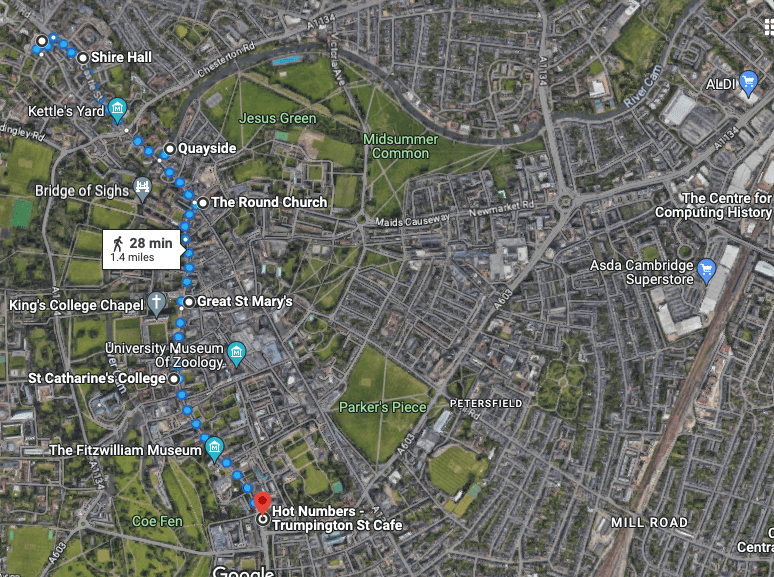
Above – a walking route from Castle Hill to The Fitzwilliam Museum and Hot Numbers Coffee

This also has an additional bonus of stopping off next to where I want a new large concert hall.
“How do you get the tourists from say the railway station up to the top of Castle Hill given there’s no bus service from there?
This is where the proposed Cambridge Connect light rail network that goes under the city centre could be amended to add an additional spur that serves Castle Hill,

Above – a concept map by Cambridge Connect / Rail Future.
A spur could go from the city centre underground to the top of Castle Hill (with the opportunity to capture the massive uplift in the land value to pay for it), heading towards The Meadows/Orchard Park, Impington Holiday Inn, and then along the guided busway route to the Science Park and Cambridge North.

Above – from G-Maps here – a concept of an additional spur to serve tourists, a new office and heritage development behind Shire Hall’s existing building, the main community centre in Arbury (one of the most economically-deprived wards in Cambridgeshire), a potential ‘park and light rail / travel hotel link’ – again that could be taxed, and then onto the existing corridor to Cambridge North.
That route also highlight the bonus of linking Trumpington to Cambridge Regional College by light rail. Given the significant number of new social and council houses already built in South Cambridge, this provides a much-needed direct, fast, reliable link to one of the largest regional providers of vocational qualifications. At the same time, it opens up a host of new job opportunities for people living in Arbury, as well as a light rail link (with one line change) to Addenbrooke’s.
Banning tourist coaches from the city and requiring them to deposit their passengers onto the light rail network
This is my preferred proposal as it provides a significant revenue generator for the light rail network. Provide ‘coach driver heaven’ facilities at each of the out-of-town coach parks, and provide discounts/free services for coach drivers dependent on the number of passengers they bring. After all, we’re told by Visit Cambridge that over 7million visitors visit the city each year, the vast majority of which are only for the day. When Cambridge University proudly announced its tourism impact on the economy, the study concerned focused on the 462,000 overnight visitors rather than the millions of day-visitors. I wrote about it here.
Even if a £1 tax on each all day travel card were imposed on those day visitors, it would still generate more in revenue from the initial ticket price alone which would help pay for the construction and maintenance of the light rail network. Nottingham’s existing tram system gives some idea of how much one day and single tickets might cost. Combine that with residential and commuter traffic, along with cycle/e-cycle-based freight facilities and the impact could be huge.
The problem is local government and combined authorities do not have the necessary powers, funding, or administrative experience and governance infrastructure to make this happen.
Therefore *if* a tourist tax is to work for Cambridge – residents, commuters, students and tourists alike, ministers will need to incorporate this into a comprehensive new vision and set of policies for local government across England. Because Cambridge isn’t the only heritage tourist honeypot facing such issues.
Food for thought?
- Follow me on Twitter
- Like my Facebook page
- Consider a small donation to help fund my continued research and reporting on local democracy in and around Cambridge.
 The Cambridge Town Owl