Before I begin, for those of you that find this interesting/useful, and are willing. &able to do so, please consider supporting my research costs via https://ko-fi.com/antonycarpen. (And thank you to those of you who do- you’ve enabled me to purchase some books for some future workshops!)
Now…town planning. (Why are there no evening classes on it – or even on politics like we used to have in the 1990s?)
Unfamiliar with how to comment? See the guidance from South Cambridgeshire District Council here
To get to the planning portal, see https://applications.greatercambridgeplanning.org/online-applications/ and type in the reference 23/03204/OUT into the simple search box. You’ll be presented with something that looks like this:
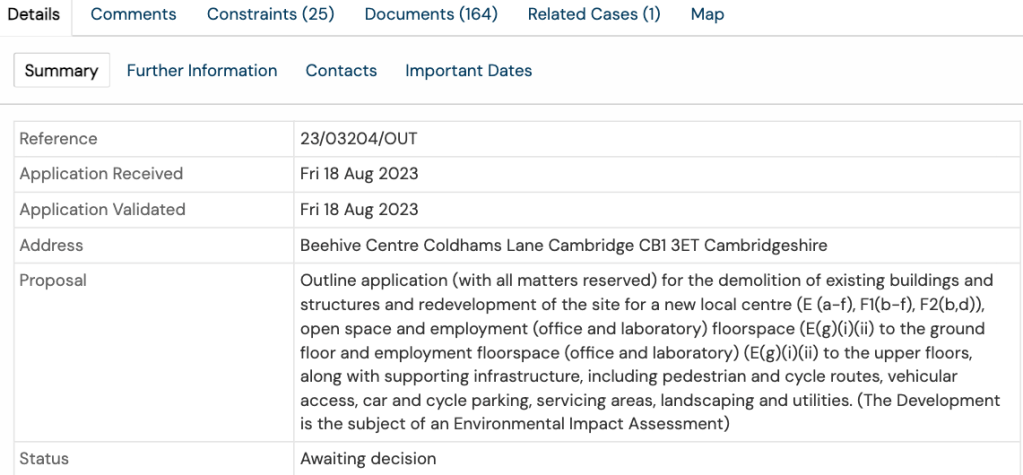
Above: Eeek!
There are 164 documents (with more possibly to be added) in this application.
Some of those documents are huge and very complex – inevitable given the size of the site and the scale of the overhaul. It will look *very different* to what is currently there. The document to look for is the Outline Planning Statement. Or in this case, the statement broken up into several chunks to make them more digestible.
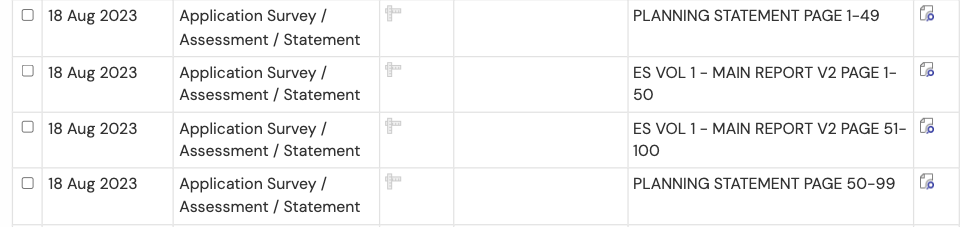
There are several documents listed as ‘planning statement’ but treat them as a single document. The first part looks like as below.
Some organised campaigns and constituted groups have already expressed concerns about the proposals.
“Consultation on proposals to redevelop the Beehive Centre, Coldhams Lane. We have reiterated our concerns of the suitability of the site for employment and preference for a mixed scheme including residential. We also object to the scale and height of the buildings and the lack of open green space.”
Cambridge Past, Present, & Future
Cambridge PPF – formerly the Cambridge Preservation Society, have expert planners they can call on to scrutinise planning applications. The issues they have raised include:
- Suitability of the employment use and lack of residential as part of a mixed scheme
- The scale and height of the buildings
- Open space / urban greening / biodiversity
- Sustainability
- Relocation of current uses
Lack of direct rail transport to the site.
Cambridge PPF wrote:
“This is an inappropriate location for a high density employment development because of its poor accessibility by public transport. The proposal is of a regional scale and density and so requires public transport accessibility from the wider region, such as proximity to a main line train station. Cambridge station is at least a 20 minute walk away along narrow and inadequate pavements.”
Cambridge PPF to RAILPen, 31 July 2023
I concur. Which is why their proposals for transport need detailed and expert scrutiny.
The summary document (to save you wading through over 150 pages of appendices) is their Framework Travel Plan. It’s the document near the foot of the list labelled Appendix 13.2.
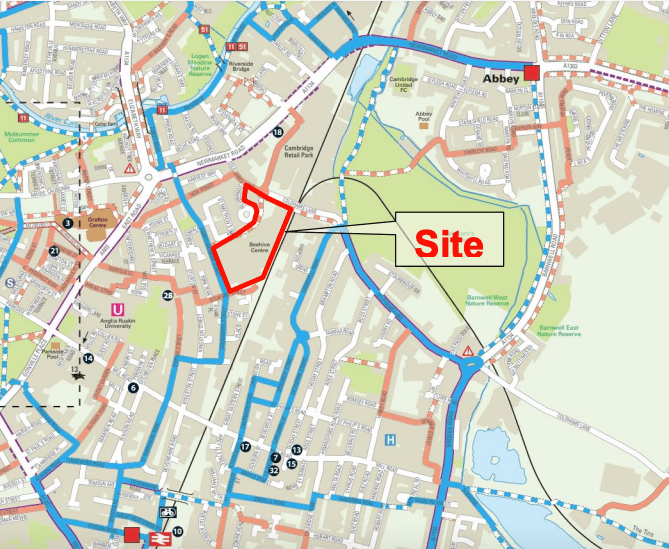
Above – p16 of App13.2 – map of the site in the context of cycle networks – even though most of them are either on-road cycle lanes or shared footway/cycle paths.
For those of you reading through the Framework Travel Plan, much of what they’ve written will sound either familiar, obvious, or both. But they have to go through the essentials assuming the reader has no knowledge of the area. What it also does is give a very ‘paper-based’ view of the transport network in Cambridge, rather than an actual real-life experience of pedestrians, cyclists, motorists and bus passengers. Such plans all too often give the impression that all of the facilities listed will be uniquely available to them rather than assessing what the current capacity is, or the current quality of service, and what impact the new development (in this case a very large one) will have.
The target modal shift should not be based on thoroughly outdated data – in this case the 2011 Census Travel To Work data.
“The Sites mode share has been based on 2011 Census ‘travel to work (workday population)’ data for medium output area 006 where the Site is located. Table 4 shows the existing travel to work mode (workday population), the target mode share for the Site and the required change in mode share.”
Above – p22 of App13.2 – Paragraph 3.15
The problem is that the pandemic inevitably skewed travel to work data because it was collected as part of the Census 2021 – and accordingly The Office for National Statistics has added a cautionary note to such data – as noted by Cambridgeshire Insight with their 2021 data here. Three huge reasons why the 2011 data is obsolete:
- The guided busway had not opened when the 2011 census was being carried out
- Cambridge North Station had not been opened in 2011
- The impact of the massive bus cuts are not accounted for – hence the big weakness of paper-based exercises.
Nothing on light rail
One of the things I would like to see is a commitment to support (including financially) proposals for a new suburban or light rail station around Coldham’s Lane Bridge in order to serve the various sites next it. Note RailPen also own the retail park site off Newmarket Road as well. So it’s in their interest to get such a stop built and soon.
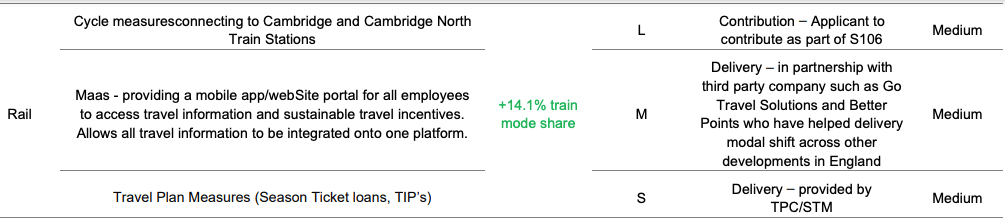

“The Sites mode share has been based on 2011 Census ‘travel to work (workday population)’ data for medium output area 006 where the Site is located. Table 4 shows the existing travel to work mode (workday population), the target mode share for the Site and the required change in mode share.”
Above – p41 of App13.2 – Paragraph 8.1
Note this is an outline plan – with an updated plan due at a much later date. I’d like to see clauses in this document stating that they will refresh their plans in the face of more up-to-date data on travel to work, and confirmation that they will support appropriate proposals on suburban and light rail plans that stop close to their site.
I’ll leave it to bus experts to indicate whether Cambridge’s roads can handle the projected increase in bus and private commuter shuttle traffic. I don’t think it can. Also, I’m against the principle of private commuter shuttles being run by different science parks as it’s local residents that take the hit to their health given so many of them are diesel.
Social Infrastructure
Much has been made by the developers of working with community groups – credit to those local groups that took the time to engage and make their cases. It’ll be up to the councillors on the Planning Committee to push for more – but this means they have substantive options to work with. Which is not always the case.
Above – if you do a Ctrl+F and type in ‘social’ on the list of documents you’ll be taken to the documents that cover social infrastructure.
The interim report in green has some interesting findings about what residents in Abbey, Petersfield, and Romsey Ward (that surround the site) think of their areas.
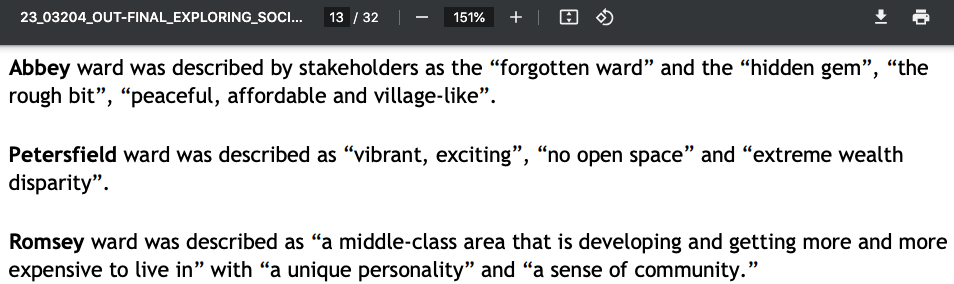

Above – Social Life Report – Exploring Social Infrastructure around the Beehive Centre, p13
It also has information on who uses what.
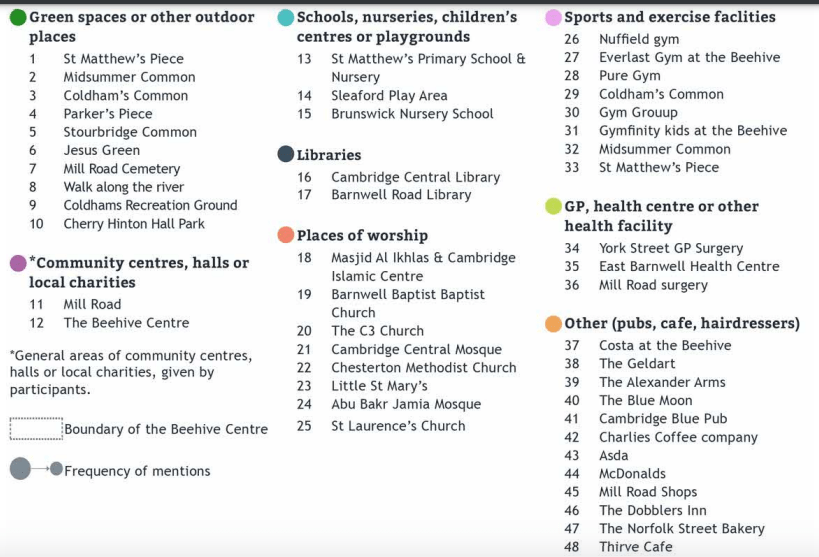
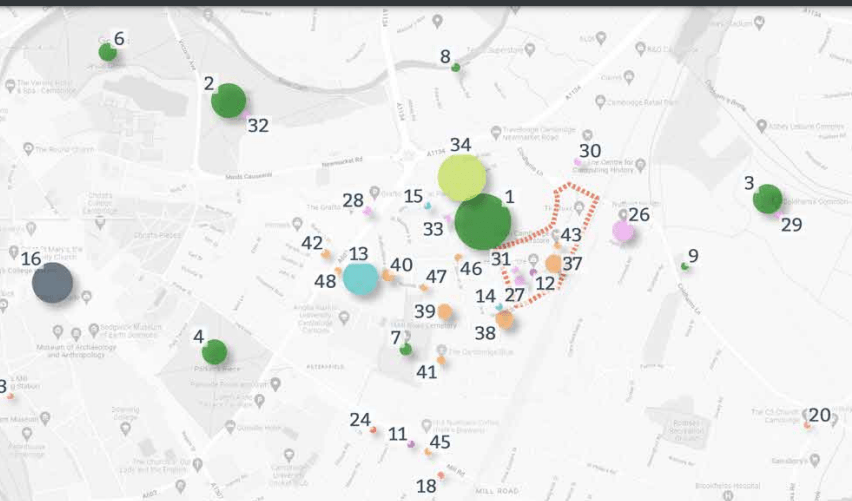
Above – note the sample sizes were not huge.
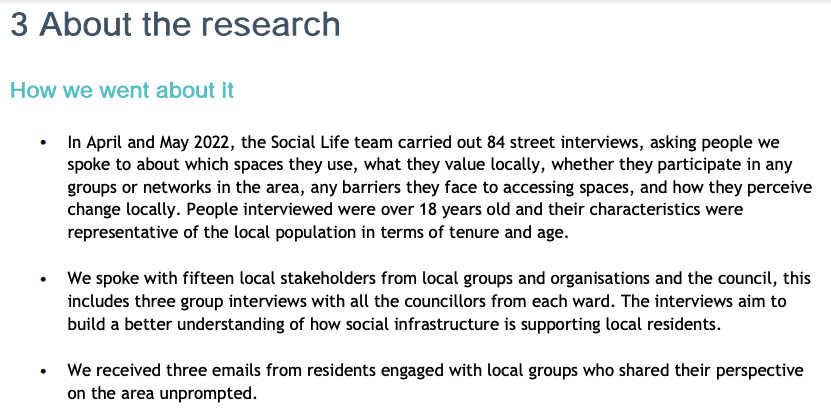
Above – Social Life Report – Exploring Social Infrastructure around the Beehive Centre, p8
While the insights are interesting, it points to future areas of research rather than solid evidence bases on which to make big decisions.
Shouldn’t someone in the council be collating, archiving, and making available in an easy-to-find place all of these consultancy reports?
Yes – but that involves using resources that councils don’t have. That said, there’s a massive public interest in the University of Cambridge funding a research project that does just that. Amongst other things it would bring together a host of evidence bases into one place, and make it far less labour-intensive for future researchers to find and analyse that information and data for future studies.
“One for the Department of Land Economy at Cambridge?“
Specifically the Centre for Housing and Planning Research.
Know anyone who could turn this into a research project? Please let them know! Only our city needs it!
Food for thought?
If you are interested in the longer term future of Cambridge, and on what happens at the local democracy meetings where decisions are made, feel free to:
- Follow me on Twitter
- Like my Facebook page
- Consider a small donation to help fund my continued research and reporting on local democracy in and around Cambridge.
 The Cambridge Town Owl