
Jeffery Francis Quarry Switzer gave a lecture in 1962 the text of which was included in a book that I fortuitously picked up from Plurabelle Books on Coldham’s Road by the Computer Museum which covered Cambridge’s town planning problems of the era. You can read the transcript here.
Six decades on and I wonder why so little seems to have changed. In his lecture he noted the following:

“…there is a need for public understanding and co-operation. I think that in Cambridge we have been very bad about this. Perhaps this happens in all towns, but judging by the correspondence in our local press, Cambridge people really do not understand its planning problems. The basic issues here are so simple, but we will get them confused, and people will go on talking – but I have only got a few more minutes”
J.F.Q. Switzer, Cambridge Land Economy Dept, November 1962
The lack of public understanding is not the fault of the public
I’ll write it again with a few more words.
The public’s lack of understanding of the planning system is not their fault.
It’s not the public that put in place an unnecessarily complicated planning system in place. Ditto an over-complicated taxation system full of loopholes.
With the publication of the latest set of proposals from the Greater Cambridge Partnership around congestion charging (you can read the headlines here from Gemma Gardner of the Cambridge Independent), expect to see another round of bitterly contested public meetings – mindful that Michael Gove is likely to make a big announcement on Cambridge’s future (which surely must involve doing something with the governance structures for good or bad) over the next six weeks. If you’re proper hardcore you can read the 500+ pages of meeting papers for the GCP Assembly on 07 September 2023.
Plea to the town planning community: Please can some of you step forward and run some urban planning evening classes that are applicable to Cambridge?
You have a whole department for Land Economy – and a specific Centre for Housing and Planning Research that sits within it. There is a huge public interest for some of your qualified staff – and those within the city who are qualified and civically-minded to run some workshops and/or a term’s-worth (say ten by 90-minute sessions) of classes to get people from across a broad spectrum of our city clued up on the essentials. By that I mean that we don’t just pick one tutor for one venue. Arbury and King’s Hedges are the first areas to pilot Gove’s new design code arrangements, so I strongly suggest they get to go first because they will be the first affected. Secondly the level to pitch the workshops to inevitably will vary reflecting on the degree of educational attainment (amongst other things – tenure of accommodation is another) of the different wards in our vastly unequal city.
Seriously, what does the public *need to know* so that we can pull back from the situation we currently have where politicians and political institutions are held in contempt?
Only I made a detour today to the Cambridgeshire Collection to have a look at the old brochures the county council / Training and Enterprise Council used to produce every year in the 1990s. It was both an enlightening and sou’destroying read.
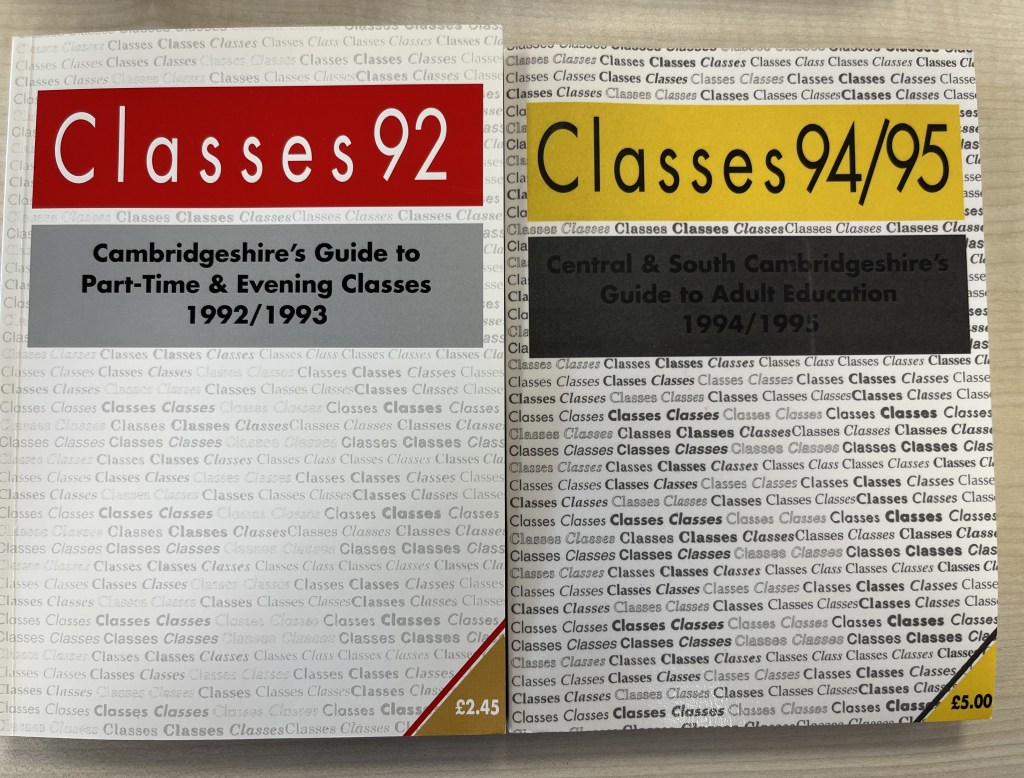
Above – note the inflation as well!
Actually, the 1994/95 book has about 100 more pages of courses in it – 350 or so in all! Given how Anglia Ruskin University has evolved, it is no longer considered part of the ‘local offer’ even though back then it still was. Hence many of its degree programmes that were linked to the policy responsibilities of the county council get listed. This is also pre-tuition fees so the ARU – back then Anglia Polytechnic University, had a different dynamic to what it has 30 years since.
In the olden days, we used to have one-day workshops on planning and transport!

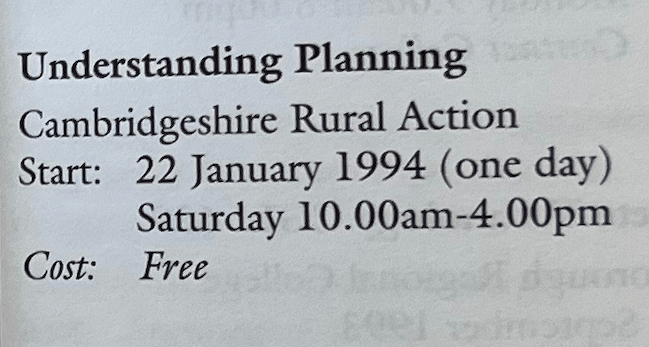
Above and top: You could introduce your community to community transport in the first moth, get them all involved in a new campaign in the second month, and educate them all in the essentials of planning at the start of the third in 1993/94!
That’s from the 1993/94 brochure from Cambridgeshire County Council. When did everyone decide town and transport planning didn’t matter?
As I’ve mentioned before, town planning as a discipline is notoriously difficult to find any easy-to-access course locally. Most existing courses around assume that you want to become a qualified town planner or are already one and are looking for CPD points. Unless you’re prepared to pay a fortune for a bespoke course from someone who is a) qualified as well as knowledgeable, and b) an excellent communicator, the sort of routine community-accessible workshop is hard to come by.
The same applies for politics and citizenship – as I mentioned in this earlier post about the lack of citizenship courses for adults who grew up in Cambridge (or rather, with full citizenship rights) but who might have had a 15 minute talk from a councillor at school in the 1980s/1990s after which ministers decided that this was enough law, politics and democracy for the average teenager to make it through life with. (I still blame John Major and Gillian Shepherd for my miseducation!!!)
There was also a variety of providers too – whether the University of Cambridge’s more academic look to a more interactive discussion group with the U3A Cambridge
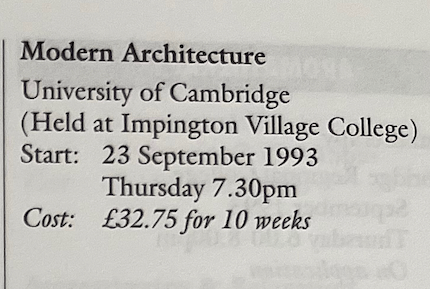
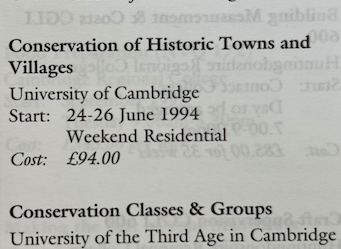
There’s a bitter irony about how the importance of skills and training in the 21stC is inversely proportional to what should be the comprehensive offer of shared learning in the community.
It was sobering reading browsing through the brochures that dated from when I was at secondary school – and reading the explainers of the differences between GNVQs from NVQs and the sea of acronyms that I didn’t really understand at the time. But then such were the rigid class boundaries (no one had explained to us what class was in the philosophic term) that our teachers explicitly told a group of us streamed into one of the top sets that we didn’t need to know about it. It was only when I joined the civil service that I bumped into a couple of people I was at school with who were streamed into lower attainment sets who just happened to be later developers and ended up going to university and graduating like I had done – just a couple of years later.
Politics!
Yes – you could do that too. Note it wasn’t until the mid-2000s that Cambridge Regional College stopped offering A-levels in a change of government policy that made it a vocational college only. Furthermore, the cuts to lifelong learning budgets since then meant Hills Road stopped offering Government and Politics as an A-level evening class – ironically just at a time when the public was becoming more interested. init.
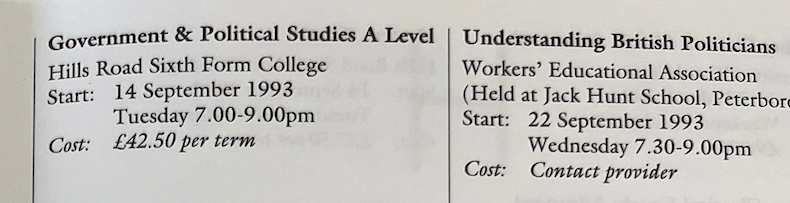
In this era the Worker’s Educational Association in Cambridgeshire was still a movement with a presence – but sadly today all you get is a 404 message.
Does it matter? I think it does because of the massive inequalities in the workplace that has accompanied the decline of trade unions.
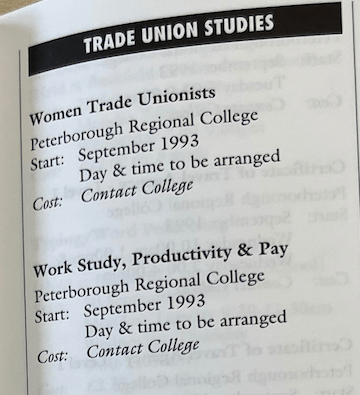
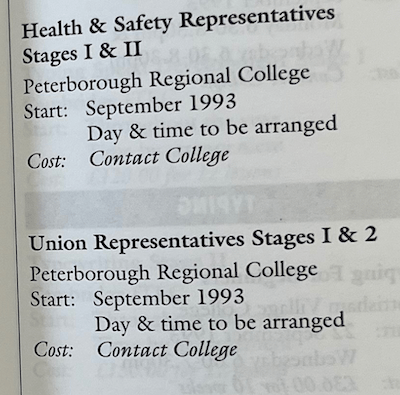
Above – from CambsTEC 1993/94 – Trade Union Studies modules at Peterborough Regional College.
When I was a trade union rep for the PCS Union in my civil service days in Cambridge, they paid for me to undertake accredited training. (You get paid time off for such learning). Which is why I advise any young person entering the workplace as an employee, join. a trade union, stand as a representative / ask to join the branch committee – even if it’s only. as a non-portfolio committee member, and go on as many training courses as you can. Not many other places will pay you to learn!
This is also why I think (especially with a Labour Mayor at the CPCA) the Combined Authority should be negotiating with the WEA and county trade unions (all of them) to get an accredited training programme up and running (especially for those with few other qualifications) and fund those ones where there is a clear public interest to do so – such as Health and Safety in the Workplace. Pre-pandemic, the picture was grim:
“In recent years, UK health and safety fines have risen steadily, with 2019 being no exception. In fact, the ten highest H&S fines of 2019 were all over £1 million”
Skillcast 03 Jan 2020
Trade union H&S officers are often the eyes and ears of the workplace where there is a good working relationship between unions and employers. (You only hear about the disputes on the news). Think of the additional costs the firms found to be not complying with the law had to face in terms of their own legal costs.
Given the greater awareness of trade unions in the face of recent industrial action, now might be the time to introduce the working public to another side of the work that trade unions do – one that they might not be familiar with but one that they may want to make use of. Furthermore, it re-introduces/supports the concept of learning in the workplace – which matters given the collapse in the number of adult learners at level 2 (GCSE) level courses due to austerity. (Shah 2020, p6). One way of opening doors to future civic learning – i.e. not just personal self development but for the good of the community, can be through trade unions.
“The future of Cambridge looks incredibly complex with all of those different interests – it’s not like a union course could cover it?”
A Ph.D thesis could not cover it. It covers multiple policy areas in a world where individual economic/financial interests can only see the future of our city through their own lenses. Rebuilding that culture of evening classes and vocational lifelong learning that Dorothy Enright began on East Road a century ago (have a look at the vocational, academic, leisure, and civic courses in CCAT’s brochure nearly 20 years after her death) indicates what we could be aiming for – and that’s for just one institution.
Collating all of the county’s courses into a single annual brochure – is that still possible?
One of the things I found browsing through the brochures of a generation ago was picking up on the surprising course titles that I didn’t expect to see. (Eg homeopathic medicine – as lampooned by Mitchell and Webb). There were others that reminded me of qualifications in professions easily overlooked such as in banking. Others were a reminder of the skilled trades that (stereotypically) politicians like to urge other people’s children to do – just not their own! (When are we going to see Etonians turning down oxbridge places en masse in favour of social care apprenticeships?!?)
I’d be very interested in the CPCA collating county-wide (or perhaps one for Peterborough & Fenland, and one for Cambridge, Huntingdon, & Southern Cambs) to go into single annual brochures, and publishing, publicising, and distributing hard copies en masse as part of a big publicity drive to get people learning. Prior to that they’d need to run some events asking the public (including employers, community groups, charities, and societies) what sort of workshops & part time / evening courses they want to enrol on.
Because at the moment what we have is only a shadow of what we used to have.
Food for thought?
If you are interested in the longer term future of Cambridge, and on what happens at the local democracy meetings where decisions are made, feel free to:
- Follow me on Twitter
- Like my Facebook page
- Consider a small donation to help fund my continued research and reporting on local democracy in and around Cambridge.
 The Cambridge Town Owl