
I’m not going to go into detail on this because I made my point at the local elections in 2023. But for those of you who are following developments…
See the Cambridge Independent at:
- On the changes to the GCP proposals
- On the impact of inflation in the building & construction sector that is pausing the proposed busway out of South East Cambridge (and a couple of large car parks too)
- Some party political reactions
There are over 500 pages of papers to read
Which is why in my previous blogpost I made the point about the lack of formal learning options such as evening classes to learn about urban planning. (Noting a Cambridge lecturer made the same point over 60 years ago. Progress?)
The meeting papers are here. Scroll down to page 439 for the overall risk registers
Highlights include:
Page 09 – summary of the consultation feedback at the Joint Assembly
Page 19 – Public Questions from the meeting on 08 June 2023 – and responses
Page 33 – Outline business case for Making Connections (the C-Charging)

Above – screengrab of the outline business case
“If a STZ were approved, the GCP would also leave a funding legacy to the city region, by using a proportion of a one-off central government funding agreement for the city region (the City Deal of £500m over 15 years) and investing it such that it secures an ongoing locally-raised and directed revenue source, which would be legally ringfenced to spend on achieving transport objectives”
Meeting papers, p34
Page 35 – Link to Michael Gove’s speech to supercharge Cambridge as part of the supporting evidence base
Page 42 – Options assessment on what changes to make to the original proposals
Page 53 – Recommendations for bus & sustainable transport investment (that don’t include light rail)
“A guiding principle of the consultation proposal was that buses would be delivered before any charge is put into place. In the short term, this would be within the current deregulated bus environment using City Deal funds set aside by the GCP Executive Board, but implemented by CPCA as the Strategic Transport Authority.”
Meeting papers, p55
Above – note this principle constitutes ***A huge residual risk*** even after mitigation due to labour shortages, reliance on stagecoach, delays in bus franchising, inflation, and more

Above – P56: How could this go wrong? / What could make this go wrong?

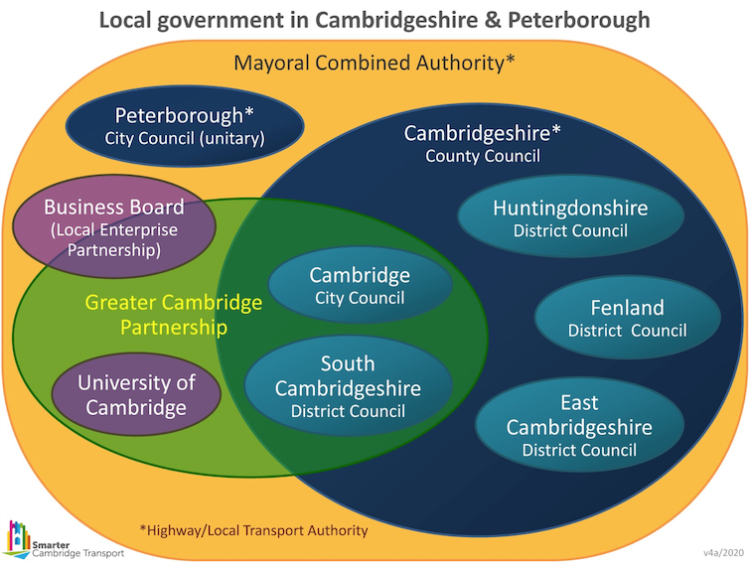
Above – why have one organisation responsible for local transport when you can have three? P64
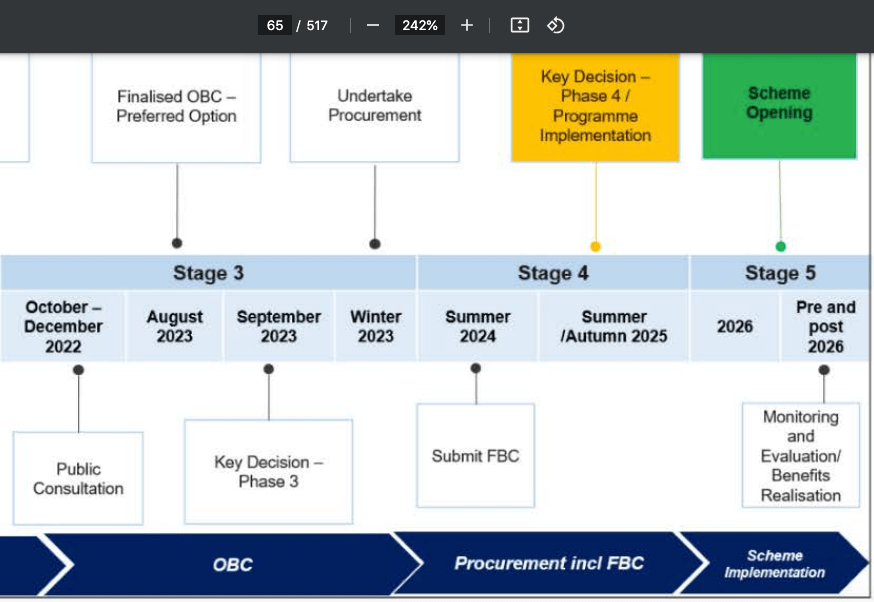
Above – did anyone mark in a possible general election? P65
Page 70 – timeline of the Making Connections (Appendix 1) which has been contested all the way through since the first plans became apparent.
Page 80 – Consultants’ business case – the people from WSP Atkins. Who must have been paid a a hefty sum for this.
Page 99 – Consultants’ options and scenarios
Page 194 – Risks

Above – Risks and constrains, from p194 of the meeting papers
- Legal challenges to the scheme (e.g. Judicial Review) result in delays or cancellations to the scheme.
- Inadequate bus network improvements: the bus network improvements are not sufficiently attractive and/or believed to be deliverable, there are delays to the delivery of bus network improvements, or the improvements are not deliverable due to funding constraints. This could result in a disproportionate penalisation of vulnerable groups in society.
- The impact of the Sustainable Travel Zone on traffic flows is too low or high. The STZ either fails to generate enough revenue to fund the wider Making Connections package or does not reduce traffic enough to alleviate congestion to the desired level.
- Unintended traffic consequences: the potential impacts on the network due to the displacement of traffic, displacing negative outcomes to other areas of Greater Cambridge.
- Lack of public acceptance: the scheme is perceived as having too negative an impact, particularly in current cost of living crisis, resulting in significant objections.
- Economic resources and delivery teams constraints: the potential lack of adequate economic and people power to fund and run the implementation of the Programme.
Page 330 – Risk management

The biggest risk that is *not* acknowledged is the collapse of Political support
Page 339 – project interdependencies.
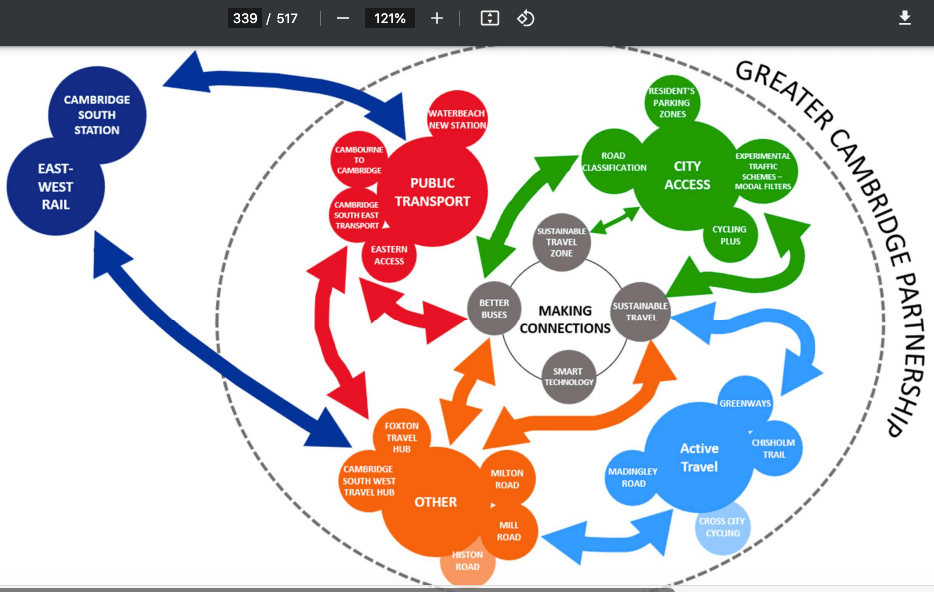
Above – from p339 of the meeting papers
Page 342 – Programme dependencies – worth reading this as it covers what is dependent on what. Such as bus fleet capacity, electricity charging capacity, rate of house building, delays in approvals (think also the threat of judicial review – esp if one is granted by the High Court) and more!
Page 367 – tables of ‘lessons learnt’ and experiences of previous projects.
Page 370 – ‘benefits realisation’ – these will need to be evaluated and monitored post-construction if this all goes ahead as planned.
Page 376-8 – Carbon management and Risk mitigation strategy on emissions
Page 384 – Next major item, future investment/spending profile. Note the hit from inflation

Above, p384 of the meeting papers. This is just as much a failure of the Government’s foreign and economic policies including leaving the EU without a substantive deal to replace what was there.
Page 395 – pausing the Cambridge South East Transport (busway) and Foxton car park

Page 406 (above) – note the rising costs of CSET
Page 408 – Waterbeach cycleway and busway
Page 422 – Map of Waterbeach proposals
Page 427 – Cambridge Eastern Access Project – initially was meant to be part of James Palmer’s CAM Metro but has ended up being little more than cosmetic roadside improvements creating on road bus lanes and cycleways.
Page 439 – overall progress reports and risk registers.
Page 469 – list of completed GCP projects.
End papers – refresh of who is responsible for what.
I’ll leave it there.
If you are interested in the longer term future of Cambridge, and on what happens at the local democracy meetings where decisions are made, feel free to:
- Follow me on Twitter
- Like my Facebook page
- Consider a small donation to help fund my continued research and reporting on local democracy in and around Cambridge.
 The Cambridge Town Owl
One thought on “Cambridge road user charge becomes peak-time C-charge as inflation hits other GCP projects”
Comments are closed.