
Attempts to educate the general public on ‘citizenship’ from a central government perspective are doomed to fail – especially if it doesn’t help people solve local and day-to-day problems.
That’s my take-away from the social and contemporary historical reading around the subject area. Of which I’ve done more than is sensible. But it’s in my disposition to do this.
The title reminds me of a church service I was at with a longtime school friend (our families are still in touch so I won’t name them) in the early 1990s. It was an Italian visiting priest who was in his late 20s and had just come back from a placement in a famine-hit country in Africa. He was talking about social justice and highlighted an example of where the church as an institution had not understood the priority of the people there. The church wanted converts, the people wanted food. The anecdote he gave was:
“I said that The Lord loves everyone. They responded: “That’s great – where’s the rice?””
Hence the title of this blogpost. Ministers and even activists like myself can wax lyrical about citizenship, but if it doesn’t involve helping people deal with their local or day-to-day issues, they won’t engage. They’ve got more important things to do with their time than spend a Saturday morning or a weeknight evening on a cold, rainy November listening to me with my flipchart paper, post-it notes, pens, and a seemingly random list of activities.
“So, how do we make it relevant?”
Hence doing lots of background reading to see what other generations have tried, and trying to figure out the shortcomings of the Government’s existing approach – including the gaps in GCSE Citizenship Studies. Also, under the present Government, we’re not all equal in the eyes of the law as citizens. Voting rights based on nationality rather than residency is but one example.
“What does history tell us?“
Nearly three-quarters of a century ago, some local publishing giant released Citizenship and Social Class by Thomas Marshall of the London School of Economic and Political Sciences (The LSE). You can read a digitised copy here. He pays tribute to his namesake Alfred, husband of Mary Paley, the #LostCambridge hero, Economist and founder of The Marshall Library. In essence THM highlights three specific rights:
- Civil Rights
- Political Rights
- Social Rights
Do note the criticisms which highlight the limited geographical applicability and also the social conventions of the day that today we’d see as outdated. Putting it politely.
At the other end of the timescale is Theresa May’s Civil Society Strategy published by the Government she led in 2018.
It’s worth a browse – if only to learn about the mindset of minsters of the day and to ask Conservative candidates for a progress updated in the run-up to the next general election!
I jest!
Actually there are some things in there that a future government of almost any political colour could work with. For example the attempts to tackle loneliness – which compels ministers to table annual reports to Parliament. (See here, scroll down). The latest update – signed off by the MP for South East Cambridgeshire (two council wards east of me), Lucy Frazer KC MP, has been published and you can read it here. While I think that central government could and should be doing far more on this, the fact that they have a policy and are publishing annual progress updates means there’s something to pin them to. It’s much harder if ministers don’t acknowledge the problem in the first place – and thus don’t publish any response or make any policy statement. Remember what I said about Michael Gove and The Blob? That: ministers acting as the very blob they criticise.
One example is loneliness.
Their solution is straight out of the old skool civil service manual. Set up a programme, attach some funding to it, and incorporate reporting requirements to report back to Parliament on how taxpayers’ money is spent.
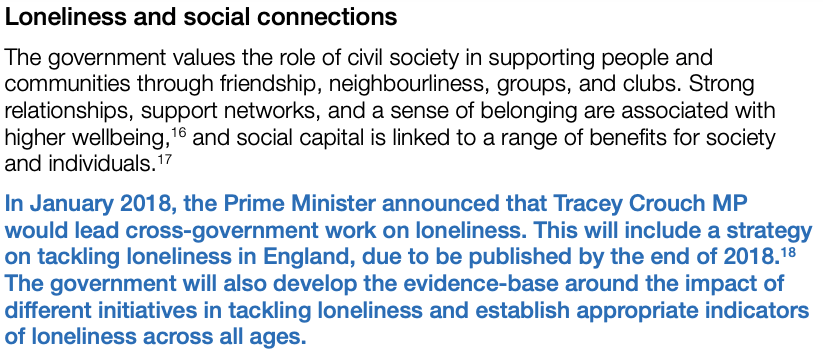
Above: Civil Society Strategy (2018) p31
They highlight some of them.
“In June 2018, we announced £20.5 million of grant-funding for charities and community groups working to bring communities together. This is made up of the £11.5 million Building Connections Fund, a partnership between the government, Big Lottery Fund, and Co-op Foundation, plus an additional £9million through separate funds run by the People’s Postcode Lottery and the Health Lotteries.”
Ibid, pp32-33
They’d have been far better using that funding to contribute towards new lifelong learning centres in every town – a policy a damn sight more expensive.
“A community learning centre in every town, individual learning accounts and boosting part-time Higher Education and employer-led training should be at the centre of an adult education revolution to tackle social injustice and revitalise the country’s economy, the Education Committee has said.“
CTO 12 Aug 2022
Active citizens
Much as been written on this by researchers but I often wonder how active researchers are *as a cohort* not just in local democracy but in wider civic life – including helping solve neighbourhood-to-city-wide issues.
We’re fortunate in Cambridge in one sense in that we’ve got a more academically-educated pool of candidates to choose from who can apply that expertise to a bureaucracy-heavy system. It’s much harder for people in those towns and cities where you’ve got a population with lower levels of educational attainment *having to face a similar broken and over-complicated system*. That’s not to say it does not have its drawbacks – Cambridge Labour is criticised for not bringing through more candidates and councillors from working class and/or non-university backgrounds. Which is one of the reasons I make a big deal about lifelong learning: Part of the solution to getting more people from more diverse backgrounds into local democracy has to include lifelong learning opportunities that cover politics, democracy, and citizenship.
Old research has not gone away – there’s still some useful reminders.
Such as Engaging People in Active Citizenship that the UK took part in pre-EURef.
“Active citizens usually learn their citizenship skills through trying to solve a problem or to fulfil a mission, rather than by setting out to “learn to be good citizens”. Learning, and citizenship emerge as a consequence of this primary motivation. Learning therefore has to be embedded in those processes.”
Engaging People in Active Citizenship – Finding 9.
Therefore any attempt to pitch citizenship workshops or courses cannot be labeled as ‘citizenship’. Which seems strange but it makes sense.
Because otherwise it will go the same way Big Society went.
“Lifelong learning has become a major focus of policy attention for governments, private sector organisations and social movements, but the learning of citizenship in the area of civil society is still usually under-resourced by comparison with the workplace.”
Engaging People in Active Citizenship – Finding 14
The above was in the mid-2000s (I cannot locate the date though). But it’s the same as what Qasir Shah of UCL stated in 2020. Which is why I wrote this blogpost asking about the success rate of social policy research, only all too often we go around in circles or hit a ministerial/HMT policy road block and everyone gives up until another generation has a go.
“Didn’t the Home Office do Active Citizenship before the current regime took over?”
Ah – the incompentocracy of Braverman and Jenrick.
See the Internet Archive here – thank you Prof Melissa Terras for this link. Again, 15 years ago the Home Office funded some work to create new materials to support the active citizenship policy. Hence Labour and other opposition parties would do well to look at that if developing new policies on citizenship. What’s the learning from those government-funded studies from the 2000s? What’s changed since, and how? Esp tech/comms/social media impacts.
In 2011, the Centre for Local Economic Strategies published this briefing (only 2 pages of substantive text). on Active Citizenship.
They recommended the following ways to increase active participation:
- Citizenship education: increasing learning opportunities
- Volunteering: increasing opportunities to make a contribution
- Civic participation: increasing opportunities to engage with state organisations
- Confidence building: intervening to remove obstacles to citizens coming forward with their concerns
- Feedback: making it easier for citizens to complain and hold state bodies to account for their action
- Consultation: seeking citizens views prior to taking action
- Shared governance: sharing power with citizens/groups
- Devolved decision‐making: handing specific powers to citizens/groups to carry out
Sadly the opportunities to demonstrate all of these on all things future of Cambridge transport (eg the actions of the GCP & Combined Authority) have been dashed.
What we’ve learnt in the decade since is the impact of misinformation and disinformation, something Dr Ben Kisby of the University of Lincoln examines here. It came up in a conversation this morning at the Queen Edith’s food hub.
What do you do if the starting point of your target audience is being convinced about an untruth that’s doing the rounds online?
Because the first protests against non-existent policies have already happened – see here in Liverpool.
Hence snapping up and digitising two publications from 1927 by the Workers’ Educational Association that cover the importance of lifelong learning (and why we need to rediscover that somewhat lost culture).
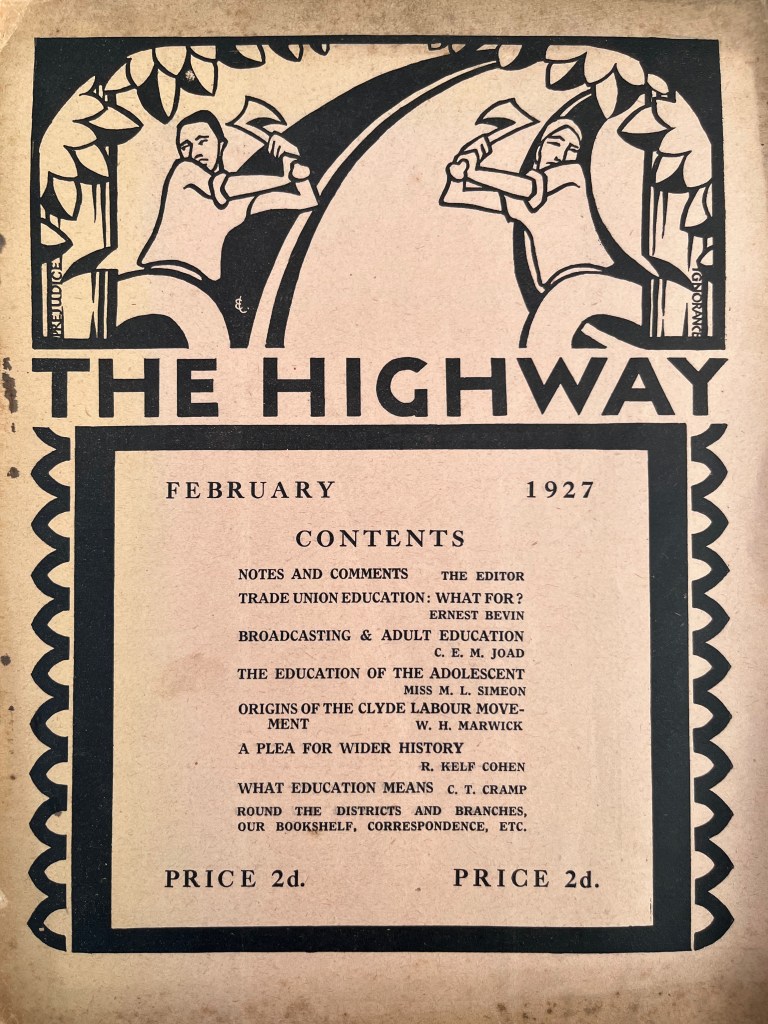

Above – from 1927 (digitised here) featuring articles on trade unions and education by two trade union titans of their day, Ernest Bevin of the TGWU (later Minister for Labour under Churchill, and Foreign Secretary under Attlee), and Walter Citrine, the General Secretary of the TUC.
Note neither Bevin or Citrine received a secondary school education – going into work before they reached their teens. Hence the importance of the lifelong learning movements – especially for those adults who left elementary school illiterate & innumerate.
Hence already asking people about the issues they have with our city, and what things they’d like to know more about with a view to getting things sorted.
Food for thought?
If you are interested in the longer term future of Cambridge, and on what happens at the local democracy meetings where decisions are made, feel free to:
- Follow me on Twitter
- Like my Facebook page
- Consider a small donation to help fund my continued research and reporting on local democracy in and around Cambridge.

 The Cambridge Town Owl