Trying to prevent more taxpayer-funded research from gathering digital dust in a forgotten corner of the internet
I’ll try and keep this short because all-day brainfog which may mean I have to cry off the Stourbridge Fair later.
This follows on from my own proposed local pilot workshops in that I want to see how far my city wants to go on learning about all things citizenship, democracy, on how our city functions, and how we can improve it.
The Learning and Work Institute – formerly the National Institute for Adult and Continuing Education.
They really should have stuck with the latter rather than changing the name but because they got merged with another quango, they got a new name. One that is too work-focused for my liking as it makes it easier for ministers to underfund lifelong learning for the common good rather than the narrow focus of getting someone to become more productive in the workplace and/or a higher paying job. You can have a browse through the NIACE’s back catalogue on ABE Books here as they published a substantial amount of research in their time. (See also books by their predecessor organisation the British Institute for Adult Education).
There’s a strange irony in stating the above because the proposal for a citizens’ curriculum for basic level learners is one that seeks to broaden a person’s knowledge and skills base rather than focusing on one or two core areas – i.e. literacy and numeracy. The problem is that if providers are measured by 1) exam results and 2) number of people getting into jobs, then that is what they’ll pressurise their service users into doing even though that may not be want they want to get out of it.
“The Citizens’ Curriculum – what is it again?”
It’s a framework of things that go beyond literacy and numeracy – the two things that basic level skills courses focus on. I can imagine how mind-numbing some of the things can be because big state systems are not nearly nimble enough to respond flexibly enough to meet people’s needs. (I’ve seen it for myself first hand more than enough times – and have also seen at the other end all too often how ministers are prone to misuse the data that comes back. And that’s an ideological issue).
You can see how dated some of the things are – i.e. pre-EURef.
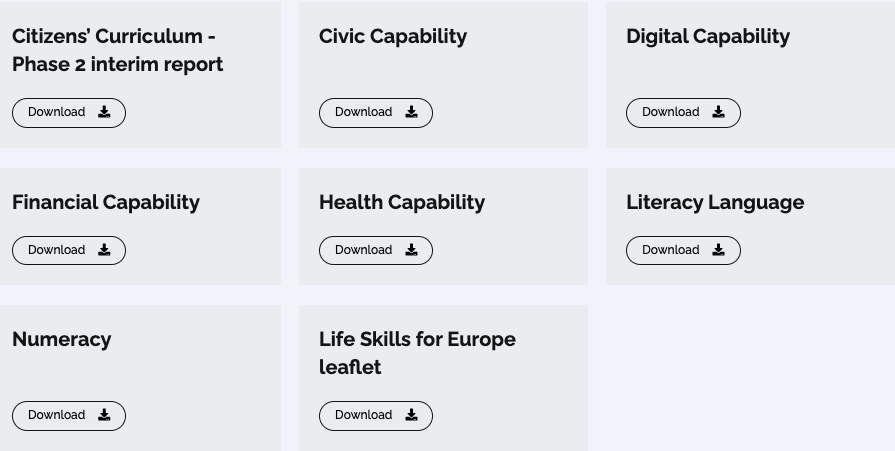
Above – a snapshot of guides from https://learningandwork.org.uk/what-we-do/essential-life-skills/citizens-curriculum/
If you click on the link above and scroll halfway down, you will find that set of download icons. Instead of two capabilities – literacy and numeracy, they’ve added digital, money, health, and [for want of another term], civics. If you click on the Civic Capability Box from that page, you end up with a two-page document that is as shown below.
You can see where the cross-over is with citizenship on the national curriculum: rights and responsibilities are at the top.
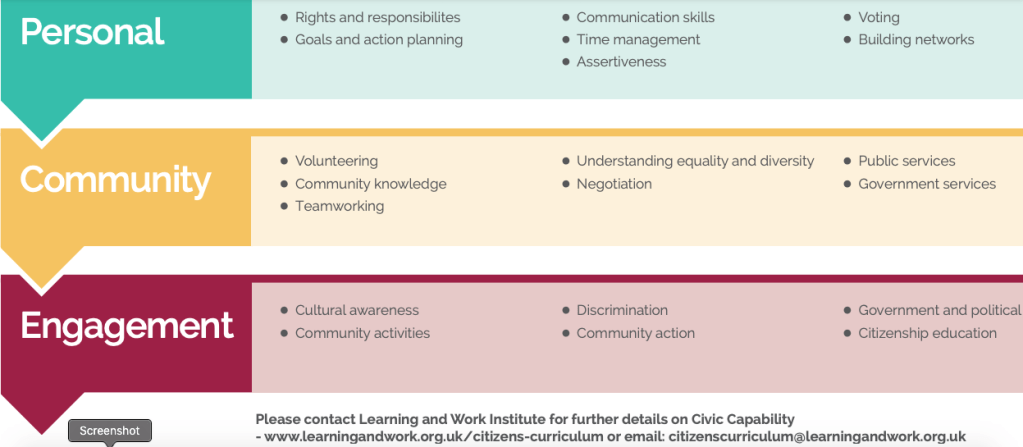
One other point of note is the separation of ‘voting’ as an action to engaging with locally elected politicians. This matters because we have heard too many times of how those still campaigning to re-join the EU are somehow ‘against democracy’.
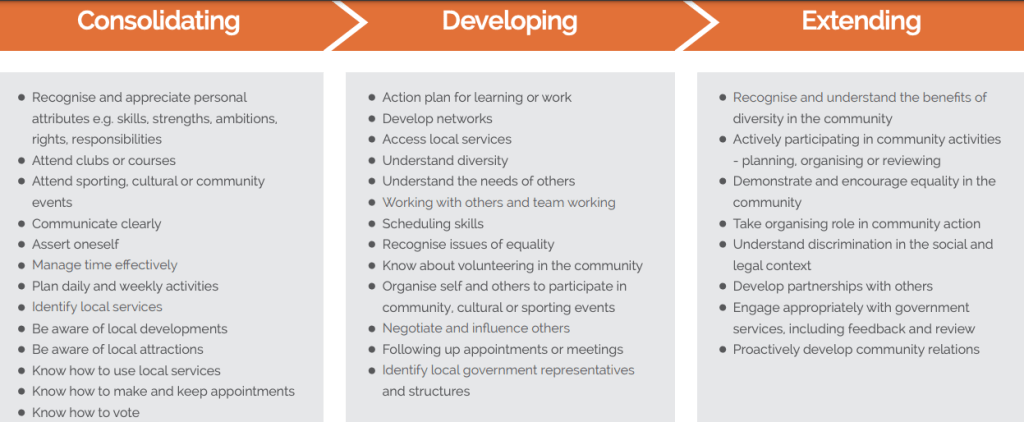
Above – note how ‘knowing how to vote’ is separate from being able to identify local government representatives and structures – the latter being a higher competency function.
When we look at the Literacy download option, we find that the three headings are linked to the Government’s Qualifications’ Framework.
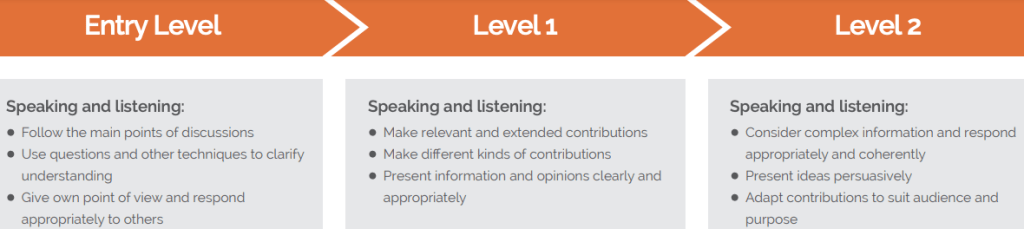
The scale is from entry level to level 8, the equivalent of having earned a doctorate in your specialist field. That means you have done a substantial amount of original research that in the opinion of the university awarding your doctorate, has made a substantial addition to the collective knowledge of your academic field. (My highest qualification is on level 7 – my PG Dip in Historical Studies from Anglia Ruskin University back in 2005). Level 2 is the equivalent of a GCSE/O-level, and Level 3 is the equivalent of A-Level, T-Level, IB, and BTEC National.
Now let’s compare that against *the distribution of skills* both in Cambridgeshire and nationwide. This from the Combined Authority.
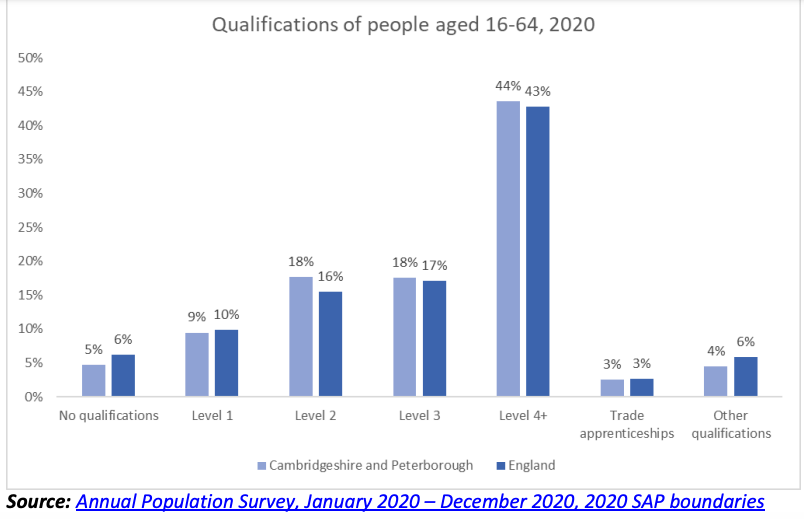
Above – Qualifications of people 16-64 in 2020, from the Cambridgeshire & Peterborough Skills Report Refresh December 2021
Note the figures are inevitably polarised when distributed geographically.
“Cambridge has one of the highest skilled workforces in the country, with 63.4% of working people having qualifications of NVQ Level 4 and above, compared to the national average of 43.1%. Only 3.4% of residents in Cambridge have no qualifications, compared to 6.4% of people nationally.”
State of the City, Cambridge City Council 28 June 2022, p2
Which means I cannot copy-and-paste the framework that L&W have produced and apply it to Cambridge. That approach would be completely inappropriate and patronising. At the same time, academic ability/attainment in one subject does not automatically mean that audience will be able to pick up the nuances and complexities of a subject in a completely different field that they’ve not had any background briefing on. Furthermore, there will be things in politics and public policy that to an audience highly qualified in the hard sciences will seem utterly bizarre.
“Does that mean the framework is completely useless?”
Not at all!
Actually, it makes sense to me looking at it from a public policy perspective. Let’s look at the Phase 2 project report.
Above – click on the Phase 2 Interim Report in this link
The summary findings included:
- Changes in their employability,
- with 8% finding a new job,
- 20% starting to apply for jobs,
- 33% starting to look for work,
- 49% improving their work-related skills, and 1
- 4% starting to volunteer on a regular basis.
- Improvements in their attitudes towards learning, with 94% feeling more motivated to learn and 42% signing up for another course.
- Increased social and civic engagement, with
- 73% making new friends,
- 59% reporting an improved social life,
- 28% improving their relationships with their family and
- 16% joining a community group.
- Improved self-efficacy, with
- 67% improving their self-confidence,
- 65% reporting a greater satisfaction with their life, and
- 31% reporting improved physical health.
Now, the DWP should be interested in the employability stats, but if I was back in my community development policy area at the old DCLG, or working in a public health policy team at the Department for Health and Social Care, I’d be onto the sponsor department that manages the relationship with L&W.
“Are these numbers statistically significant?”
The study says they are, although the base numbers for each of the surveys is generally between 100-200. But it’s a pilot. You’d expect that. What you want to find out from a pilot scheme is whether there is something worth investigating further, expanding the numbers involved to see if it can become a mainstream service that receives routine, core funding annually. The problem with pilots like this is all too often they are the result of an initiative from a junior minister and it’s quickly forgotten about after said minister moves on. -and any beneficial learning is lost except as after-dinner anecdotes from former civil servants like me. And I hardly get to go out these days anyway. )-:
The other thing to note from the report is the sheer diversity of activities involved – each tailored to local population demographics and need
From p22 of the report, there is a detailed table of each of the pilot areas stating the demographics of their target audience, the activities they undertook, and how it related to the citizens’ curriculum.
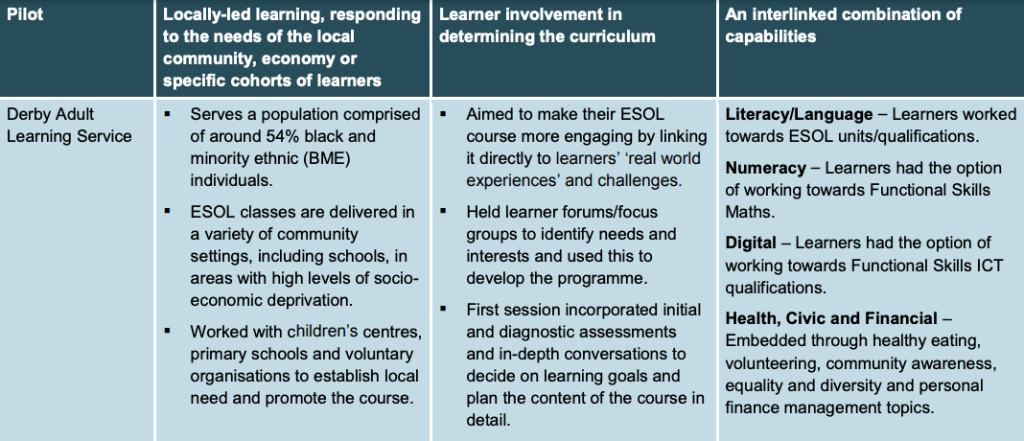
Above – click on the Phase 2 Interim Report in this link and scroll down to page 22.
Derby Adult Learning Service’s pilot is only the first row of a number of pilots across the country. Some target women on low incomes, others worked with homeless people, and others focussed primarily on those with no/few academic qualifications. Inevitably there were people who would would be covered by more than one category – yet at the same time the activities they did had a positive impact on more than one variable being measured. That’s why ministers need to get out of the habit of concentrating too much on single variables as a measure of success.
Because sometimes headline results showing success can mask failings elsewhere, and vice-versa. I’m a living, breathing example of that – where I ticked all the ‘middle class is magical’ boxes on paper, but came out of the education system after graduating an utterly broken man. But with a 2.1 degree from. a redbrick university in a ‘respectable’ subject [economics!] on paper I was supposed to go into the City and make my fortune. (Even though by that time I had become a tree-hugging environmentalist reading the works of Herman Daly, one of the earliest environmentalist economists.)
A citizens’ curriculum cannot be left to the lifelong learning sector to deliver alone.
This is where the fields of public health and town planning come in. The pilots demonstrated successful outcomes in health improvements. What would participants and their mentors say was needed to enable more to make those sorts of improvements? Which of the things can be delivered through public health teams? Which of the things can be delivered through the town planning processes? (For example amendments to local plans that make active travel more accessible & easier, through to protecting open green spaces).
That brings us back to GCSE Citizenship Studies and the curriculum content. Because the NHS and town planning are both conspicuous by their absence. If anything, there is a strong case to make English town planning core component for GCSE Geography in England – the decisions for Wales, Scotland, and Northern Ireland where town planning is a devolved matter, being for their ministers in their devolved administrations.
“So…you won’t be using these in the early workshops?”
No – because these are findings from later stages of the public policy process. Where I’m at is several steps behind. Cambridge, with its growing population and high population turnover still has a lot of work to do to repair the damage done by all things GCP.
Sorting out Cambridge’s governance structures is essential for our city to be able to develop a meaningful citizens’ curriculum. Otherwise we’ll simply end up wasting time trying to get our heads around an unnecessarily over-complicated governance structure that by simply existing ends up doing more damage than helping!
Anyway, this has gone on for much longer than I thought it would and my eyes are hurting. Either way, this month is going to see some big calls being made about the future of our city. Hence why we need to get going on helping more of the people of our city find out how it functions – and malfunctions.
Food for thought?
If you are interested in the longer term future of Cambridge, and on what happens at the local democracy meetings where decisions are made, feel free to:
- Follow me on Twitter
- Like my Facebook page
- Consider a small donation to help fund my continued research and reporting on local democracy in and around Cambridge.
 The Cambridge Town Owl