
Quite a turn-around given over a decade ago I was urging organisations to make use of all things online. But with new and revamped community centres opening, how can we ensure they are used in the midst of our cost of living crisis? Especially if social media reach is much more limited than before?
This could be an issue we discuss at my first pilot workshop on how our city functions. If that’s what participants would like. (I even made a little video – even though I was brain-fogged up to my eyeballs in the heat, which meant this was something like the 15th take!)
Looking at social media ecosystem today, the barriers that we have between the different platforms and the hot-wired algorithms that drive users towards clickbait rather than posts from friends, contacts, and causes they follow have created a very different world to the one of the early 2010s.
It’s more than a little destabilising having been around when social media communities were…well…social. Fast forward to today and I’ve noticed a couple of groups in Cambridge now doing the bare minimum on keeping pages and feeds updated, and moving back towards paper to advertise local gatherings.
The question that remains outstanding: How can the people & institutions of Cambridge communicate with each other in a fragmented media landscape?
When I asked this question a decade ago it got little interest even within my own at the time buzzing bubble. Yet with the long term future now properly up for debate with multiple competing interests – and in the face of a climate emergency, that question needs a comprehensive answer. Not least because as local politics has shown, institutions cannot take electoral approval (or rather, lack of open disapproval) as a given.
Cambridge’s local area committees are discussing serious issues, but who is listening in?
Take Cambridge City Council’s online South Area Committee (see the video here, and see the meeting papers here)

Above – a screengrab from the day after the meeting – only 26 views for the three southern wards/divisions in Cambridge – which should be covering about 35,000 people.
And it’s not like there aren’t serious issues to deal with (have a listen from 55m here re Cherry Hinton) – and serious failures in public services whose roots can be traced back to Whitehall. That last sentence probably explaining why people don’t get involved: if the solution is one that requires ministers to make a move, it won’t happen.
Two opposing movements leafleting in neighbourhoods for public meetings and getting a turnout.
Both are at very different parts of the political compass matrix. (Which is easier to explain than the old-fashioned left-right spectrum). In 2023 I’ve seen leaflets against the proposed C-charge, and I’ve also seen leaflets for local meetings of Just Stop Oil. One of the latter was within walking distance and so I popped my head around. What struck me was how similar the demographics of local residents at the meetings of opposing groups were: Generally middle-aged to elderly – with a few more younger adults who were short-term renting on the environmentalist side. As I mentioned in an earlier blogpost, where was the missing middle? Where were the 25-40 year olds? Too exhausted dealing with the multiple demands of full time work and trying to raise a family was what one local resident told me when I asked them about community workshops on how our city functions.
This was something that also struck me with some of the community vocal music groups I’ve seen performing this year: Where is the missing middle? Ditto with the election hustings. Where was the missing middle? This tells me that the issue is structural: it’s not something that can be solved by a publicity campaign.
There’s a deeper malaise in the institutions that shape our city – the roots of which go back to Westminster and Whitehall. Hence my delight at finding John Redcliffe-Maud’s book assessing the last major overhaul of local government published in 1974. Because so many of the issues he discusses with Bruce Wood have not gone away.

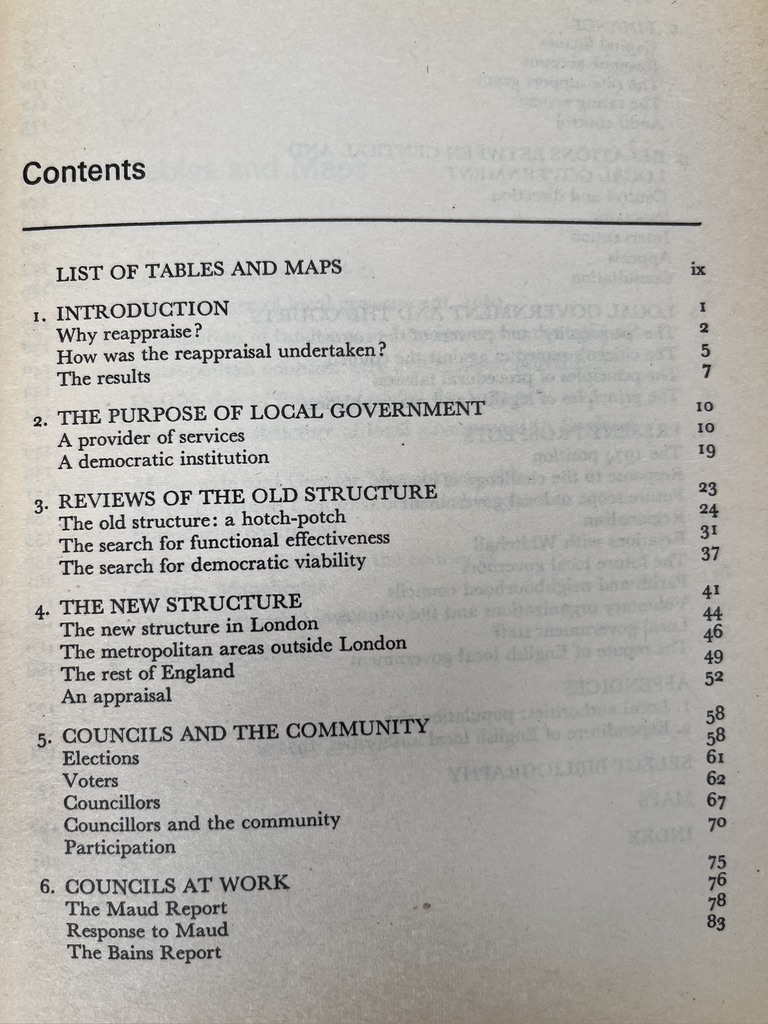
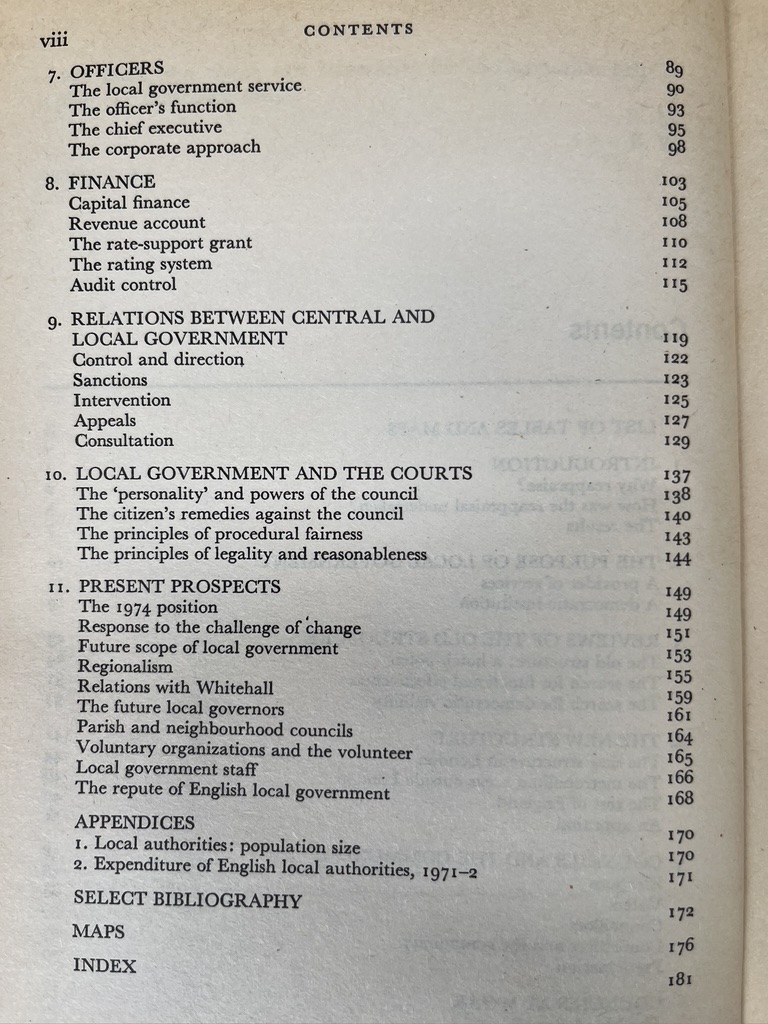
Above – English Local Government Reformed (1974) – you can get a second hand cheapo copy for under a fiver from ABE Books.
Redcliffe-Maud also wrote a book about supporting the arts in England and Wales in the same era – one that may interest several of you.
The opening of new community venues and spaces in Cambridge
And with them should come new notice boards. It will be interesting to see what the community notice boards look like once the autumn term is up-and-running again. Only in the late summer they get a bit sparse. That said, austerity has meant places like local libraries have had to start charging people to put up notices. Understandable it if’s a commercial advert but if it’s a community event? Again, the unforeseen/dismissed consequences of central government policy.
I got to look around the nearly-completed but unstaffed Queen Edith’s Pavilion on Nightingale Avenue. The joys of a broken finance system means that there might be capital expenditure from developer contributions, but no powers to tax the wealth being generated a few hundred yards around the corner on the biomedical campus because ministers won’t let councillors do this. Not surprisingly 13 years of austerity resulted in Birmingham City Council issuing a Section 114 Notice (erroneously called ‘bankruptcy’ but that depends on the cause of the financial distress – in this case (in my opinion) it is ministerial policies that are the root cause). Ministers were warned by the old Commons Communities Local Government Select Committee in 2021.
So we have a nice new large space (which is nicer than I thought it would be when I saw the plans) but no one employed to staff it. Ministers require further budget cuts from councils already hit by inflation.

Above – The City Council is still trying to find a charity to run it even if only for one day a week. You’d have thought with the wealth being made in Cambridge’s economy that someone, if not a group of firms would be able to stump up the cash to employ at least a caretaker for the building.
There are new and upgraded community venues that have opened in Cambridge of late including:
- Marleigh Community Hall
- The Mill Road Community Centre
- The Meadows Community Centre in Arbury (a revamp of the old facility)
- St Martin’s in Coleridge, Cambridge (removing the church pews to open up the main building)
- Downing Place URC (opposite John Lewis) (A revamp of the old St Columba’s Presbyterian Church following a merger with Emmanuel URC, sold off to Pembroke College)
- …and opening in May 2024, the Cherry Hinton Community Hub and expanded library.
There also remains the future of East Barnwell.
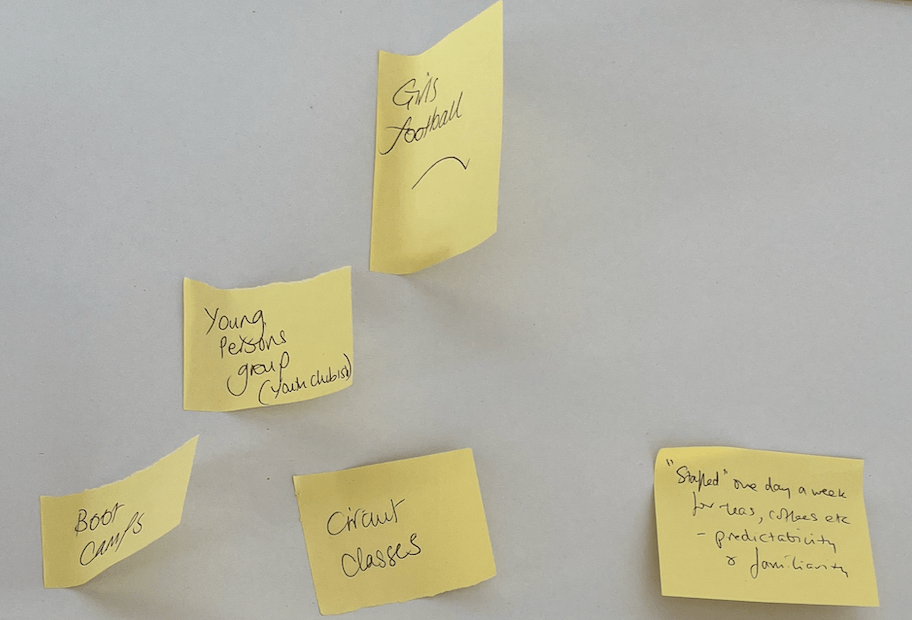
When asked for suggestions for activities in the new pavilion building, one youngster asked for a youth club and another a girls football club – mindful of how popular it has been for quite some time – yet still scandalously under-provided for.
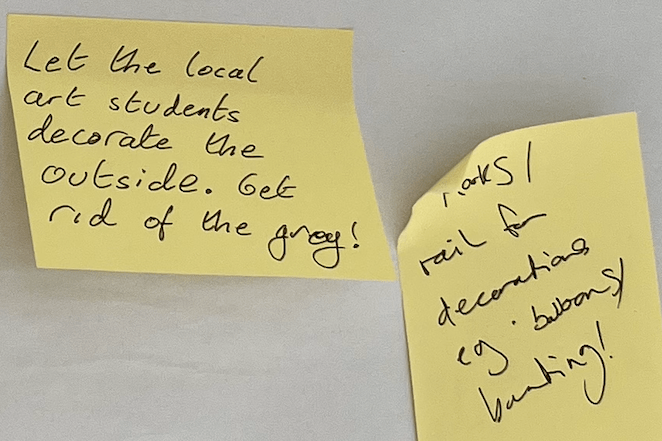
Above – not being a fan of the grey colour scheme I suggested local art students (e.g. those at Long Road Sixth Form College or The Oakes/Netherhall) be allowed to decorate it instead – before it inevitably gets tagged).
Too fatigued to flyer for community action and local history
I was fortunate to get to Nightingale Rec last Sunday having burnt out before I could get out of bed on Saturday for the Stourbridge Fair. This time the electric bike made all the difference travel-wise. We’ve got a new event calendar for the Cambridgeshire Association for Local History starting on 07 Oct 2023 at St John the Evangelist Church Hall opposite Homerton College from 2pm. I had printed out card flyers to hand out but was too exhausted to pester the couple of hundred spectators watching the Somersham Brass Band that had gathered. CFS/ME drains your confidence and the last thing you want to do is talk to people when you’re in that mood so I refrained. That combined with the heat also meant not getting much further than over the road over the past couple of days. So getting the word out on anything offline is hit-and-miss-miss-miss with me!
Yet at the same time, I get the sense more people are picking up on the limitations of social media ecosystem as it currently is – and for local events at least, pay less attention to it. Compared with a decade ago, on FB you have to actively search for events rather than having ones organised by friends and groups you’re in or pages you follow automatically appearing on your newsfeed.
Essentially what’s happened is big tech has tried to monetise the social benefits of social media – in the case of events by making them less likely to appear in news feeds unless the organisers pay up. As each platform has tried to throw up e-walls from the other, the ability to move seamlessly from one to another has been disrupted – instead we see more ‘reels’ to keep people hooked on clickbait content. Which is a shame because it didn’t need to end up like this. Furthermore, the UK Government is powerless to do anything about it because the multinational nature of the industries mean that a multinational regulator is the most effective response to deal with the negative externalities of that industry. A far cry away from the home-made leaflets that people design and print at home. If only the ink wasn’t. so damn expensive!
So…yeah. I hope make a few more mainly community action or local history-based posters on local notice boards if you’re in my part of town.
If you are interested in the longer term future of Cambridge, and on what happens at the local democracy meetings where decisions are made, feel free to:
- Follow me on Twitter
- Like my Facebook page
- Consider a small donation to help fund my continued research and reporting on local democracy in and around Cambridge.
 The Cambridge Town Owl