
“Greater Cambridge Partnership’s congestion charge plans unravel over ‘party politics’” declares the Cambridge Independent – and its right. But the GCP was designed and created in a very different party political environment – one that no longer exists.
Today’s Greater Cambridge Partnership Assembly meeting was grim watching. I cannot recall a meeting where senior councillors and officers came under withering metaphorical fire from both supporters and opponents of any of its projects. After today’s meeting, I cannot see how it can function in the current Political environment.
Let’s remind ourselves of how much has changed over the past decade – from when the partnership agreement (The City Deal) was being negotiated.
This is where concepts like contemporary history and corporate memory become really important – especially in a city with a high population turnover. Furthermore, we are a city where few of us (myself included) received a formal education in the essential governance of both city and country. (Come to my workshop on 30th Sept at Rock Road Library to explore how our city functions – and malfunctions!)
The Liberal Democrats and the Conservatives have ideologically different views on how local government should be structured and run
This means that the Greater Cambridge City Deal inevitably required lots of negotiation and bargaining between the two Coalition partners, and their local government counterparts. In the early 2010s, the Liberal Democrats were in political control of Cambridge City Council – although losing seats at every annual election, while the Conservatives controlled South Cambridgeshire District Council and were the largest party on Cambridgeshire County Council. With the latter, they had a majority until 2013, and until 2017 relied on UKIP councillors (twelve of them!) to pass budgets that inevitably restricted council tax rises. Labour at the time did not have any political control in local government until 2014.
The Greater Cambridge City Deal was the best that the Liberal Democrats were able to negotiate from the Conservatives in the face of austerity in the public sector that their MPs and ministers signed up to.
That deal was very different to what was in the Liberal Democrats’ manifesto for 2010 – which Mark Pack has uploaded here.
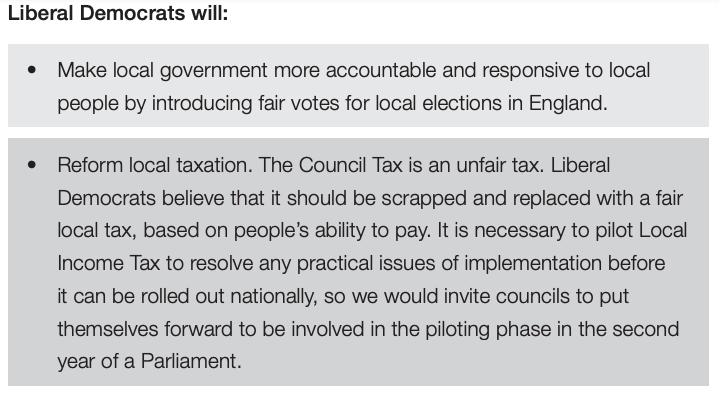
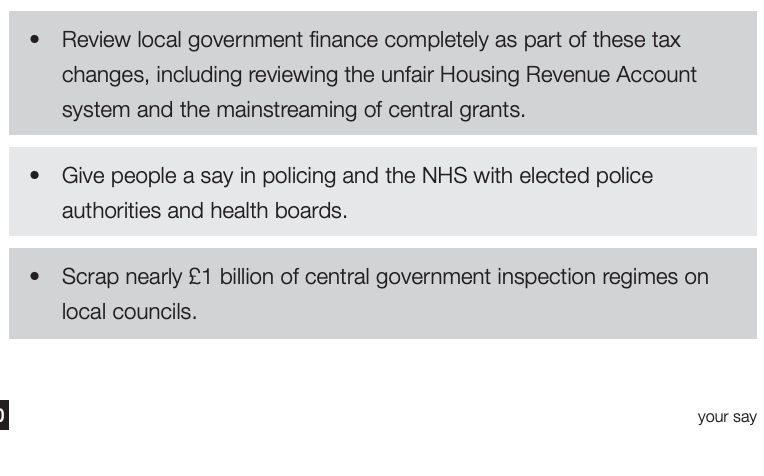
Above – Libdems Manifesto (2010) p46
The Liberal Democrats want to change how local government is financed and also want to change how local councils are elected – i.e. getting rid of First Past The Post. Note their proposed local income tax pilots. There is a substantial amount of historical research on local income taxation going back decades including:
- Royal Institute of Public Administration 1956
- Labour Research Dept 1975
- Layfield Inquiry on Local Government Finance – Income Tax evidence paper 1976
- Local Taxation Options – The IFS 1991
- Local income Tax – JRF 1992
However, being in coalition means compromises. That meant the Liberal Democrats could not bring in a system that would allow councils to have income streams independent of The Treasury. Yet they still needed to deal with Cambridge’s transport issues – ones that the Labour Government and the Conservative-led County Council were unable to resolve when the latter was persuaded to try a congestion charge in 2007-08. (Yes – that is a Conservative-led County Council proposing a congestion charge!) That thing about local history? Exactly.
So in the end, the Liberal Democrats agreed a system that was a good old-fashioned Whitehall grant with some reporting mechanisms and ‘gateway reviews’ to ensure money was being spent properly.
The framework for that was the Greater Cambridge City Deal, signed in June 2014
The problem was that a month before that, the Liberal Democrats under the leadership of Cllr Tim Bick, had just lost political control of Cambridge City Council in the local elections that year. The party had dominated local democracy in Cambridge in the 2000s – the Cambridge electorate having a habit of punishing whoever is in government in Westminster. By joining the Coalition in 2010, the Liberal Democrats lost councillors every year – having previously won seats in Labour strongholds such as Romsey, Arbury, and King’s Hedges. Have a look at the Cambridge City Council elections chart 2004-2020 by messrs Edkins & Rosenstiel.
This meant the councillor picking up the reins for the City Deal for Cambridge was Coleridge’s Labour councillor Lewis Herbert – the new leader of Cambridge City Council.
The only thing that could Lewis becoming council leader was from a cuddly dragon!
And Puffles the Dragon Fairy was only there because opposition political parties saw the ward as too-safe-a-seat to contest with limited resources – and wanted some publicity for these ideas.
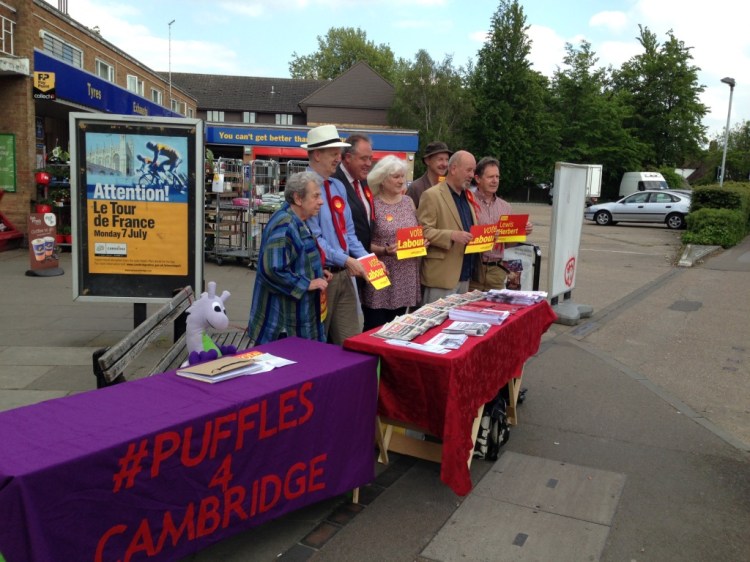
Above: Election campaigning – Puffles and Labour outside the old Budgen’s store (where I used to work while studying for my A-levels!)

Above – Puffles beating UKIP at the ballot box in Coleridge. (They said they’d contest every seat in the city but didn’t show up in the end).
The following year, Coleridge Rec got another dragon – the slide in what some people now call “Dragon Playground”, commissioned by former Cllr Dr Carina O’Reilly, now in Lincoln.

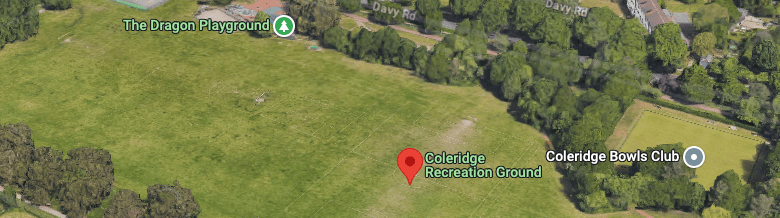
Above – on G-Maps: “The Dragon Playground”
With this new-fangled city deal, that meant more meetings to scrutinise
And people were willing to engage constructively in those early days. Reflecting the surreal profile that Puffles had at the time, the shadow communications team were on first name terms with the dragon but not with me.
Above – Gtr Cambridge City Deal Comms Strategy – 18 Nov 2014
A year or two earlier I had taken Puffles to a party in London and. onarrival I heard someone say: “Yay! Puffles is here! Yeah – who’s that bloke with Puffles?” And thus began several years of filming meetings – later commissioned by the Federation of Cambridge Residents’ Associations.
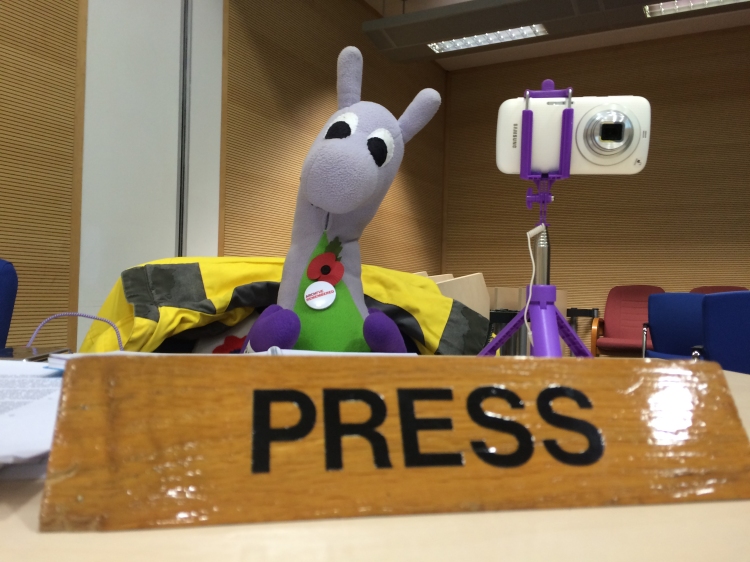
Above – Puffles would become a familiar figure at council meetings – here on the press desk at South Cambridgeshire Hall in Cambourne which has appalling acoustics for a modern building.
“Was it really necessary to feature Puffles?”
No. And Yes.
Because from a local history perspective it shows just how much has changed since the City Deal was signed off in 2014. And when we look at the City Deal in a wider public policy context, it is just one of many urban policy initiatives over the past half century that have been launched by ministers. And how many of those were outstanding long term successes?
Dashed hopes?
Have a look at this interview I filmed eight years ago – excruciating as it is for both me and Roxanne of CamCycle.
Above – Me with head hair and few greys, interviewing Roxanne De Beaux of CamCycle. Cambourne, Cambs, 04 Aug 2015
Now compare it with her speech here, eight years, one month, and three days later.
“Inaction is a political choice that will have a detrimental impact on our transport network. It will not address the urgent issues of our growing region.”
Greater Cambridge Partnership – meeting of the Joint Assembly 7 September 2023
We’ve both been following the fortunes of the GCP for almost a decade.
That does not mean we’ve been neutral or had our own opinions. Roxanne as an employee of CamCycle has a duty to represent the views of the membership (of which I’m one). -one that now numbers over 1,700 people. I guess in my case I tried to film what was going on so that more people could keep track of things – something that the Federation of Cambridge Residents’ Associations started funding me for (from which point the later videos carry the transparency declaration).
Those videos have been incredibly useful for campaigners, politicians, and even officials writing the minutes, because they have been able to go back through the historical record to see who committed to what. It was only after the first lockdown that there was a strong enough business case to get professional AV systems installed in council buildings, meaning that I no longer needed to film. Useful given my health had taken a bit turn for the worse.
Polarising the public
Instead of uniting the public, we have ended up with a polarised public.
“You are just another cohort in a long line of leaders who have failed to solve [Cambridge’s transport] problems” – Dr Sara Lightowlers – Cambridgeshire Parents for Sustainable Travel [campaigning in favour of the sustainable travel zone [STZ] and a congestion charge.]
“Is anyone from the GCP going to get fired?” William Bannell [campaigner against the STZ]
The Chair Cllr Tim Bick understandably ruled Mr Bannell’s comments out of order (in breach of the standing orders criticising individual officers nominally following the decisions of elected politicians) but it’s worth noting that on the same day, Peterborough City Council dismissed one of its most senior ranking officers for reasons we are yet to find out beyond ‘not passing the probation period‘.
Lengthy and convoluted decision-making processes that wear down both councillors and the public.
The GCP’s transport director Peter Blake set out somewhere in the afternoon meeting what the assessment process was for large transport infrastructure. He listed:
- The Strategic Business Case
- The Outline Business Case
- The project/component-specific business case
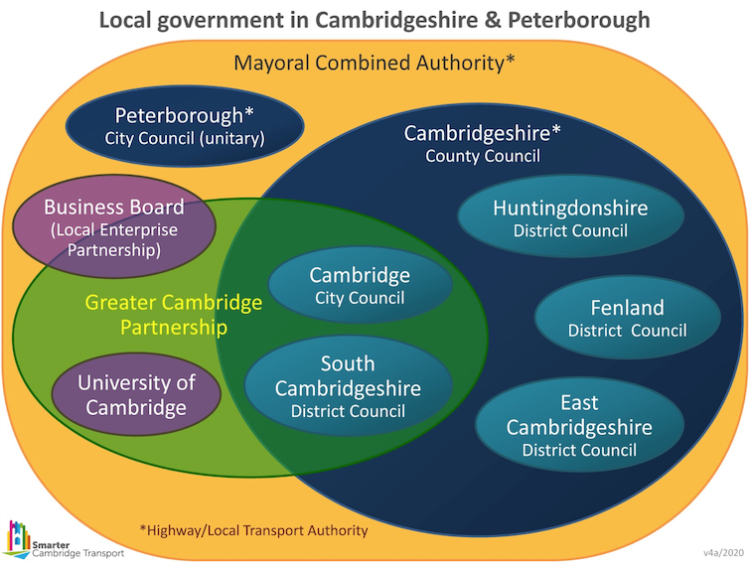
This was after Cllr Katie Thornburrow (Executive Councillor for Planning) called for a review of the governance structures, having noted that each major decision had to be approved by three tiers of local level authorities – the GCP Assembly, the GCP Board, and then the County Council (in the case of the Congestion Charge – as it’s the county council that has the legal powers, not the GCP) before being implemented. In the case of the busways it’s the same – but at the end of it an application has to be made to the Transport Secretary under the Transport and Works Act.
With Bus Franchising there is also a convoluted process involving a Bus Service Improvement Plan, a Local Transport Plan, and then an outline business case independently assessed and audited. With the various public consultations that happen at various points.
Surely there must be a better way to make decisions and at the same time ensure that the public can make informed comments that both influence *and improve* the proposals.
Sometimes senior officers don’t help themselves.
Cllr Sam Davies MBE (Ind – Queen Edith’s) had tabled a detailed question unpicking the assessments and analyses on the transport schemes supporting the growth of the Cambridge Biomedical Campus. You can watch the video here.
“In 2019, the Biomedical Campus Transport Needs Review was published. This was an exhaustive investigation into how the projected growth of the Campus to 2031 could be achieved while maintaining vehicle trips to the site at levels equivalent to 2017 (‘Target’) or even reducing them to 10-15% below 2011 levels (‘Stretch Target’).”
The conclusions of the Review (Part 3, p54) emphasised that “It is critical that GCP schemes are kept to programme (as identified in this Report) to address short-term continued highway traffic growth, mitigating negative impacts on Campus operation and quality of life”.
Cllr Sam Davies to the GCP, Public Qs paper, pp12-13. 07 Sept 2023
Cllr Davies asked if the forecasts had been revised in light of the freezing of the proposed South East Cambridge busway proposals – ones that are being hotly contested by Stapleford Parish Council and also the Cambridge Connect Light rail Project.
Above – that was the sound of my jaw hitting the floor.
The least he could have said was that it would be up to the Assembly to recommend to the Board whether such an updated assessment was needed. Given Michael Gove’s announcement about his vision for Cambridge, I cannot see how anything can proceed *without an updated assessment*.
Above – with the scrapping of the CAM Metro in 2021 (Recalling it relied on The Chancellor to bring in legislation for Parliamentary approval of land value uplift powers for councils – which is yet to be done), how on earth do GCP officers hope to achieve the target reductions in motor car journeys?
Moving from nominally supportive MPs to actively hostile ones
The MP for South Cambridgeshire confirmed he’s in talks with ministers about the future existence of the GCP in his CambsLive column on 04 Sept 2023. (I called for the abolition of the GCP at the Queen Edith’s Hustings in the City Council elections as part of a series of policies to create a new unitary council with far greater legal and revenue-raising powers). While we know the MP for South East Cambridgeshire Lucy Frazer KC has spoken out against congestion charging, the huge workload that comes with being a Cabinet Minister (She’s the Culture Secretary) along with the outdated parliamentary conventions (ministers are banned from raising constituency issues on the floor of the Commons, so no video clips speaking on behalf of constituents) means we don’t have a detailed history of her views on. the GCP, or her proposed alternatives.
The Labour Party at a national/shadow ministerial level needs to come up with a comprehensive response – and their local councillors would be wise to refer this to their policy specialists in their party’s HQ
As mentioned, Cllr Thornburrow called for a governance review – a conversation that would inevitably involve ministers. Given how close it is to a general election, the future of the GCP is something that a future government of a different political party would want to take a view on. It’s almost certain that given Michael Gove’s announcement, senior civil servants making preparations for the constitutional discussions with shadow ministers that precede expected elections would list the future plans for Cambridge as something for even a short discussion. Even if it is: “Yes – we will need civil service advice on this should we get elected.” I think it is highly likely that a future Labour Government would take a different view to the policies of both the Coalition and the Conservative governments. What that view is, I don’t know.
From what I have seen today the GCP as it stands has never looked so politically unstable. Far better to start the conversations *now* on overhauling the governance structures, powers, systems, processes, and financing of local government in and around Cambridge (ideally one that becomes part of a national overhaul that Parliament has recommended) than to let this situation drag on.
Food for thought?
If you are interested in the longer term future of Cambridge, and on what happens at the local democracy meetings where decisions are made, feel free to:
- Follow me on Twitter
- Like my Facebook page
- Consider a small donation to help fund my continued research and reporting on local democracy in and around Cambridge.
 The Cambridge Town Owl