Or should one be incorporated into a wider Commission on the Governance of England as the House of Commons Public Administration & Constitutional Affairs Committee recommended in October 2022?
Or alternatively, not have one at all and ‘let the market’ sort things out.
Some of you may have seen the call by former Treasury senior civil servant Dame Sharon White, now the boss of John Lewis.
“Too many towns and cities are shells of their former selves,” White said, writing in the Telegraph on Monday. “Boarded-up shops left vacant, dwindling numbers of banks and post offices. And in their place seemingly endless rows of vaping and charity shops.”
The Guardian 11 Sept 2023
The impact in Cambridge has been for developers to snap up retail sites and propose converting them into sci-tech parks – such as The Grafton Centre in Cambridge here. The deadline to submit your comments is 23 Sept 2023 (I wrote a guide on how to do so here – one that also discusses a range of issues such as public transport).
The reasoning behind Dame Sharon’s case is to bring a series of complex policy areas together and consider them collectively rather than piecemeal.
“We now need a new royal commission to set a course to revitalise our high streets,” she said. “Planning, taxation, crime, environmental policy, housing and transport all play their role, but must be considered as a whole.”
The Guardian, 11 Sept 2023
I agree with all of those – but then you could say all of that in relation to how a settlement, whether village, town, city, or metropolis, is governed. Hence my preference for the Commons PACAC proposal of 31 October 2022. Furthermore, the complexity mirrors the concerns I raised in my previous blogpost about a proposed Community Power Act.
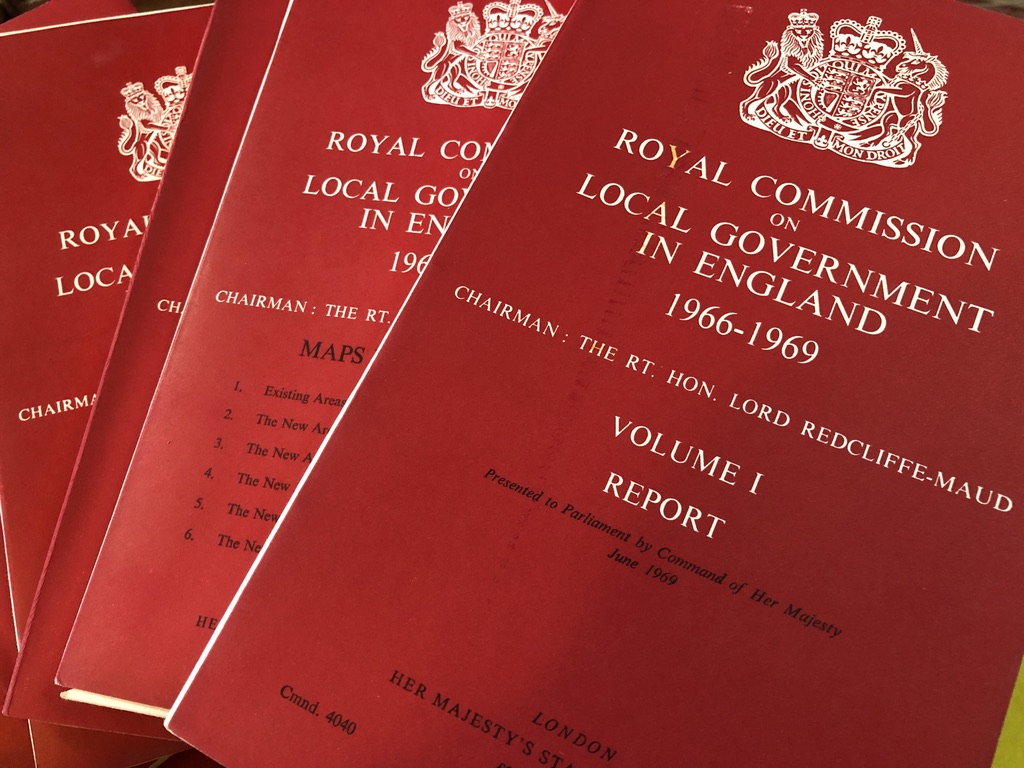
The Redcliffe-Maud report – a monster of a report. And then some.
The House of Lords Library had a look at the use of Royal Commissions in 2020. In the case of the Royal Commission on Local Government in England 1966-69, chaired by Lord Redcliffe Maud, his report was accepted by Harold Wilson’s Labour Government in 1969 and included in their manifesto. It wasn’t accepted by Sir Edward Heath’s Conservatives – who won the general election the following year. And the rest is history. Hence the county and district council boundaries many of us are familiar with today. For those of you interested, Redcliffe-Maud’s report (which has its own WikiPage here) can be seen as follows:
- The summary
- The main report
- The maps to the main report
- The research appendices
- The maps to the research appendices
One of the commission members, Derek Senior dissented from the findings and managed to get his own version of recommendations included. But I didn’t have the headspace to digitise his works. Mr Senior also wrote about Cambridge a decade prior, having been commissioned to write a guide to the Cambridge Plan (digitised here) – essentially the Holford Wright Report of 1950.
“If you are interested in the Plan as a citizen, as a member of the University, or as one of the thousands of people all over the world who know and love Cambridge, then you will find these documents by themselves of little use. They will not tell you what the Plan is all about, or explain how one proposal is related to the rest.”
A Guide To The Cambridge Plan (1956) by Derek Senior, p6
“In this booklet I have tried to show you the wood as a wood. Since it is not a statutory document it can concentrate on essentials, both in text and in diagrams. When you have read it you will, I hope, be able to see the Plan in the round, to appreciate the problems which its authors had to solve, and so to reach your own informed and independent judgment as to how well they have discharged their task.”
I’ve included those points because as is often the case with big corporate plans today, they are written to be referred to, not to be read in their entirety. Senior’s guide to the Cambridge Plan is very much in a different style.
I think there’s merit in incorporating Dame Sharon’s proposals into a wider report – *and* having her as one of the commissioners given her civil service background.
At the same time, I think there should also be trade union representation on any such sub-committee focusing on the high streets as well. Not least because it is trade union members – some of the lowest paid in our economy, who work in high street shops who are on the front line. Therefore their interests must be protected. Furthermore, one of the largest unions representing retail workers, The Union of Shop, Distributive and Allied Workers (USDAW) is campaigning to save shops, and is calling for a retail recovery plan.
It’s easy to forget that trade unions representing high street workers have a very long history – as the digitised publications on USDAW’s history pages here show. So there’s actually a case for having an independent social historian as one of the commissioners or attached to the sub-committee on the state of the UK’s high streets.
“Why not have a separate Royal Commission on the High Street?
It’s finding that balance. The findings of the Royal Commission on the High Street might not carry enough weight to influence policy makers and ministers in the relevant departments (Whitehall silos are notoriously difficult to break – especially The Treasury!) Having them as part of a wider commission on the other hand might have enough strength.
But then that must be set off against the risk that the High Street’s needs are de-prioritised for other parts of local government – especially where you have competing interests. For example where does the traditional high street stand in relation to the [15 minute / insert desired time frame] city concept? Or the growing prevalence of home working? Note any new trend is not without its risks – and loneliness can be a big challenge for freelances and home-workers who don’t get the chance to interact with a stable group of people on a regular and routine basis. Something I have missed desperately since leaving the civil service.
Local councils could also be funded by central government to hold their own local versions to ignite local participation and make the entire exercise much more meaningful to the public. They could, for example begin once the first interim reports have been drafted that outline the findings from early hearings, literature reviews, and evidence bases. Furthermore, there’d be a role for local universities and higher education institutions to provide the academic and research support role for their own local areas rather than having a handful of research institutions or think tanks hoovering up all of the contracts.
The reason being that the direct participation of universities at that level breaks the bubble that is easily created between senior local council officials / executive councillors and university management, to the exclusion of other members of universities. You only have to look at the questions arising in Cambridge about how the University of Cambridge consults with its members – staff, students, academics, on what its corporate policies should be on the future of our city.
Furthermore, such a setup could catalyse new working relationships and more meaningful research opportunities on local issues that might actually make a meaningful different to the towns and cities that universities are hosted by. It’s one area that for me at least remains an area of frustration – the inability of local public service organisations to tap into the local research capacity in our city, and the inability to publicise the findings of those that make the choice to do high quality in depth research on local issues in and around Cambridge. I’ve lost count of the number of researchers from outside the UK who find Cambridgeshire’s governance structures laughable. So why do Conservative ministers insist on maintaining it? How do they explain it to a city full of world class global researchers? Or dare they not concede that the set up is purely party-political in nature? Similar questions will arise for opposition parties at the general election on if they would change the structures, and if so, how?
Unfortunately the call to establish such a commission from the Commons PACAC last October (2022) was ignored by Michael Gove. Hence they summoned him back to explain himself.
“Earlier this month the Committee called out the Government for the poor quality of its response to the Governing England report. The Committee said it showed a clear lack of engagement with the important issue of good governance in England and called on Mr Gove to appear before the Committee to account for the response.”
Commons PACAC press release, 17 March 2023
You can watch how Gove got on here.
Will Dame Sharon’s call for a Royal Commission on the High Street be answered positively? That decision may well be one for the next government to take, for the timeframe involved in setting one up is not a short one. And time is not something the present government has much of.
Food for thought?
If you are interested in the longer term future of Cambridge, and on what happens at the local democracy meetings where decisions are made, feel free to:
- Follow me on Twitter
- Like my Facebook page
- Consider a small donation to help fund my continued research and reporting on local democracy in and around Cambridge.
 The Cambridge Town Owl