
The joys of trying to transport books by electric cycle – but it was worth the experiment!
It was a lovely sunny day for it too at what has become the annual Greener Queen Edith’s event which sort of combines campaign and info stalls, a skip day, a food hub, and ‘bring and buy/swap’, and more.
I was offered a slot to promote my pilot ‘Great Cambridge Crash Course’ where we discover through small group exercises how our city functions. And malfunctions! I figured out that standing there handing out fliers would be off-putting, so put up a book stall instead with examples of the books that participants will be able to select from at the end of the workshop. (With thanks to Sam and Rachel for their help in transporting/storing the books).
Transporting books via an electronic bike
I did two trips, walking my e-bike with the ‘walk’ function that enabled me to move several bags/small boxes of books which I was able to keep overnight at the home of a local resident who lives close by where the stalls were. (Sam dropped the unsold stock back). I was hoping to have most of them stacked up in a cycling towing trailer but something went wrong in the assembling of it so couldn’t use it this time around. But the principle seems fine. He says!
Next time around I won’t need to haul so many. Or rather the e-cycle won’t need to. (For it took the strain rather than me!) The reason for bringing so many this time around was because I had no idea which, if any of the books would be of interest to local residents – mindful that Cambridge has a high population turnover.
What residents were and were not curious about.
The Usborne for Beginners’ Series was very popular from browsers and buyers alike. There’s a case for every Cambridge school and public library to stock the entire set. Not least because it may well help educate the parents as well. For those that bought them, I threw in Andrew Marr’s All about politics. book as well – interestingly the brand name was one that carried. All of the stock I bought off the internet at discounted prices – books that were otherwise gathering dust in a warehouse somewhere. A couple were inevitably in not the best condition so I donated those to the local book exchange.
Given the cost of living crisis, I put some guidance prices on the sign stuck to the tripod, but said ‘am happy to be haggled’. Which made it easier to have a conversation with people too. This part of South Cambridge is historically a predominantly White Working Class and elderly community, many of whom live in current or former council accommodation, or in sheltered accommodation. It has become more diverse in recent decades, reflecting the economic growth and changing employment profiles of the city. This wasn’t a stereotypical gathering of jet-set scientists with more degrees than a thermometer – despite the presence of the biomedical campus two bus stops away. Hence the ‘community event’ feel.
Policy books for policy events
With the exception of one or two, the back copies of specialist magazines (policy, politics, public transport) were of little interest. Ditto the books on citizenship other than to compare the AQA’s syllabus content between the 2002 edition and the 2022 edition.
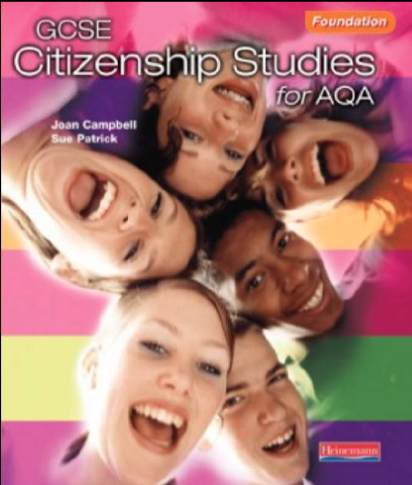

Above – compare and contrast: Left – ‘Cool Britannia’ vibes vs Right – an authoritarian Home Office?
There’s a comparative study of the two publications waiting to be done by any student looking for an extended subject topic to research. What does each book say about the culture of the time, and the approach of the ministers of the day towards citizenship as a concept?
It was a community day, not a ‘citizenship discussion day’, and nor was it an ‘environmentalist politics’ day
In one sense people seemed content to discuss ‘politics without the Party Politics’ if that makes sense. Not just in terms of their day-to-day lives but also in terms of their own personal histories such as their years living on the other side of town. Hence several people picked up some local history books related to the growth of Cambridge as a town/city. Political parties and politicians barely got a mention other than as authors of books including the late Paul Flynn’s guide on How to be an MP, and also John Hutton’s guide on How to be a Minister [of the Crown], both of which were bought by interested residents. I explained to them that the authors had taken the party politics out of the book and focused on the functions, demands, realities, and responsibilities of high public office. For example in the latter there was a section on Special Advisers – see the explainer by former Civil Servant Martin Stanley here. Most people don’t know what a special adviser is, let alone what they do beyond ‘providing advice’. (A wise and competent special adviser is one who functions as an effective conduit between ministers and the huge number of civil service policy advisers in a department – of which I used to be one of the latter. When that relationship works well, it can save a huge amount of time and effort for both ministers and civil servants).
At some stage we will need some local public policy Q&A events
Furthermore, these will need to be organised by alliances of campaign groups and civic society organisations. It cannot be done by an individual. Inevitably it will be a self-selecting audience. But they need to be events that can bust myths and provide a safe space for the public to learn about an issue and ask both robust questions on the essentials, and unpick complex issues on how future policy proposals might apply to them.
We need to acknowledge the pressures of time that local residents face.
“That’s. a really interesting book – I just don’t have time to read it, that’s all.
…said one parent with a growing toddler in a buggy to me. That I can understand. I have. no idea how anyone trying to juggle parenting *and* a full time job without a wider support network can cope. Hence looking back at the 1990s and how horrible it must have been for single parents in an era when mainstream politics and the print press blamed them for all sorts of social ills.
This is where in principle things like podcasts, vlogposts and short video explainers can be useful, but again it needs the legitimacy that comes with organisations. i.e. not just me, a smartphone, and a selfie stick.
There are very few accessible introduction to civics books around – for both children and the wider general public.
I’ve written about this before with the old Penguin Specials.
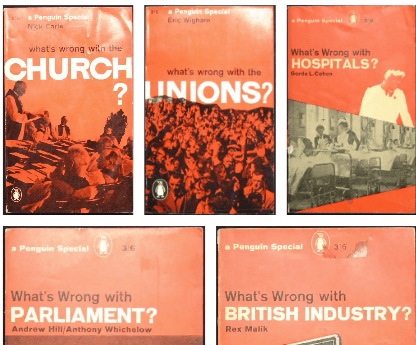
Above – What’s wrong with [stuff]? series from the 1960s
Furthermore, some are really hard to find – such as The Motor Car and Politics in Britain 1896-1970 by former Special Adviser to Sir Edward Health, William Plowden. What happened to that culture of the mass publication of contemporary public policy books?
In for the long haul – step by tiny step.
Well…I’ve got nowhere else to go amongst other things. That plus my limited capacity to work – the Post-Exertional Malaise (from Chronic Fatigue Syndrome) has not kicked in yet but when it does, I’m expecting it to be ***absolutely brutal***. So please don’t expect much from me until the middle of next week!
A couple of people mentioned the election – a few saying thank you for standing, and others asking if I had thought about standing again. I said that the demands of elected public office are too great for my long term health, and that stalls and workshops as and when I’m well enough to put them on are the best I can hope for in order to inspire others to go down the road of contesting elections to local public office irrespective of political party. That also needs more of us to get involved in defending sound political processes as well as demanding improvements to the existing one – which Prof Matthew Flinders sets out in his book Defending Politics. Because the lack of trust and the lack of knowledge in our institutions of state and our [flawed] democratic systems are significant barriers to improving things. Something has to start at the grassroots. What that success looks like on that front… I’m still trying to figure out. In the meantime, do sign up for my pilot workshop on 30th Sept at Rock Road Library!
Food for thought?
If you are interested in the longer term future of Cambridge, and on what happens at the local democracy meetings where decisions are made, feel free to:
- Follow me on Twitter
- Like my Facebook page
- Consider a small donation to help fund my continued research and reporting on local democracy in and around Cambridge.
 The Cambridge Town Owl