
The papers for Cambridge City Council’s Transport & Planning Scrutiny Committee for 28 Sept 2023 have been published – and there’s a statement of community involvement that needs scrutinising.
You can see the papers here. You can also see the Get Involved pages by the Greater Cambridge Shared Planning Service.
This is really heavy going with PEM+Brainfog after Saturday, but here goes.
Before I get side-tracked on design panels (p59 of the agenda reports pack, para 4.12), this is basically the citizenship thing all over again.
**Cambridge people don’t understand their town planning problems!**
Said Jeffery Francis Quarry Switzer in a lecture in 1962. Or rather:
“…there is a need for public understanding and co-operation. I think that in Cambridge we have been very bad about this. Perhaps this happens in all towns, but judging by the correspondence in our local press, Cambridge people really do not understand its planning problems. The basic issues here are so simple, but we will get them confused, and people will go on talking – but I have only got a few more minutes”
J.F.Q. Switzer, Cambridge Land Economy Dept, November 1962
I wrote about his comments in an earlier blogpost. In it I pleaded with Cambridge’s town planning circles to respond to this.
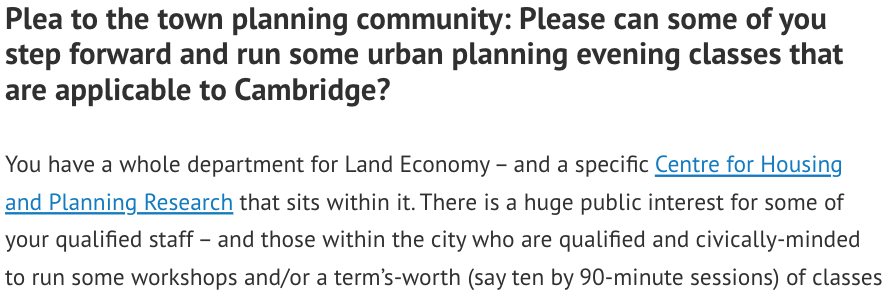
Above – me moaning.
So far, no news. Which means I have to ask a tabled public question instead. That noise you heard was the rest of the city groaning at the prospect. Or rather a handful of councillors and council officers. I don’t blame them. Just hold me back before I get to this level of detail.
Town planning is not covered in GCSE Citizenship courses
I mentioned this earlier here. But then given only 145 students in the whole of Cambridgeshire took GCSE Citizenship Studies in 2022, changing the syllabus of one GCSE course won’t change the situation. To what extent GCSE Geography could incorporate the study of Cambridge from a development planning perspective is a different issue. That said, when I did GCSE Geography the last thing I’d have wanted to have done was to have stayed in Cambridge. We went to the lost town of Dunwich on the East Anglian coast, and then to the London Docklands in the mid-1990s – a year before the IRA laid waste to some of the areas that we had studied. So I don’t know how appropriate it would be to use Cambridge as a case study in the way that visiting schools from other parts of the country do – having been stopped in the streets to fill out short surveys about the city on more than a few occasions.
Pre-GCSE however, it’s something that schools *could* incorporate – but it needs significant support and resources from local and national organisations. Why? Because Cambridge is such an unaffordable city to live in that many teachers have to commute into the city to work – sometimes crossing district and county boundaries. The last thing they want to do in their spare time is to go back into Cambridge for…anything that can be accessed elsewhere and more easily/cheaply so. Or rather than was the testimony from a couple of teachers from when I was a school governor a decade ago. They shone a light into how Cambridge’s housing crisis has a knock-on effect on teaching.
Because the housing crisis won’t be solved overnight, what training options are there for teachers?
- Who should fund them?
- Who should organise them?
- Who should prepare the teaching materials?
There are a range of subjects that could be covered over an extended period of time. One of them inevitably is local history: how did Cambridge get to become the city is is today? Part of the problem there is that no one has written a comprehensive history of post-war Cambridge. (I’d love to do it myself but I don’t have it within me to do so – it would have to be a partnership with a professional writer and illustrator amongst other people).
Given continued austerity from central government, schools are hardly in the place to prepare the materials themselves. In the olden days, the Local Education Authority had in-house production teams that fulfilled that function, but Thatcher’s policies got rid of that. The assumption in neo-liberal economics was that the private sector could do such things much more efficiently than the state. Hence why so much is contracted out to third party providers.

Above – Detail of the “Journey To Work” board game produced by Cambs Curriculum Development Centre that was part of Cambridgeshire County Council’s Education Service in the 1970s – featured in this blogpost.
Now try to find a private sector company who can do that on a shoe string budget *and* make a profit while covering all costs. Using 1970s technology only. Not going to happen. Not from a corporate provider anyway.
Thus we have another example of where the fragmentation of the local public sector is a barrier and a massive diseconomy of scale in the centralised structure that we have for schools and education in England.
Educating adults on town planning and local development plans
There’s a big structural difference between dealing with individual planning applications (‘Planning Casework’) and dealing with the local-level rules that all planning applications should have to abide by. (‘Development Planning’) Both the terms in brackets were ones I became familiar with during my early civil service days. There were *four* different planning units in those days at Eastbrook on Shaftesbury Road off Brooklands Avenue:
- Planning Casework
- Development plans
- Regional Planning
- Transport Planning
For the latter two, they dealt with the short-lived East of England Plan and major transport infrastructure. One of the reasons Cambridge is a bit of a mess at the moment is that any co-ordination at a regional level went with the abolition of regional structures by Eric Pickles in late 2010. Hence why Cambridge and surrounding towns are struggling with transport policy because there is no regional tier to deal with Cambridge’s connections to nearby towns over county borders.
“You’re getting side-tracked”
Nearly.
The thing is with geography at GCSE level is you can cover big concepts such as alternative forms of transport to the motor car, and the impact of the latter on things like the environment and people’s health. It’s harder to apply that to local development plans, or even individual planning applications when you’ve got a restricted syllabus and the pressure to deliver good exam results with OfStEd breathing down your neck. And with limited resources too.
I actually don’t know how to go about solving this problem
In the olden days, the county council/local education authority might have been able to employ a handful of specialists that could cover citizenship, civic engagement, and town planning activities, with each covering and specialising in a different part of the county, to ensure schools that didn’t have that in-house expertise had access to a wider support network. So fragmented has the governance of city and county become that I have no real idea where responsibility might rest.
I was vaguely aware that ministers wanted to bring in new Regional Commissioners for Education (which they’ve since done – see here).
“The Regional Director for the East of England is responsible for working locally across children’s social care, SEND, schools and area-based programmes to improve outcomes for children, families and learners.”
Gov UK – profile of Jonathan Duff, the current RD for EoE
You can read about the responsibilities of the Regional Directors for Education here
Essentially Mr Duff is a civil servant and accountable to ministers much as it was under the old Government Offices for the Regions. Furthermore, each region has an advisory board. The East of England one is here.
“Jonathan Duff, Regional Director for the East of England meets with elected, appointed, and co-opted advisory board members”
“Elected members? Well I didn’t vote for them!”
You don’t get to vote for elected members of the regional board of education!
“Why not?”
Good question – how do they get elected and by whom? Only there’s nothing in the links on how they got elected and who the electorate was.
Regional Directors for Education have ‘transparency issues’
Schools Week magazine had a look.
“Just one in 10 regional director meetings had representations from the public, backing up concerns important academy decisions are being quietly determined with little input from parents.”
Schools Week, 19 June 2023
“That was only a few of months ago”
The minutes of the meetings might look dull (see June 2023 here) but they are taking some significant decisions.
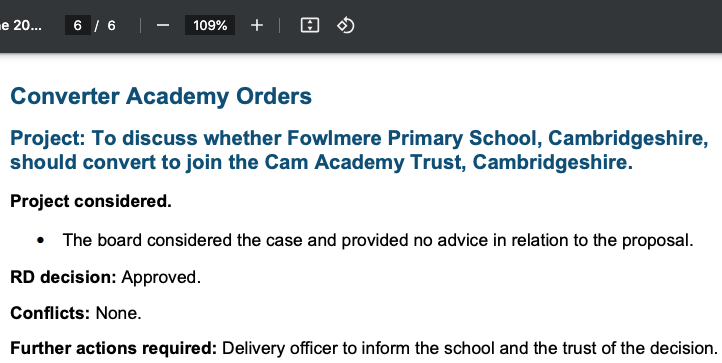
Above – the conversion of a primary school to become part of an academy trust is quite a big deal irrespective of merits. In the above case, Fowlmere Primary School in South Cambridgeshire District.
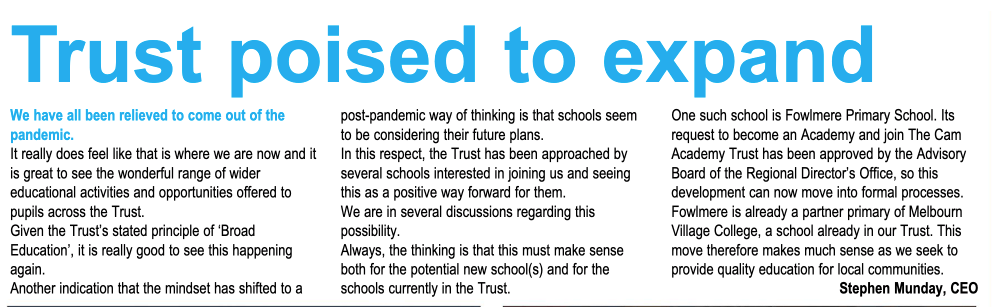
Above – comment in the termly magazine of nearby Melbourne Village College
Interestingly, the trust the school is joining – the Cam Academy Trust, covers not just much of the old Cambridge County, but also schools in Bedfordshire and Huntingdonshire too. (Noting the map shows district councils rather than the counties that formed the old local education authorities!)
Given how complicated all of the above is for teachers, no wonder they have so little time for anything else! There is also the wider issue of lines of accountability – something that is likely to come up again when Michael Gove makes a decision on the future of Cambridge the city (and economic sub-region). By moving to an academy system, Michael Gove as Education Secretary moved the lines of democratic accountability away from county councillors and onto MPs. (Did anyone tell MPs that when they enacted/approved the legislation bringing this about?!?)
“So…what is the best way of supporting teachers when it comes to youth engagement in both individual large planning applications, and future local planning policies?”
I genuinely do not know.
As one parent said to me at Greener Queen Edith’s, “That’s. a really interesting book – I just don’t have time to read it, that’s all.” …when browsing through one of the various books introducing all things citizenship, democracy, & public policy on my book stall. I’m not pretending it isn’t a complex public policy area. But if ministers cannot come up with accessible processes and the means by which the public can make informed choices on whether to participate, the existing structures and ministerial policies remain a huge barrier to participation.
And that matters because those decisions will affect day-to-day life of local people for decades to come.
Food for thought?
If you are interested in the longer term future of Cambridge, and on what happens at the local democracy meetings where decisions are made, feel free to:
- Follow me on Twitter
- Like my Facebook page
- Consider a small donation to help fund my continued research and reporting on local democracy in and around Cambridge.

 The Cambridge Town Owl