
This, they told Cambridge City Council’s East Area Committee is why so many schools in Cambridge cannot afford to offer GCSE Citizenship – they cannot afford to take the risk of hiring a specialist teacher given how low the uptake is likely to be in the short term. They also slammed ministers over the lack of powers and the weak penalties over unlawful/illegal parking.
You can read the meeting papers here
Very few people watching online
You can re-watch the live-stream here
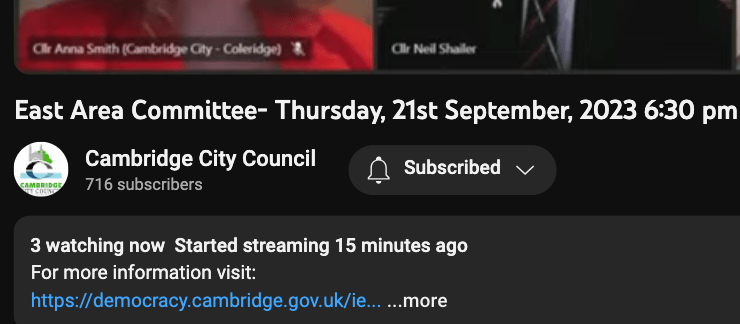
Above – not the greatest look for our online area committees
By the end of the meeting, 22 views had been logged. By how much that number will rise will depend primarily on the local mainstream media outlets. If they write about it and link to the stream, they’ll get more views. But that will only go so far given how fragmented and loaded the current algorithms are. In a cost of living crisis it’s hard to make the case for spending money on social media adverts.
Much of the state of our most local tier of government in Cambridge reflects the continued austerity imposed on local councils – there’s very little they can do as institutions in the current system. Furthermore, many of the things that residents would like to raise with them – such as the shortage of GP and NHS dentists in the city are things that are far beyond the influence of local councillors.
Until national government gets its act together, this is the system that councillors and residents have to work with. So I tabled three questions. There were also a few other questions relating to hyper-local issues – often road related such as this one in support of restricting motor traffic on Mill Road Bridge. (One that has two very passionately opposing groups – local residents in favour, and a mix of local shops and people who commute down Mill Road who are against.) The debate that followed was the City Council’s Environment Report (See the papers here) which in the grand scheme of things is like a ‘state of the residential districts’ report.
Question 1 – encouraging greater use of new and recently-improved community facilities in Coleridge ward
You can listen to Cllr Dinah Pounds (Labour – Romsey) reading the question out here
It related to this building project at St Martin’s on Suez Road, almost next to Coleridge CC, which is where the Cambridge branch of the men’s mental health charity, Andy’s Man Club meets every Monday evening. (If you know any men who might benefit from getting things off their chest to a sympathetic audience, do let them know).
Coleridge needs more volunteers to step forward!
Councillors Anna Smith and Rosy Moore (both Lab – Coleridge) responded – you can listen to their comments here. Cllr Moore made an appeal for more people to step forward first of all to take part, and secondly to help get involved in co-organising future events. (See contact details here if you are interested or know anyone who is).
One thing it’s impossible to avoid in South Cambridge is how many of the organised community activities for adults are inevitably church-based. Not easy for those of us who had negative experiences of organised religion in the past. It reminded me of groups organising events and being asked not to hold them in place that serves alcohol, or to have it somewhere that is easily accessible by public transport. There are a host of things that are so easily overlooked that can automatically shut out people from participating.
Yet the existence of the institutions ultimately is a result of local history dating back to when the estates were built at a time when the social and civic structures of society were different to what they are today. One of the things I’ve learnt from going through the old local newspapers in my Lost Cambridge research is reading between the lines of how and why my childhood neighbourhood changed.

Above – an example of the Cambridge Evening News of 01 Aug 1970 with a regular church services notice board. From the British Newspaper Archive
Some of the churches listed are no longer with us – such as Hills Road’s magnificent old Wesleyan methodist chapel, while others have been converted to other uses. There’s an extended project for a further or higher education student on comparing the state of churchgoing in Cambridge in the early 1970s with that of today, half a century later.
“We currently have 20 people in formal membership with the church. Sadly, one of our members…died in October. Like the previous year, we have also been a slightly smaller congregation than usual.”
ZBC East Road Cambridge: Annual Report and return to the Charity Commission, 2021
It’s one of the landmark religious buildings in Cambridge, yet has dwindled in size over the post-war decades. Today it survives primarily by leasing out the older half of the building that overlooks Petersfield the green, to Jimmy’s night shelter. Part of any research project would involve going through the Charity Commission’s online register and cross-referencing those held at the Cambridgeshire Archives in Ely from decades gone by.
Going through the literature on community development and town planning, it’s clear to me that contemporary politics and society is still trying to figure out what sort of anchor institutions could stabilise communities and integrate new arrivals into them in a way that doesn’t involve continued mass subsidies from the taxpayer. Given the current extractive economic system that we’re in, I can’t see those solutions coming anytime soon. As Cllr Sam Davies MBE in Queen Edith’s south of Coleridge noted, it certainly is not coming from those making their fortunes in Cambridge.
“You’re rambling again. Question 2” )
Have a listen to Cllr Pounds again here. This was asking why so few students were taking GCSE in Citizenship Studies. I referenced the total of only 145 students in 2022 electing to take GCSE CS.
This was answered by Cllr Bryony Goodliffe (Labour – Cherry Hinton Division for, and also Chair of the Children and Young People Committee Cambridgeshire County Council).
“With the current funding crisis in education, specialist subjects are difficult to fund, and we have seen a decrease in the breath of subjects which are offered where schools cannot ensure a full cohort of students”
Cllr Bryony Goodliffe (Lab – Cherry Hinton) to East Area Committee, 21 Sept 2023
She also highlighted the independence of academies around subjects taught beyond those required by law. For humanities, only history and geography – in particular with the introduction of the EBacc has constrained the takeup of other subjects.
Cllr Anna Smith, who was a history teacher at Hills Road when I was a student there (I still regret not taking it!) highlighted how Tony Blair’s New Labour Government brought in citizenship as part National Curriculum, and just as importantly after 2001 put the resources in to make it happen on the ground. The decision to so was in part in response to the recommendations from the 1990 report Encouraging Citizenship. It’s up to the Tories to explain why they did not implement the recommendations during my secondary school years even though they had more than enough time to do so.
Cllr Mike Davey (Labour – Petersfield) the Leader of Cambridge City Council mentioned responding to school requests – which reminded me of a minor disagreement I had with some former Labour councillors back in late 2013/early 2014 – nearly a decade ago! The whole thing makes for excruciating reading on my part (WTF was I thinking of?!?) but in the grand scheme of things there were two issues that in hindsight I was struggling with, and one that they (collectively as an institution) were finding challenging.
- I was still in regular contact with serving civil servants despite the fact I had left the institution 2 years before – therefore my mindset was still institutionalised, only I couldn’t work out why local government did not seem to respond as fast as when I was in the Department for Communities and Local Government. (This is what I call the Westminster Bubble effect – things work *very differently* when you are in it! Hence blogposts like this)
- I was still going through a major existential crisis – struggling to deal with undiagnosed CFS/ME (it took over 8 years after this point to get a diagnosis), trying to find out how to ‘recover’, and working out how to ‘find my niche’ after seven years in the civil service. That is the longest time period. I have been in any institution. The next longest? Primary school.
What local government in Cambridgeshire was struggling with was how to deal with this new fangled thing called social media. Not the social media of today where so much is hotwired to junk, but a world where your social media feeds showed you the updates from people and groups you followed. The attempt to monetise those social benefits and then capture them has destroyed that ecosystem. At the time there was limited engagement between the city council and young people – austerity was kicking in. Furthermore the institutional silos had children and young people as a county council responsibility. Until a group of Year 9 students at Coleridge achieved by lunchtime what I had failed to achieve in 2 years.
“I have indeed done quite a few of those school events and I have to say that at some of the meetings I’ve had at Coleridge, council meetings don’t have a patch on the grilling you get from students who want to get answers to questions they care deeply about.”
Cllr Anna Smith (Lab – Coleridge) to East Area Committee, 21 Sept 2023
The final point Cllr Davey raised was putting that question to the academy chains. This was something I picked up about the democratic deficit in local public services. I have no means of holding academy chain leaders to account except through my MP as I have no children. (Nor do I want any – I couldn’t handle the work and responsibility!) Under the old Local Education Authorities that were part of county councils, it was no different to a meeting like this one – just held in a public neighbourhood building.
And…Question 3)
This relates to the Great Cambridge Crashcourse Workshop
“I’ve been following details of the workshop – it looks really exciting! For those not aware, while the county council leads on 11-18 education, the Combined Authority leads on adult education, which is why [as Deputy Mayor of the Combined Authority] I am answering. “
Cllr Anna Smith (Lab – Coleridge) to East Area Committee, 21 Sept 2023
As Cllr Smith rightly says, it is the Cambridgeshire and Peterborough Combined Authority that has policy responsibility for adult education and lifelong learning – a function transferred to them with the Statutory Instrument establishing the CPCA. (Specifically Part 4 (10(b)) of the The Cambridgeshire and Peterborough Combined Authority Order 2017)
This means having to follow up with the CPCA – slightly awkward given that as a candidate in Queen Edith’s earlier this year my manifesto called for its abolition in favour of a unitary council for the southern half of Cambridgeshire , incorporating nearby towns over the county border! That aside, it is the Skills and Employment Committee of the CPCA that is the detailed policy-making function that then sends recommendations up to the CPCA Board for ratification. Cllr Smith, who chairs the CPCA’s Transport and Infrastructure Committee was also in the news today with a video of her statement about how the Peterborough Bus Depot funding was contingent on the Local Transport and Connectivity Plan being approved by the CPCA Board. To which the representative of Peterborough City Council seemed to be onside. All was well until the Leader of Peterborough City Council wielded his veto without explanation yesterday. And all hell broke loose. The Mayor of the CPCA Dr Nik Johnson had to release this statement in response to some of the misinformation coming out from his party-political opponents. Yet just as with the Greater Cambridge Partnership, the CPCA *was not designed to function in a hostile political environment*
We find out on 18 October 2023 if the Full Council of Peterborough City Council will pass a motion of No Confidence in the Leader of the Council. Note too that Peterborough is one of those bell-weather swing seats for general elections.
Last item: Cambridge Parking Chaos
This is a chronic problem in our city – made worse by austerity because there are so few civil enforcement officers [traffic wardens with more powers] to penalise law-breaking motorists. Have a listen to the debate.
The penalties that require approval by Parliament tabled by central government are so low as to be treated almost as a business expense by some motorists. Given that so much of the Department for Transport’s resources went into dealing with the EURef fallout, and given that the Home Office is one big incompentocracy, it’s hard to see any significant changes coming this side of the general election. And in principle it should be such an easy win. Substantially increase the fines, and enable local councils to keep a large proportion of the revenue. That way they can increase the number of civilian enforcement officers until law-breaking motorists get the message and change their behaviour. Because at the moment it’s as if the laws on parking do not exist.
There. That took longer than expected!
If you are interested in the longer term future of Cambridge, and on what happens at the local democracy meetings where decisions are made, feel free to:
- Follow me on Twitter
- Like my Facebook page
- Consider a small donation to help fund my continued research and reporting on local democracy in and around Cambridge.
 The Cambridge Town Owl