What are the prospects for the constituency that has lost 40% of its old districts, while gaining some new ones from the soon-to-be-vanquished South East Cambridgeshire, along with Cherry Hinton Village from Cambridge?
The changes to constituency boundaries have now been finalised by the Boundary Commission for England. To understand the sign-off process sadly requires an understanding of UK political systems that most people do not get to learn about unless they study politics beyond A-level standard.
“…the Government must prepare a draft Order to implement the new constituencies for the whole UK. This should be provided to the Privy Council for approval within four months of the last report of the four Parliamentary Boundary Commissions for the UK being laid in Parliament. Once the Privy Council approves the Order, the new constituencies will be used at the next General election following that date”
Boundary Commission 2023 Review.
“What’s the Privy Council?”
“The Privy Council is the mechanism through which interdepartmental agreement is reached on those items of Government business which, for historical or other reasons, fall to Ministers as Privy Counsellors rather than as Departmental Ministers”.
https://privycouncil.independent.gov.uk/
It’s one of those institutions that has a *very long history* – in this case it dates back to the days when monarchs were involved in day-to-day politics, and their most closest advisers were ‘privy councillors’.
“Why do we have one?”
Because getting rid of it without massive constitutional reform would cause more problems for the Political Establishment than it would solve – ditto the disestablishment of the Church of England. Because ministers past and present have been of the view that there are more important issues for them to be dealing with, things have stayed as they are. The same goes for reforming the structures, boundaries, and finances of local government in England. It has been thrown into the ***too difficult to deal with*** pile. Hence why your council tax bills are calculated by indexing the value of where you live to what they might have been in 1991.
“We do not decide your Council Tax band. It is based on how much the property would have sold for on the open market on 1 April 1991.”
Cambridge City Council
“Why 1991?”
Because the Tories panicked after bringing in the Community Charge – a Poll Tax/flat rate tax which led to much higher bills than they anticipated. This resulted in a big non-payment campaign (reflected in much lower collection rates) and a riot in central London in 1990.
“The government has no plans to replace or fundamentally reform council tax. A revaluation would be expensive to undertake and could result in increases to bills for many households. The creation of higher council tax bands, which in itself would require a revaluation, may penalise people on fixed incomes, including pensioners, who could face a substantial tax rise without having the income to pay the higher bill.”
Ministers to House of Commons Levelling Up Committee, Recommendation 3
This is an example of a Political response for keeping a system in place – no matter how obsolete or that looks like it is either hard to justify as a public policy issue (focusing on the evidence and not the political/electoral considerations) that might have additional solutions to the problem. You can browse through some past publications that have considered how councils should be funded here.
Back to the constituency boundaries, what does the new South Cambridgeshire look like?
Like this:
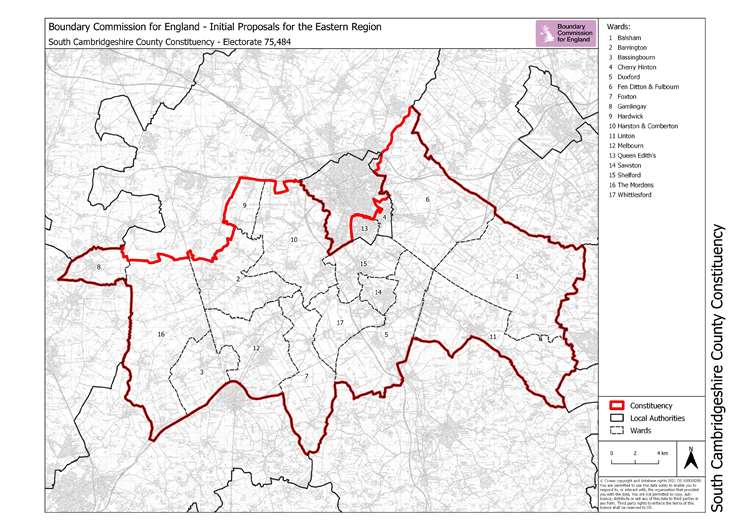
Above – from the Cambridge Independent here
Several people tried to make the case for Cherry Hinton and/or Queen Edith’s to be part of Cambridge, and for Trumpington to be part of the new South Cambridgeshire.
“…we are not minded to modify our proposals. We consider that including the Cherry Hinton ward in the Cambridge constituency instead of the Trumpington ward would likely break community ties between Cherry Hinton and Queen Edith’s.”
Boundary Commission 2023
The Boundary Commission noted these protests and turned them down.
Therefore the new South Cambridgeshire Constituency (but not South Cambridgeshire District Council) will include Cherry Hinton AND Queen Edith’s wards (while both wards remain part of Cambridge City Council).
“So, who is going to win?”
I’m not an astrologer nor an economic forecaster. This is a three-way marginal. That said, I can understand why one party might want to claim they are the favourite and other parties complaining that this might not be the case. The electoral results in and around Cambridge have been volatile ever since the EU Referendum.
Let’s look at the result for 2019

Above – South Cambridgeshire 2019
This contrasts with the 2017 results where Heidi Allen held her own for the Conservatives, but where Dan Greef for Labour polled over 17,000 votes to just over 12,000 for Susan van de Ven for the Liberal Democrats. As I said, results reflecting the volatility of local politics. Note in between the 2017 and 2019 results, the Conservatives were destroyed at the ballot box by the Liberal Democrats at the South Cambridgeshire District Council elections in 2018, and Heidi Allen left the Conservatives first to join the ChangeUK setup, and then joining the Liberal Democrats before standing down in the face of some horrific threats to her personal safety. Something the present Government still has not done nearly enough to prevent in our political system.
Both of those general election results were based on existing constituency boundaries. Therefore using past results from those general election results to decide who might be the favourite is not so straight forward.

Above – this diagram from Byline Times East Anglia using OGLv3.0 shows the up-and-coming constituency boundaries superimposed onto the old Cambridge, South Cambridgeshire (left) and South East Cambridgeshire (right) – so the newtowns of Cambourne & Northstowe will find themselves in this new ‘St Neots and Mid-Cambs’. In return, the new South Cambs constituency will gain Sawston, Linton, and Cherry Hinton.
“Ah – but look at the local election results!”
A fair point – have a look at the ward breakdown from the 2022 local election results -where the Conservatives got destroyed. Again. But if you look closely, Labour did not contest a range of seats in that election. Their Conservative opponents accused them of some sort of a ‘stitch up’ by having Labour not standing, while if I recall correctly, Labour said it was unable to secure enough candidates in time in a part of the country that electorally has hardly been one of their strongholds. Since 2004 Labour has never had more than 2 councillors on South Cambridgeshire District Council.
What will the impact of Cherry Hinton be?
Historically this has been a Labour vs Conservative battleground over the decades – you can see the Cambridge elections database here for past results. Over the past 20 years Labour has been dominant but the row over Congestion Charging gave them a fright when the Conservatives came within a whisker of winning their first seat on the city council since 2012 – the fallout from the 2023 elections resulting in a win for the Conservatives in King’s Hedges in a by-election several weeks later.
This means that there is a significant non-Liberal-returning ward coming into play. Furthermore, we do not really know what the electorate in Cherry Hinton will feel at a national level regarding the Liberal Democrats. It’s a challenging one for their party strategists.
“The Tories are nominally defending this seat – or at least the geographical area of it. How might they do?”
For the Conservatives, they have selected their new candidate Mr Carter-Chapman for the revamped constituency. The challenge their party has is that their incumbent candidate has chosen not to contest the reoriented constituency that shares the same name as his present one – even though around 60% of the old South Cambridgeshire constituency will be in the new one. Hence criticism from Pippa Heylings of the Liberal Democrats, selected some time ago as their candidate for South Cambridgeshire. On top of that, the Conservatives have to defend their record in Government, whether the pandemic, the problems with Brexit (promises vs reality), to the records of Boris Johnson, Liz Truss , and Rishi Sunak as Prime Ministers at a time when accusations of collapsing standards in public life and corruption in high office have rarely been far from the front pages.
The other big unknown is if a populist candidate emerging from what was the pro-leave movement chooses to stand – taking votes from the Conservatives. There was the threat in the run-up to the 2019 general election but such candidates were pulled before nominations close. Will there be a repeat at the next general election? (And if so, what policy concessions will they demand from ministers at a national level?)
“What are Labour’s prospects?”
Much will depend how much of their Cambridge campaign machine gets out and about beyond the city boundaries. There is potentially a sizeable Labour vote out there. Because of the volatility of politics over the past decade, it’s very difficult to judge how big the ‘core’ Labour vote is from the ‘swing’ voters who are willing to vote for them at this election, having voted for other parties at previous ones. Because of the continued growth of video footage in local political campaigning – especially at public debates and hustings, the strength of individual candidates in public debates may be even more of a factor than in previous contests.
We live in interesting times.
If you are interested in the longer term future of Cambridge, and on what happens at the local democracy meetings where decisions are made, feel free to:
- Follow me on Twitter
- Like my Facebook page
- Consider a small donation to help fund my continued research and reporting on local democracy in and around Cambridge.

 The Cambridge Town Owl
One thought on “On the revamped and reoriented South Cambridgeshire Constituency”
Comments are closed.