
Political parties must debate how to fund not just jobs-focused adult education, but things like civics/democracy education, and lifelong learning for leisure – one that doesn’t have an exam at the end of it.
One of the final publications from the long-defunct Adult School Union arrived recently. It was called A sense of purpose, and you can browse through it here. I wrote about these annual schemes of work produced by the very Christian-oriented organisation in a blogpost back in May 2022, where I also looked at past and present lifelong learning institutions such as the British Institute for Adult Education which became NIACE which became today’s Learning and Work Institute
“Does Sense of Purpose give the reader a sense of purpose?”
Well it starts with the joyful question of “Is Life Worth Living?” but given my history of almost lifelong depression and my childhood-related issues with institutionalised religion (the Catholic Church), I’m probably the wrong person to ask!
Yet the format still fascinates me in terms of how it could be used in the 21st Century in towns and cities.
Because when you look at the syllabus below, it’s effectively a general studies course developed on a particular religious base. The irony is that the institutions refusal to compromise on its religious values in an era of increasing secularisation and declining conservative religious values has been given as a reason for its decline and closing.
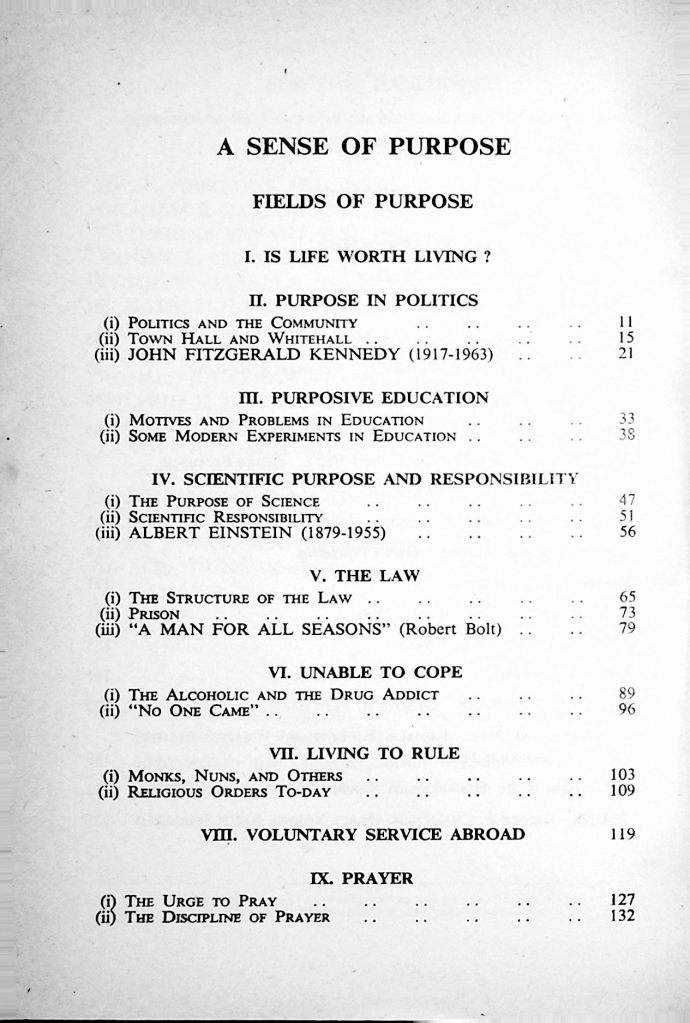

Above – A sense of purpose, by the Adult School Union 1965
At the end of the book they even list a suggested schedule of classes and dates.

…and it goes into four pages for the calendar year.
Other copies of annual syllabuses are also available to read online
Mindful the above dates from very early 1965 (probably printed and distributed in late 1964) there are more than a few things that would be useful for civics-style workshops today. Such as the one I’m running on Saturday at Rock Road Library which is now definitely going ahead because people have signed up to it!
The reason why the early chapters are ever so important (in my view) is that they provide the safe space for the public to have discussions in a safe space where they won’t be made to feel embarrassed for asking some really basic questions about how our governance systems function.
You can also browse more contemporary books by UK authors on citizenship studies in the Internet Archive here – as the authors have kindly uploaded their own works.
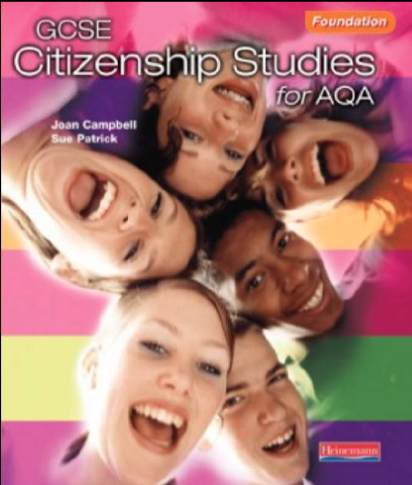

Above – Joan Campbell’s book dates from 2002, and Mike Mitchell’s more recent book dates from the early 2020s.
As Cllr Sam Davies MBE (Ind – Queen Edith’s) pointed out, the front covers give very striking impressions of what ministers of the day thought were the most important things about citizenship education. Again, a potential extended project for any teenager starting further education: compare and contrast the two books.
“Who pays for this renaissance in lifelong learning?”
Cambridge City councillors debated citizenship education at September 2023’s East Area Committee which may get some officers at the CPCA thinking. Yet there are two articles that point to a big decision that political parties will have to make for the general election – noting that ‘doing nothing’ is a firm decision in itself as it keeps in place a broken governance structure and an almost non-existent funding system.
This is explained in two articles written ten years apart. They are:
- The Bifurcation in the Labour Market – Frances Coppola (2013)
- Phenomenal Wealth – Cllr Sam Davies MBE (2023)
Cambridge is a city where ministers have given various business sectors the upper hand over the institutions of local governance, the result of which has left us with a city of public squalor and private wealth.
One of the big blockages that’s causing problems for employers is the lack of a properly-funded plan to enable people to switch careers – and undertake the training needed to do so
It feels like ever since Tony Blair brought in tuition fees for universities in the late 1990s, the idea that anyone could be ‘paid to train’ or ‘paid while they re-train’ seems to have been vanquished. For the past generation so much of the rhetoric has been about things like ‘career development loans. Even things like the National Skills Fund don’t cover living costs. Any help you do get isn’t by automatically right but something you have to apply for. Which inevitably involves means testing. A barrier in itself.
Which comes back to the point Frances Coppola made about firms being unwilling to pay for the costs of an educated and trained workforce. The incentive is far stronger to poach staff from other organisations – especially town planning consultancies poaching public sector town planners on lower pay.
The Government brought in an apprenticeships levy (you can read the briefing by the House of Commons Library here). You can also read the conclusions on apprenticeships by the Commons Education Select Committee here.
Under the present system, we can only appeal to the ‘civic-mindedness’ of wealthy firms and individuals. Using the power of the state simply is not in the political DNA of the Conservative Party for such things.
“What can and should Cambridge’s wealthy institutions be doing?”
Earlier today, former Mayor of Cambridge Joye Rosenstiel gave an example to the Liberal Democrats’ Party Conference. Have a watch of the video here.
“St John’s College, Cambridge, has set up a specialist system in partnership with Cambridge Regional College [the main vocational education centre covering Cambridge & South Cambridgeshire] of training young people in their catering departments. [Colleges also serve a large conferencing market]. The Master of St John’s College said he was as proud of those students who had succeeded in getting their qualifications on that course as he was of the graduates of his college.”
Joye Rosenstiel to the Liberal Democrats’ Party Conference 24 Sept 2023
Commendable as that set up is, that was the result of bespoke actions by some civic-minded and influential individuals in our city. The next stage is to have such things happening on a routine basis. For example where there is a system and a structure in place that employers and training colleges can sign up to, where there is a clear schedule of who covers what costs, and what support (including financial support) there is for potential students – mindful of Cambridge’s dreadful and chronic economic and social inequalities.
The problems rooted in chronic inequalities cannot be solved by charity alone. The Victorians found that out the hard way. Hence the development of modern local government in that era.
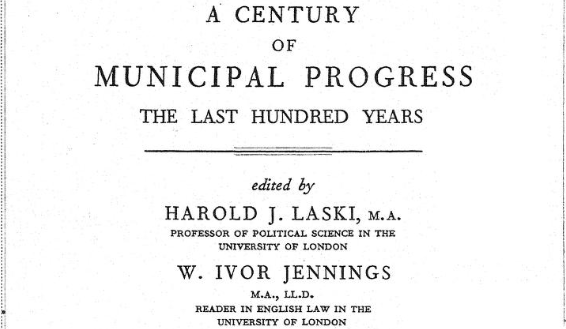
Above – Messrs Laski, Jennings (The latter later the Vice Chancellor of the University of Cambridge) and others wrote and edited this publication from 1935 celebrating a century of municipal progress – local government in England 1835-1935. (Subsequently followed by Half a century of municipal decline, published in 1985! (Second hand book copies of the latter can be bought here))
How can residents test the willingness of wealthy Cambridge sectors to contribute towards civic society and the improvement of our city for the many?
I read the headline about ARM in the Cambridge Independent with interest Is being. a’very different company’ post-stock market floatation a good or a bad thing?
“We can continue to expect investment in Arm’s workforce in Cambridge, she added.
“We are currently hiring into Cambridge – and have consistently, under [The CEO’s] leadership. It is one of our key engineering sites. It’s one of the places where we have all of our teams represented, so there is a lot of opportunity here.
“We are always looking to attract talent, from interns and graduates to more experienced individuals, to bring new capabilities and expertise into the organisation. Cambridge is a great opportunity and Arm is a growth company,” she [Kirsty Gill – Chief People Officer] said.”
Cambridge Independent, 22 Sept 2023
Given that Cllr Sam Davies has again highlighted the ministerial access that various business sectors have in/around Cambridge (see her latest blogpost of 24 Sept 2023 here), which of the senior business figures are telling ministers that their systems and structures of local government governance are utterly broken? Which are the ones that tell them that homeless people begging on the street is neither good for those homeless, nor a good look for the city or its institutions?
Ms Gill talks about interns and new talent, yet I’ve heard directly from some of those interns about the appalling state of too many of the houses in the rental market being let out by unscrupulous landlords and property management agencies. All the while ministers maintain unsustainable local government funding systems (despite being called out on it repeatedly by their own MPs) which prevents councils from increasing spending on their enforcement functions.
There’s a role for the Combined Authority in the current structure to consult with those wealthy firms how much resources they are prepared to invest in a joint project to build a new large lifelong learning institution in Cambridge that will serve the economic sub-region. There is also a role for CPCA to put on the table serious proposals for improving public transport beyond 2030 – mindful that the Mayor Nik Johnson has said he wants to contest the 2025 Mayoral Election.
Above – will Nik Johnson consider a light rail option for a 2025-29 term of office?
If you want to make the case to him, get in touch with Rail Future East as their next meeting is in Cambridge on 02 December 2023. Because we know that transport is one of the biggest barriers for people getting to places of study – and places of leisure too.
All of this comes back to the debate on the sort of city the people who make up our city want it to become. How will it compare with the vision that Michael Gove is putting together as the Government’s vision?
“As I mentioned on the show, I have it on good authority from two separate sources that business leaders knew these proposals were coming before the public announcement, and before even the Leader of the City Council, Mike Davey, or the Chief Executive, Robert Pollock, were informed.”
Cllr Sam Davies MBE, 24 Sept 2023
If that does not demonstrate the contempt that ministers have for local democracy in and around Cambridge, I don’t know what does. They can hardly complain about what the GCP is doing – an institution that ministers negotiated and signed off – a Government in which Michael Gove was a senior cabinet figure in. Collective responsibility of Government? We have to wait a little longer to see what the Chairman of Homes England recommends to him about the future of our city. Not that I’ve seen anything advertising events where the former meets with residents or commuters for their views.
It remains to bee seen what policy proposals national opposition politicians have not just for Cambridge, but for local government in England more broadly. Because we cannot continue like this.
Food for thought?
If you are interested in the longer term future of Cambridge, and on what happens at the local democracy meetings where decisions are made, feel free to:
- Follow me on Twitter
- Like my Facebook page
- Consider a small donation to help fund my continued research and reporting on local democracy in and around Cambridge.

 The Cambridge Town Owl