
They say ‘don’t read below the comments line.’ So I did. More than a few responses reflect a lack of historical awareness, frustration of a broken system, and limited knowledge of how the state functions. Or malfunctions. In the meantime, teenagers remain stuck with stupendously-long commutes because of long term national public policy failures.
The ones in the Cambridge Independent are at:
- GCP ditches Cambridge congestion charge plan as political support for it crumbles (29/9)
- Leading Lib Dems in Cambridgeshire pledge there will be no Cambridge congestion charge (27/9)
- Cambridge sixth-formers’ lives ‘absolute misery’ due to five-hour commute by bus (29/9)
Cambridgeshire police *must* investigate the death threats sent to Cllr Meschini
We have a word to describe threats of violence that have a political motive. It begins with ‘T” and ends with ‘errorism’. Cambridgeshire Police must make a public statement on what they are going to do in response. If this is allowed to slide, it set a dangerous precedent locally given the threats to democracy and political debate. The Leader of Cambridgeshire County Council, Cllr Lucy Nethsingha spoke out on the radio this morning in support of Cllr Meschini – who is the Deputy Leader of Cambridgeshire County Council as well as the Chair of the GCP for this year. (The latter rotates annually). I’m assuming there will be a statement to by senior Conservatives in Cambridgeshire condemning the threats sometime over the weekend, if it hasn’t been made already.
There’s no point trying to kick up a local party political storm over this. Social media hate is an international problem. The toxic state of party politics isn’t just a UK thing. The public policy responses – if they are to have any positive impact, are inevitably complex. ‘Wicked problems’ to coin Prof Sarah Sharples phrase – definitely complex, quite often contradictory, and always changing. What do you do when one person claims ‘freeze peach’ when the result of their constant stream of hatred results in no one standing for election to public office? Where does the public interest reside?
On our collective lack of knowledge in our political system
This comment stood out in particular.
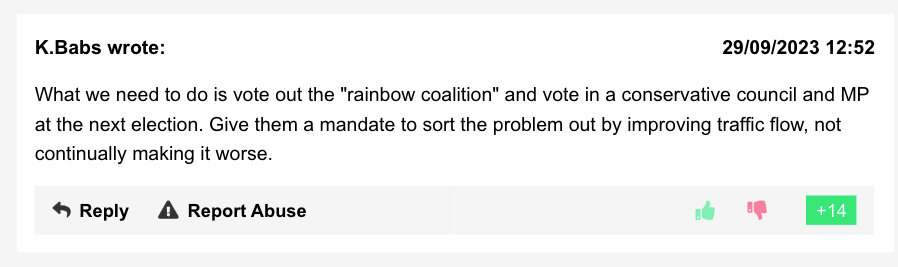
For those of you who have followed the trials and tribulations of the Greater Cambridge Partnership, the above comment will strike many of you as laughable. The idea that all of the problems will be solved by a Conservative-led Cambridgeshire County Council (the Conservatives controlled the County Council politically between 2017-21, and were propped up by 12 UKIP councillors between 2013-17) and a Conservative MP for the City of Cambridge is a fantasy. In fact that would go for any political party actual or made up – such as ‘The Big Oil Execs and Drivers of Motor Cars with Very Loud Engines Party’. Not even they would be able ‘to sort the problem out by improving traffic flow’. Note the net positive votes for that comment. How much of that sentiment reflects the frustration, and how much of that sentiment actually represents a real world belief that a Tory MP for Cambridge and a Tory-led county council could, under the existing system ‘sort things out?’
***We have been here before***
And I’m not just talking about the congestion charge survey from 2007 – commissioned by the Conservative-led county council of that era! Back in May 1990, Cambridge City Council published this document – an attitude survey of our city that also covered commuters as well as residents. At the City Council’s Planning & Transport Scrutiny Committee of 28 Sept 2023 I presented a few photo copies of some of the pages of that report that I’d paid the Cambridgeshire Collection to produce for me. (20p a page, 7 pages, you do the maths). Here are the contents pages.

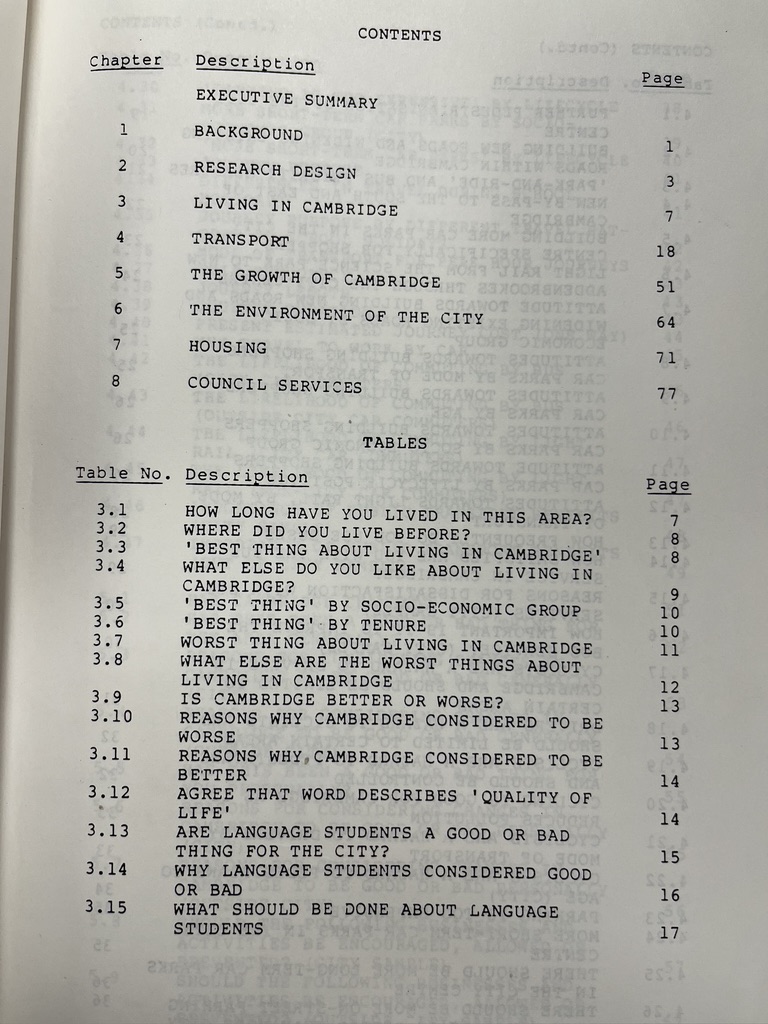
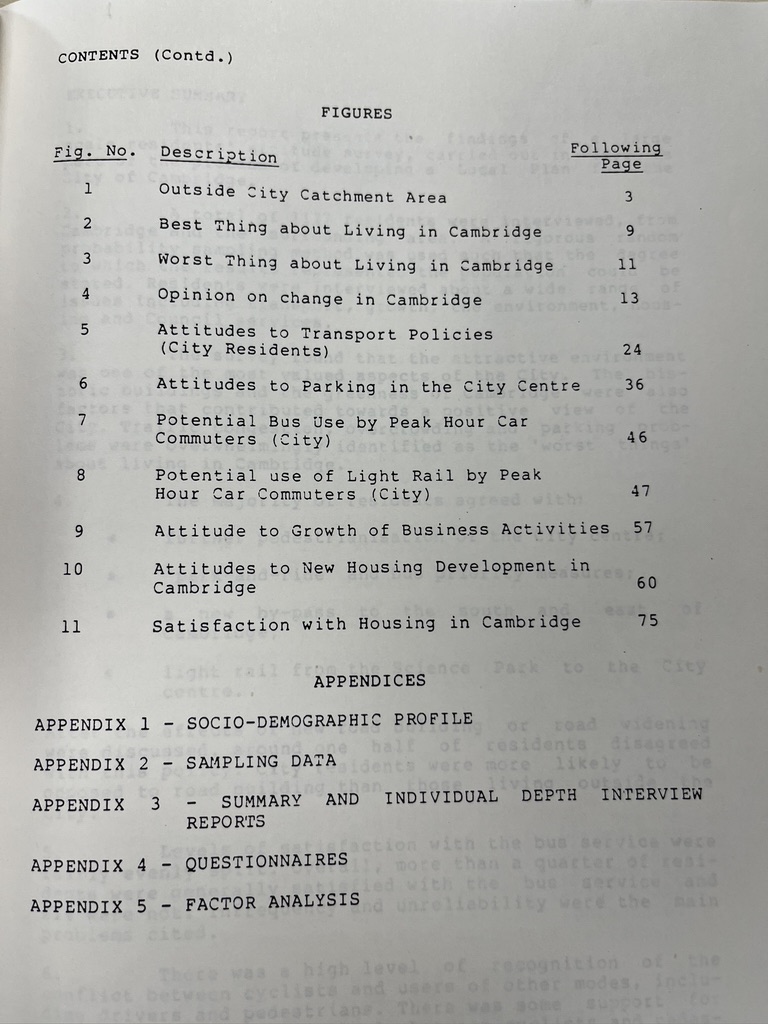
Above – this report would make for an excellent school or college project – whether crunching the hard data and displaying them on graphs, to comparing the results in this study with results from other, more recent studies and surveys about the state of our city.
Anyone interested (including teachers) can contact the Cambridgeshire Collection, or the County Archives in Ely Alternatively the Cambs Association for Local History (of which I am a member) has a couple of local historians who have published work on the history of Cambridge Transport, and who may be able to assist.
Local history tells us that the political road for congestion charging has come to and end – under the existing governance structure *and* with the existing transport infrastructure and built environment.
That is not to say we won’t see a future system of congestion or road user charging. I’m saying that *if* such a system is brought in, it will have to be under a system that would be unrecognisable today. That system under normal political circumstances would be decades in the making, and one that probably wouldn’t involve any of the current participants in local democracy – myself included.
“The Climate Emergency says we don’t have decades”
Exactly. And the UK has not experienced the sort of peacetime civil contingencies crisis that forces massive changes to the structure of government. Even the lockdowns of 2020 did not change the structure of government.
I’m not going to rehash the case for a light rail for Cambridge & Cambs – see Cambridge Connect here for that. If you want to support it, join Rail Future East, and if you want to know more about 21stC trams and light rail systems, join the LRTA as with membership you get their magazine delivered. Alternatively, browse through second hand back copies for sale here… …and donate them to a charity shop when they are done rather than binning them!
On new active travel infrastructure
In the late 2010s, I recall having a conversation with Edward Leigh of Smarter Cambridge Transport about cycleways and footpaths. He said (and as he mentioned in this 2021 blogpost) that if a fraction of the budget the GCP had been given was spent on cycleways and footpaths only, it would have concentrated the minds of officers and councillors on ‘quick wins’. Furthermore, it would have had indirect benefits of improved streetscapes. Instead, we got the worst of both worlds: A sum too great for an active-travel-only programme of improvements, but not enough for a light rail solution.
Hence the programme of busways that hit the city centre with no plan on what to do when they get there other than to rely on a discredited and unpopular private operator that has a monopoly on bus services in an industry which has ***massive*** barriers to entry. i.e.
- buying the land for bus depots,
- paying to install the garage and maintenance operations,
- and then buying hundreds of new hybrid and/or electric vehicles and
- hiring a new workforce to drive and maintain the vehicles
- paying the huge electricity/fuel bills
And that’s before you’re competing with existing operators *and* motor traffic for road space.
Looking at the ideologies that underpin privatised transport systems.
I recall one of the newspapers in the 1990s using the 1970s Hot Chocolate number as backing track for their advert. Which I guess is where the CPC got their sub-heading from on their case for privatisation.


Above – trying to find publications making the case for privatisation that were published at the time is surprisingly hard. It’s much easier to find books/pamphlets in opposition to the ideology. Noting also the growing demands for alternatives to 1980s ideology such as the Green New Deal
There is this paper on bus deregulation from 1993. Interestingly the warning signs about the transient nature of employee-led buyouts of bus services was highlighted in this 1992 paper. Yet it was impossible to tell what the long term effect would be. Fast forward to today and in an era of long term austerity and multinational-owned bus firms with no incentive to provide services other than those guaranteed to make a profit, plus restrictions on which private services can subsidise which routes, we have a situation where cash-strapped councils have to go cap-in-hand to publicity-seeking ministers who only seem to make new funding available on the condition of positive media opportunities rather than creating a sound integrated public transport system that functions properly.

Above – a minister at a publicity event involving bus fare subsidies and caps in March 2023
The above photo reflects the media-driven culture in Westminster that has been around for decades. Perhaps it’s understandable in such a toxic media environment. While toxic politics is nothing new, the way too many people and partisan institutions use social media (as you’ll have seen with recent headlines in the national media) is putting it in a different league. Worse still, it’s putting off some of the very people with the talents and skills needed to go into both public policy and stand for elected public office to take on these ‘wicked problems’.
We’ve got to come up with a better way of solving our complex shared problems. Locally, I’m trying something out with some local pilot workshops, the first is on Saturday. You can sign up here to join us at Rock Road Library, Cambridge from 12.15pm. (Note the rules on ‘No party politics’ and ‘no provocative preaching’ – this is a safe space).
If you’re free, do sign up!
If you are interested in the longer term future of Cambridge, and on what happens at the local democracy meetings where decisions are made, feel free to:
- Follow me on Twitter
- Like my Facebook page
- Consider a small donation to help fund my continued research and reporting on local democracy in and around Cambridge.

 The Cambridge Town Owl