
The opinion piece in the Cambs News is worth reading if only to learn some hard-won lessons about ‘how we do local democracy’
“It has been clear for a while where this was going”
Cllr Elisa Meschini (Lab – King’s Hedges Division) Chair of the GCP, 28 Sept 2023
I’ve been pondering on this sentiment expressed by Cllr Meschini at the GCP Board Meeting last Thursday. This was when she was left with little choice but to conclude that the political consensus to proceed with any form of congestion charging had collapsed.
The damning conclusion of the GCP’s failure was expressed in an opinion piece here by the Cambridgeshire Sustainable Travel Alliance – whose list of 30+ members and supporters are here.
“Well what would you do then?!?”
Not be here in the first place – to the extent that I put my name on a ballot paper earlier this year to make that point, and 264 residents in Queen Edith’s Ward, Cambridge agreed with me – that’s 9% of the vote. Which is beyond ‘paper candidate’ territory. (Although I still came last in that ward!)
At the time of writing, there is a significant amount of uncertainty in local government circles here. No one really knows what is going to happen next. No one really knows what Peter Freeman of Homes England will recommend to Michael Gove. Furthermore, no one really knows what consideration the latter has made for his plans knowing that there’s a looming general election coming up and his vision to super-charge Cambridge is one that could cost his party more than one parliamentary seat in Cambridgeshire. Because if you think congestion charging was controversial, wait till you see the reaction of what building *five Cambridge’s* next to each other will have for the residents in the villages around Cambridge.
The one party that could have a field day in that scenario is The Green Party with the monster of all protest votes. (That’s not a given however – that would require a critical mass of people to both join their party and become very active volunteers – a very tall order even under that scenario).
Lessons from the first Great Cambridge Crash Course pilot workshop at Rock Road Library on 30 Sept 2023
You can read my blogpost about the first workshop here.
***There will be follow-up workshops coming up***
I just need to sleep of the Post-Exertional Malaise from this one first!
Interestingly, when I publicised the workshop as something citizenship-related or ‘how our city functions’ related, no one signed up. The moment I rebranded it as The Great Cambridge Crash Course people started signing up – to the extent that more than twice as many people as I had expected turned up, so there was 90minutes of buzzing conversation plus extra time – with apologies to the Rock Road Library Staff for vacating the building 5-10 minutes after closing time only everyone wanted to carry on talking! (The sign of a good workshop?)
Two of the big takeaways?
- The local history (distant and contemporary) matters
- The explanation of the local-central government relationship matters
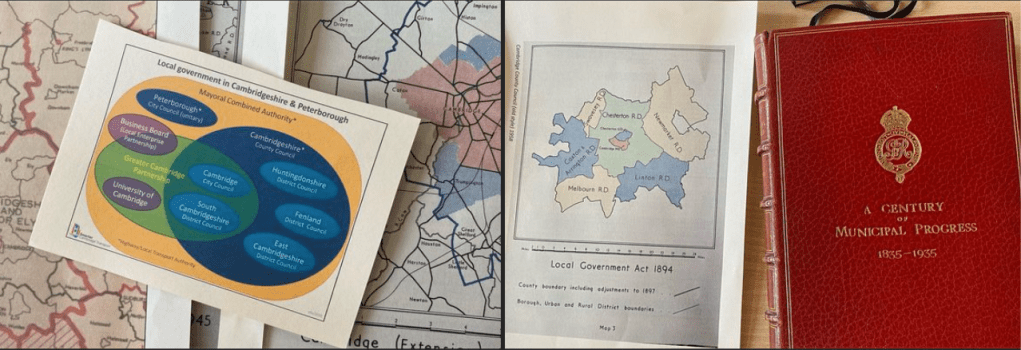
Above – telling the story of our city through maps showing the changing local government boundaries – both proposed and actual. Photo – Hilary Cox-Condron
The book in red is a centenary celebration of modern local government, published in 1935 celebrating the passing of the Municipal Corporations Act 1835, which marked the start of modern local government in England. It is digitised here. The table at the back of the book (See from here) lists the important pieces of legislation that affected local government in England. (Although it omits the Public Libraries Act 1850 which empowered Cambridge Borough Council to commission John Pink to establish our first municipal public library).
This helped explain to participants that any new governance structures for Cambridge has to have an Act of Parliament at its root – for example an empowering clause that enables ministers to bring in things like the Greater Cambridge Partnership or the Combined Authority. Certainly the funding for them – as is written in the grant funding agreements, *always* has the term: “…subject to Parliamentary approval.”
With both of those, discovering and understanding both how *and* why they matter was particularly important to the participants. Especially when it came to identifying the differences in political legitimacy. What our political system holds as legitimate in law is not the same as what the people feel on the ground. When we explored those relationships and structures that were negotiated and put in place in the early-mid-2010s, it was through that conversation that participants identified flaws and shortcomings for themselves. They didn’t need me or ‘an expert’ to tell them. Which is how it should be.
“Would today’s Cambridgeshire politicians have tried to negotiate a different structure with ministers if they had the chance?”
20-20 hindsight is a wonderful thing. But when your local council has been clobbered by austerity and ministers are offering a substantial amount of funding for something, it’s very difficult to turn it down. So it’s not just Cambridgeshire’s politicians past and present, but also ministers past and present that bear shared responsibility for where we are today.
“Cambridgeshire’s politicians can only avoid a legacy of failure by finding their courage, burying their differences, and resolving to bring about a series of alternative schemes to reduce congestion, raise revenue for public transport, encourage people to make the switch away from driving and enable bus reform.”
Cambridgeshire Sustainable Travel Alliance to Cambs News, 29 Sept 2023
Their concluding sentiment I agree with.
“Hey! Why don’t they organise public workshops to promote some new ideas?!?”
This brings us back to a challenge one of the participants raised at the workshop: The GCP has been active for nearly a decade. Very few people can remember what was happening at that time in any detail, and even fewer will have followed the rollercoaster ride that the GCP and partner organisations have been on since then. Quite understandably, many of the questions that are likely to come up at any workshop will be along the lines of ‘How did we get to here in the first place?’
Until a critical mass of the wider public has had the chance to explore how we got to where we are, it will be *very difficult* to make the case for where we go next. Even more so for those who in the minds of their opponents are associated with the collapsed proposals. That is not to criticise, because their motives were more than noble. In my opinion anyway. Those campaigners see an existential threat, and made the case (in the face of considerable abuse) to try and do something within the existing political structures.
Yes, we (the city of Cambridge) should organise workshops – and meaningful ones, on what alternative schemes might look like, so long as those workshops are properly sequenced and are held in venues that residents who don’t normally participate in such things (but. whoare affected by them) can access.
That will inevitably mean:
- Having something that covers the essentials of local politics and local democracy past and present
- Having to run the same workshops repeatedly across multiple venues
- Having more than one individual or team of people covering each theme – which means ‘training the trainers’.
“But there’s only one ‘you’ who is familiar with the distant local history, the contemporary history of the GCP, and the knowledge of Whitehall and Westminster. And your health means you can’t be at all events.”
Doesn’t mean I have to be at all or even most events. I can easily be sat at the end of a Zoom call to answer any difficult/complex questions if events are organised wi-fi-enabled venues. I can respond either in the video or chat function depending on how brain-fogged up I am. What matters is that the public gets the chance to learn some essential background and contextual knowledge in an active format and in community spaces that are easy for them to get to. Doing that will help ensure subject-specific workshops run more smoothly later on down the line.
There is a very important role for elected councillors and party political activists in such workshops.
As I mentioned in the previous blogpost, it is one demonstrated by a few of the participants who had experience of being a councillor and/or standing for local elections. It was one of soft influence and providing informal but authoritative comments on specific processes based on your experiences interacting with the public in a way that very few people get to do. This is why for all of the criticism that has come the way of councillors in/around Cambridge of late, part of the way of building up that trust in this broken system of ours is through workshops like this but where:
- A third person or third party organisation outside of party politics is the organiser. and facilitator of the workshop;
- The local politicians are not the focus of attention as they are at normal public meetings, but are there as much to learn from the discussions as everyone else is.
And there’s no shame in that. Public policy is complex by its very nature – full of uncertainties, contradictions, hidden variables and unintended consequences. A refresh of ‘how we got to here’ might be useful for those who can remember the start, as well as those who have moved to the city long after the GCP was created. And as we were reminded by the children at the GCP Board who tabled their own public questions, many of the climate activists of primary school age marching through Cambridge in the late 2010s are now at secondary school. Will any of bus service and active travel infrastructure improvements be completed by, as one of them asked the GCP Board, the time they start sixth form college which for them inevitably means commuting into Cambridge?
Because as others have noted, the processes that we have been through over the past decade or so have resulted in consultation fatigue. Part of any action going forward must include overhauling how our public institutions engage meaningfully with the public who are ultimately the ones who are meant to benefit from all of this.
Food for thought?
If you are interested in the longer term future of Cambridge, and on what happens at the local democracy meetings where decisions are made, feel free to:
- Follow me on Twitter
- Like my Facebook page
- Consider a small donation to help fund my continued research and reporting on local democracy in and around Cambridge.
 The Cambridge Town Owl