
The issue of public education campaigns on how our city and county function also came up.
Click here to watch the debate.
Be under no illusions: overhauling local government is not for the faint-hearted. So I was glad that a number of the very complex issues that tripped up previous generations were raised by councillors early on. Phil Rodgers picked up the text of the Labour Group amendment which was passed this evening.
“Accordingly, [Cambridge City] Council asks the Leader and Chief Executive to initiate discussions with other Authorities in the region and then central Government to identify options for a less fragmented and more cohesive model of Government for Cambridge, that best serves the needs of its residents. These discussions should involve and engage with the people of the city in a meaningful way, thereby recognising the need for our governance structures to reflect the wishes of the people we serve.”
Cambridge City Council – information pack for full council, 19 Oct 2023. p39
I’ve highlighted the text in bold.
My understanding from the debates is the motion can only refer to Cambridge as the city council has no legal competency for any council areas outside of it. (i.e. it cannot initiate conversations about the governance of ‘Cambridgeshire’ for the parts that fall outside of the city). Therefore it is up to other local council areas if they want to engage on behalf of their residents.
Cambridgeshire County Council also has a corporate view on a unitary council
The Leader of Cambridgeshire County Council, Cllr Lucy Nethsingha (also a backbencher on Cambridge City Council) read out the county council’s collective view as a joint administration on 17th October 2023 at their full council – have a listen. In email correspondence I asked city council officers to check with their county counterparts that their responses were consistent given the inevitable complexities involved with sometimes allied, sometimes opposing political parties, depending which tier you’re discussing!
There’s no need for councillors – or anyone else for that matter, to worry about the present governance boundaries to be set in stone and ‘if destroyed, still true for ever-and-ever’.
Council boundaries have been played about with for the last 200 or so years. Look at these two old skool maps from ages ago!

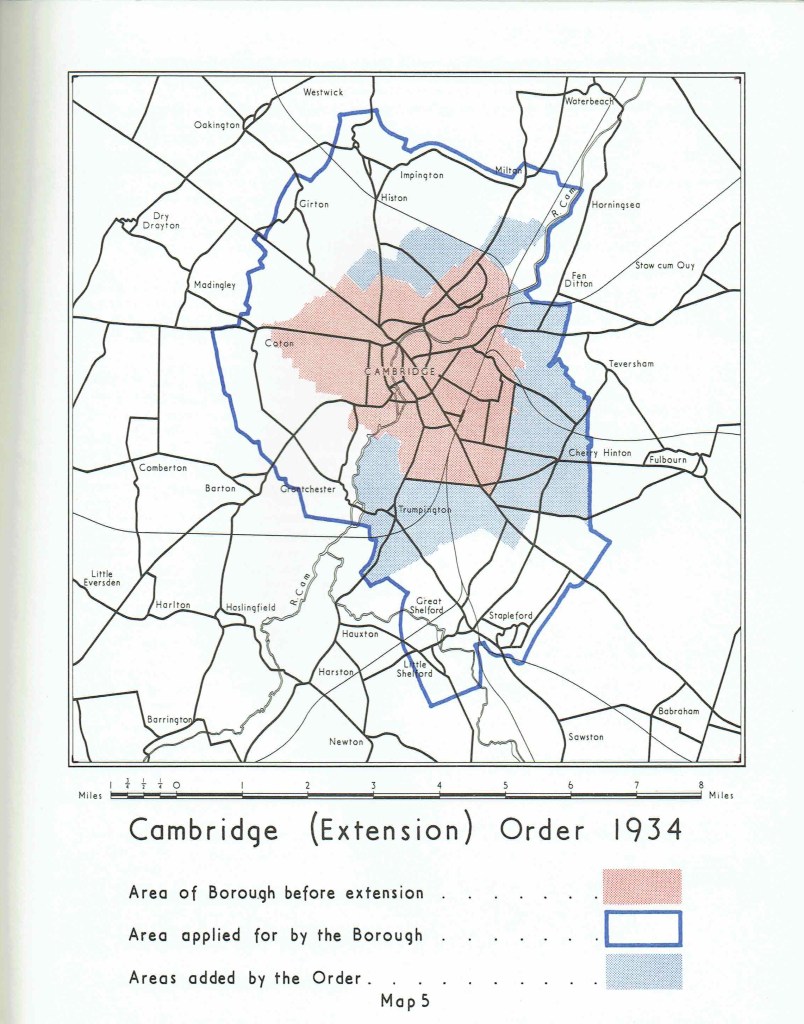
Above – an old map of ‘Cambridge Borough’ and ‘Cambridge County’ from ***ages ago*** which look very different to the later Cambridge Borough post-1934 that became the Cambridge City today, and the ‘Cambridge County’ sometimes called ‘Cambridgeshire’ on other maps, that became Cambridgeshire County Council first with (1974) and then without Peterborough late 1990s).
Note the Cambridge (Extension) Order 1934 was approved at a time when the Conservatives dominated borough and county politics (See Cambridge Elections 1935-45 by Edkins & Rosenstiel here) and they wanted an even greater number of rural parishes to fall under the governance of the Guildhall. Wanting to keep Cambridge within a set of boundaries that even people in the 1930s thought was unambitious is quite something! Whatever next? Reverting Coleridge and Queen Edith’s wards to their old name of ‘Cambridge Without Ward’?!? ((One former councillor, Eva Hartree) No, I have no idea who came up with the ‘without ward’ bit either!)
“Does this mean general election candidates have to talk about it?”
Only if people ask them questions about it – especially at hustings. Candidates could decline to answer, but that might not be a great look if a critical mass of the public conclude that ‘something must be done’ on how our city is run. In which case party-political candidates will need to familiarise themselves with their party’s policies (and any manifesto commitments) on local government reform. Because if their national party policy is against any changes, then they may have some explaining to do.
“Who in the world would be interested in a big debate about the details of local government finances, boundaries, and legal powers? People just want the bl**dy potholes filled!”
Quite.
Something I’ve been reflecting on in my research – and articulated further by Cllrs Mark Ashton (Lab – Cherry Hinton) and Anthony Martinelli (Lib-Dems, Market) in the debate that followed here.
“I think a public education campaign [on how Cambridge is governed] is an admirable goal in a sense, but to be honest in terms of practicality it’s unlikely to achieve its aims”
Cllr Anthony Martinelli (Lib-Dems, Market) to Cambridge City Council, 19 Oct 2023
That depends on the nature of the campaign – but in reality I’d guess that most public education campaigns don’t achieve their aims because there are so many other variables that influence the desired outcomes. Furthermore, with so much competition for the public’s attention, politics isn’t the sort of thing that gets the majority of the public interested – unless it involves compulsion with strong legal penalties, or is a life-and-death thing (as the pandemic has shown).
The Great Cambridge Crash Course – more events and more things to find out
See https://cambridgetownowl.com/workshops/
I raised the prospect of local councils taking a leading role on public education in my public question to the city council at the start of the meeting (have a listen here) to which Cllr Martinelli referred to in his comment. Fortunately for me, a series of civics-related textbooks published by the Great-Shelford-based publishers, Independence Educational Publishers Ltd, arrived today.

Above – some textbooks published over the past 20 years from IEP’s huge back catalogue of civics-related issues
These books are ***really well designed and produced*** – and are very similar in ethos to those of previous generations such as the Nelson’s Discussion Books series from the 1940s featured in Lost Cambridge here. For example…
Compare the list of books on the back of The Councillor from 1947 (digitised here)…>

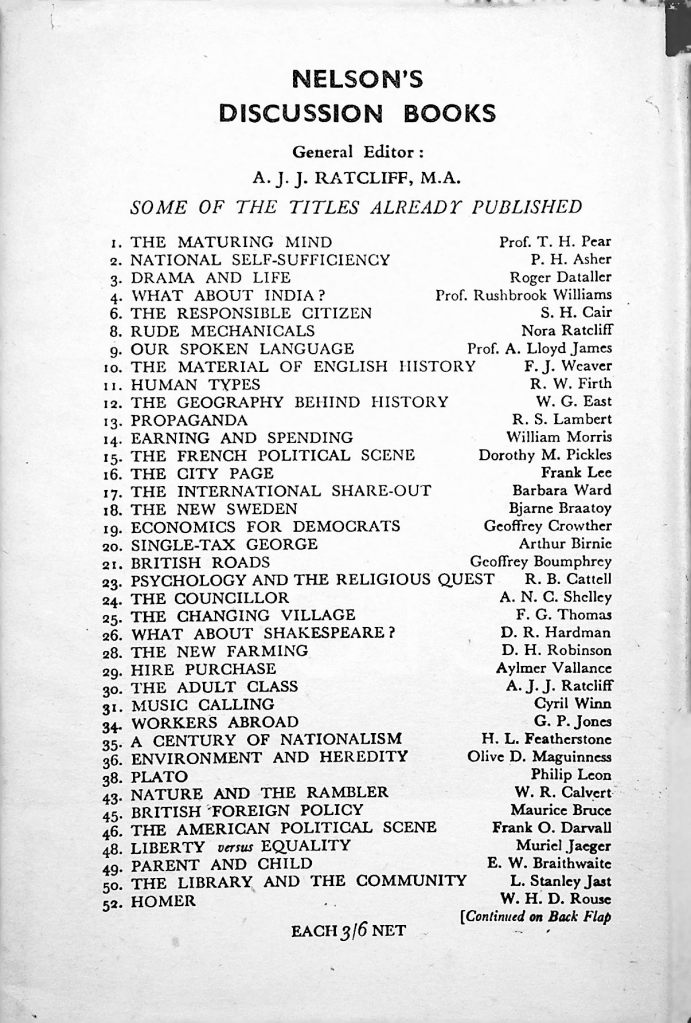
…with the list of books on the back of Housing in the UK by IEP (The latest volume being from 2021)
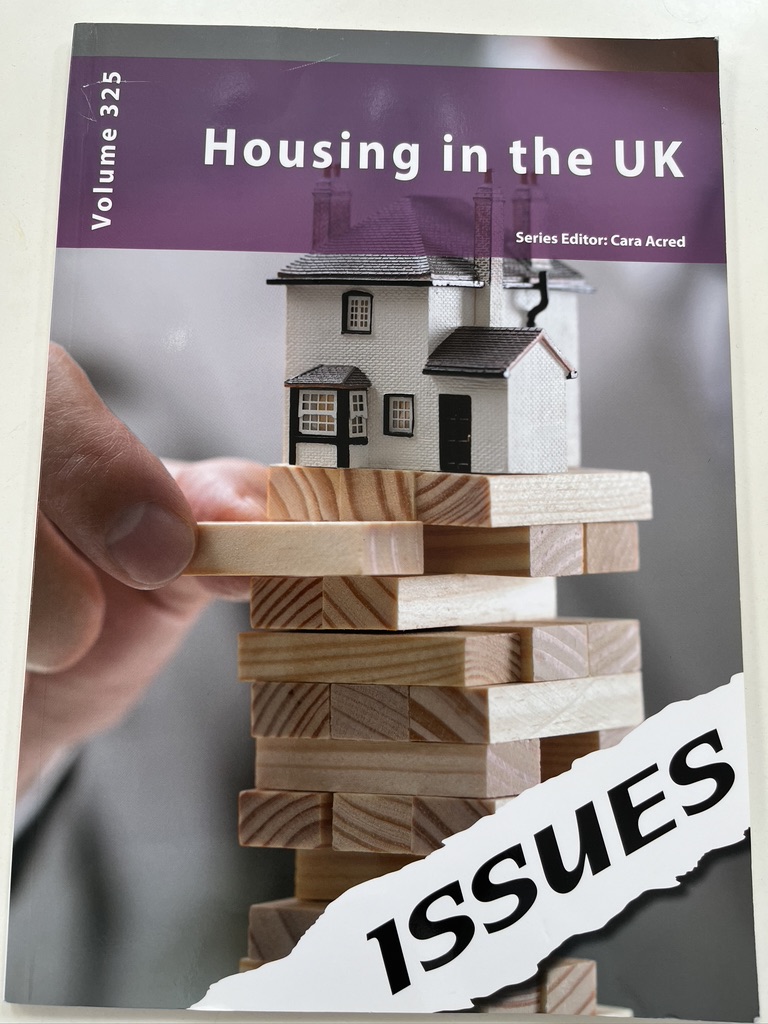

Above – by Independence Educational Publishing of Great Shelford, South Cambs. Or had some borough councillors had their way in the 1930s, they would have been in Cambridge!
Compare the traditional teaching of politics and civics to the teaching music. Or dance. Or drama.
Imagine a teacher turning up to a new school, ready to take a new class for their first music lesson having been told that the school has just acquired a brand new set of wonderful-looking musical instruments, some familiar, some less so, and the teacher says:
“Welcome to your first music lesson everyone! In today’s introduction we’re going to be looking at Grade 5 Theory! Ignore those distractions behind me! Sit down! Get your exercise books out! We’re going to do some rote learning!”
Now, apply that principle to any book that introduces people (especially adults) to politics. Where does it start from? Politics in terms of what the rules say, or politics in terms of what …I don’t know, let’s pick a random former Prime Minister whose stage name rhymes with ‘Doris’, was adjudged by the House of Commons Standards Committee to have done. I had a similar experience with economics at university. The neo-liberal theories we were being taught were so full of ridiculously strong assumptions that it got to the stage where what we were being taught was not reflecting the political realities in the outside world – despite the rhetoric and publications from the proponents and ‘star names’ from that school of thought.
Therefore, any public education campaign linked to debating how Cambridge & Cambridgeshire could be governed cannot be a standalone policy or project.
It has to be integrated into routine, day-to-day functions of local government. How you do that for children under the academies system I don’t know. But then I’m against the academies system (and ditto faith schools) as a matter of principle. (This is one of those ‘tough problems’ where ministers structured local public services into separate silos that inevitably struggle to communicate. Furthermore, getting rid of those structures & silos requires a huge amount of political capital and civil service policy resources).
“Could it work in the skills and lifelong learning sector?”
Yes.
Most definitely. Because:
- the basic learning network is already there in the form of public libraries and the pre-existing adult skills framework of the Combined Authority, and
- there is already a pre-existing and substantive back catalogue of materials to work from that is locally published as mentioned above.
The only other thing that you need are people who can either facilitate community events / group discussions, and individuals who have expertise/knowledge in a range of different subjects. And if you cannot find them in Cambridge, then our city is in trouble. Furthermore, Cambridge Regional College already provides the courses for people who have got the subject expertise but not the teaching experience (See https://www.camre.ac.uk/teacher-training-development/).
Most of the difficult work for local councils and partners has already been done.
All that’s left is the political will.
In the case of my events, I used local historical as well as contemporary case studies to make the links between what participants were concerned about, with the theory behind how Cambridge ‘got to here’. That however, cannot be the only means of educating the public. We’ve got to have the variety, one that includes online (Whether active video-conference-type, or passive ‘watching TV-style’) through to things like quiz nights for example based upon the ‘life in the UK’ test books to get people talking about what ministers expect some of our fellow residents to know in order to gain British Citizenship. (And what changes, if any, they would make!) A reminder that public education campaigns don’t have to have an examination at the end of it, and that ministerial initiatives can be turned on their heads!
Food for thought?
If you are interested in the longer term future of Cambridge, and on what happens at the local democracy meetings where decisions are made, feel free to:
- Follow me on Twitter
- Like my Facebook page
- Consider a small donation to help fund my continued research and reporting on local democracy in and around Cambridge.
 The Cambridge Town Owl