
A couple of new Cambridge-based discussion groups have emerged on Meetup – does this reflect an untapped demand for debating and discussion space in and around our city?
You can see the groups on Meetup that cover:
People can search for other groups in and around Cambridge here.
Note I’m not a member of the above & have never been to them, so don’t blame me for the consequences!
“Haven’t we had discussion societies before?”
Yes – big ones. Few bigger or more influential than the Cambridge Ladies Discussion Society – which later became the Cambridge Branch of the National Union of Women Workers, and then the National Council of Women. They pre-date the First World War, as this example from the Cambridgeshire Archives – you can find the records here. (Personally I think these should be digitised, so anyone who lives in or who can get to Ely who has some free time, feel free to help them!)
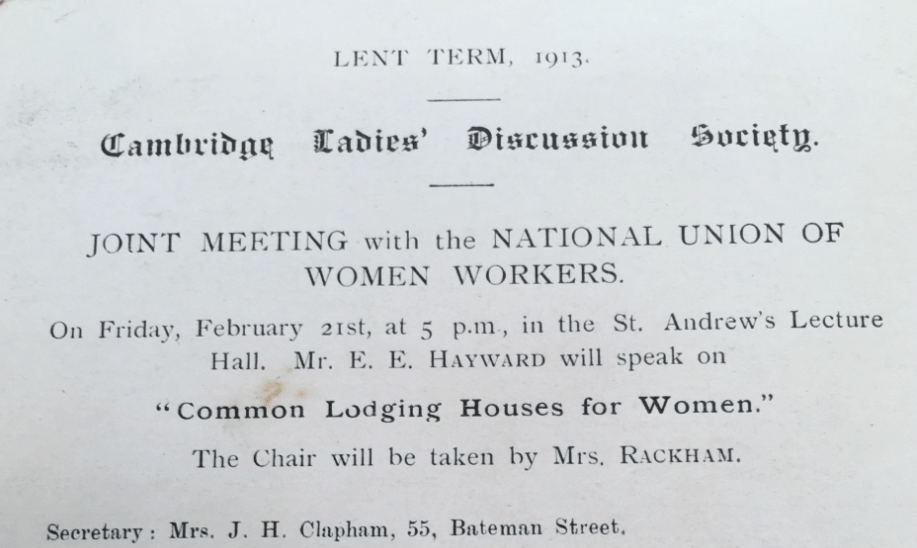
Above – an advert for one of the two termly talks from 1913, from the County Archive in Ely
Such were the strong family connections in the society that they could bring in pretty much whoever they wanted and cross-examine them on the issues of the day. It also made booking venues much easier. In the case of the autumn term of 1912, Florence Ada Keynes had a word with her eldest son on the recently-introduced national insurance system introduced by Lloyd George’s Budget and both room and chairman were sorted.
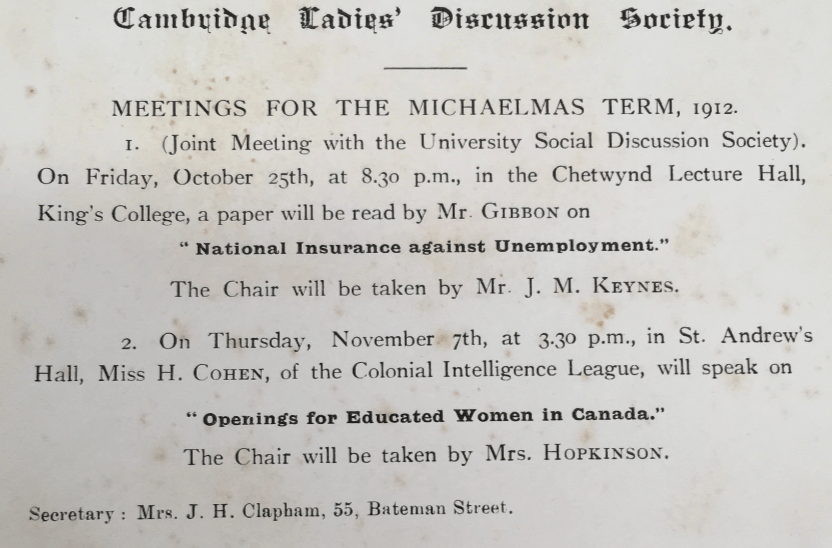
Above – a young John Maynard Keynes, by then a Fellow of King’s College Cambridge, chaired a Friday Night debate in the room next door to the hall later built that bears his surname.
Note this was at a time when women did not have the vote, while the University of Cambridge upheld its ban on women graduating. There is so much more to that story but it needs an early career researcher-or-three to delve into the archives and bring to light the stories of those women who participated in that society. i.e. not me!
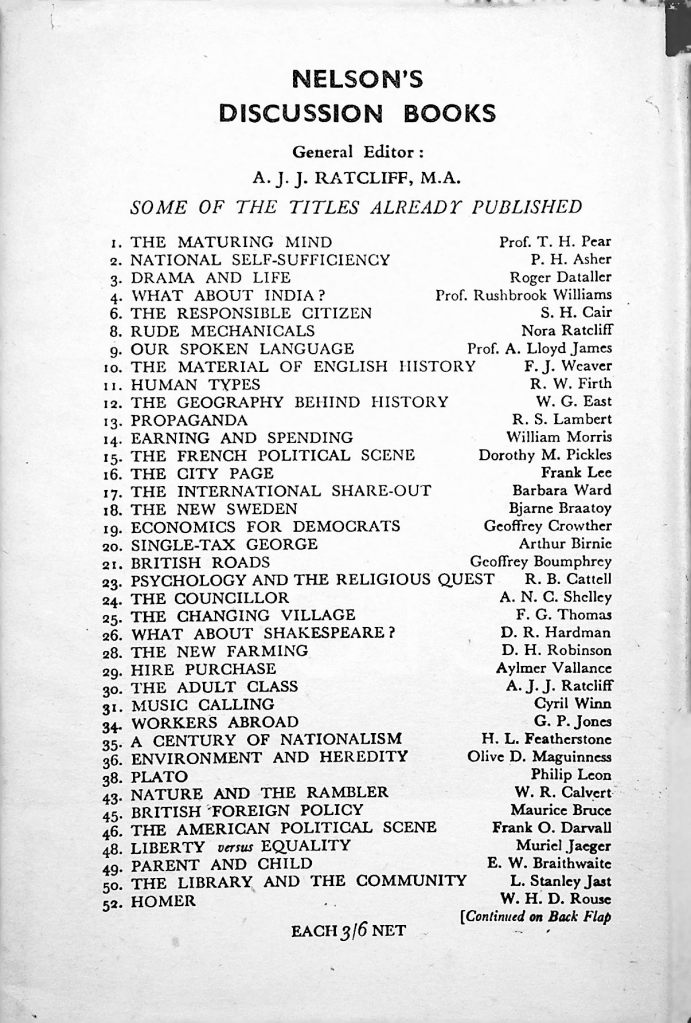
As I’ve mentioned in recent blogposts, the concept of publishers producing series’ of discussion books for use by civic societies across the country was not new. Some of them were in the form of book clubs – such as the now re-started Left Book Club (which has also started livestreaming its events) that became prominent in the run up to WWII – many of which are available second hand)
Other groups also published their own series – this one from Nelson’s series.

The most recent local series I’ve found of late is the one from Independent Educational Ltd

Above – some of the publications from the past 20 years from Great-Shelford-based Independence Educational Publications Ltd.
Organising the topics in a pre-planned calendar vs deciding what’s topical at the time
The old Adult School Union annual schemes of work (have a browse of some of them here) are examples of church-based programmes from throughout the 20th Century. One explanation for the demise of the programme was the unwillingness of the organisers to adapt to the times and insist on strong religious components at a time of declining church attendance.
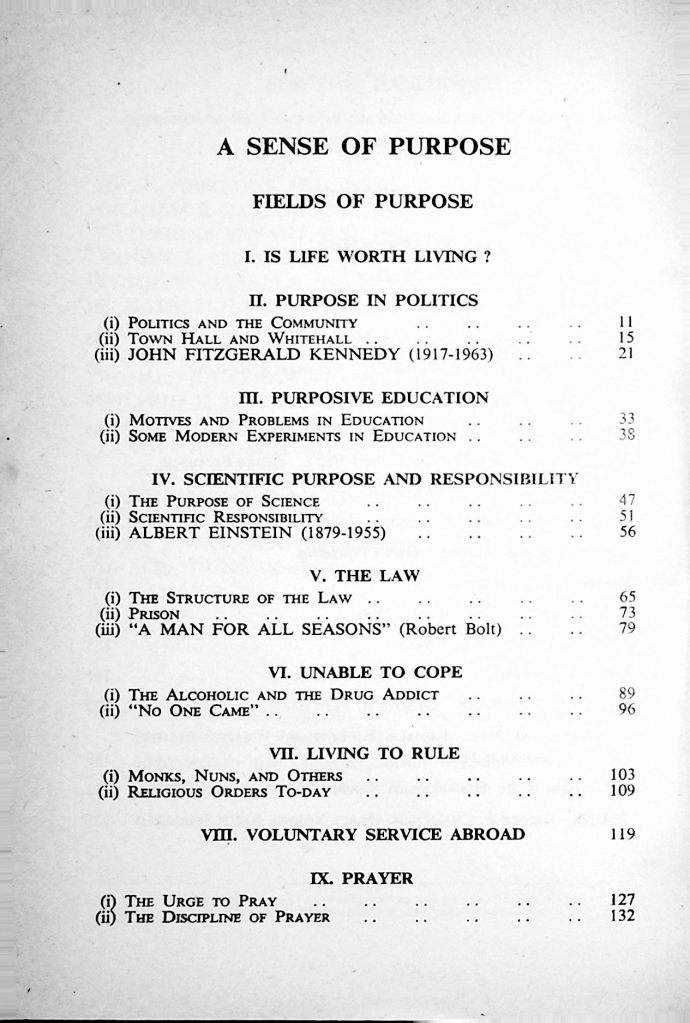

Above – from A sense of purpose, (1965) by the Adult School Union
“”For what purpose?” Seems a reasonable question to ask”
I picked up on this in a previous blogpost, comparing how politics is traditionally taught to how that would transfer over to music if the same technique was taught.
“Welcome to your first music lesson everyone! In today’s introduction we’re going to be looking at Grade 5 Theory! Ignore those distractions behind me! Sit down! Get your exercise books out! We’re going to do some rote learning!”
CTO, 19 Oct 2023
Just as with a musical instrument you start with the musical instrument, the same is the case if you are learning about politics, civics, and democracy *with a view to participating* rather than with a view to sitting an examination on it. Hence jumping at the series by IEP when it became clear that unlike the GCSE Citizenship Studies publications, these ones are not for examination purposes but for group discussion purposes.
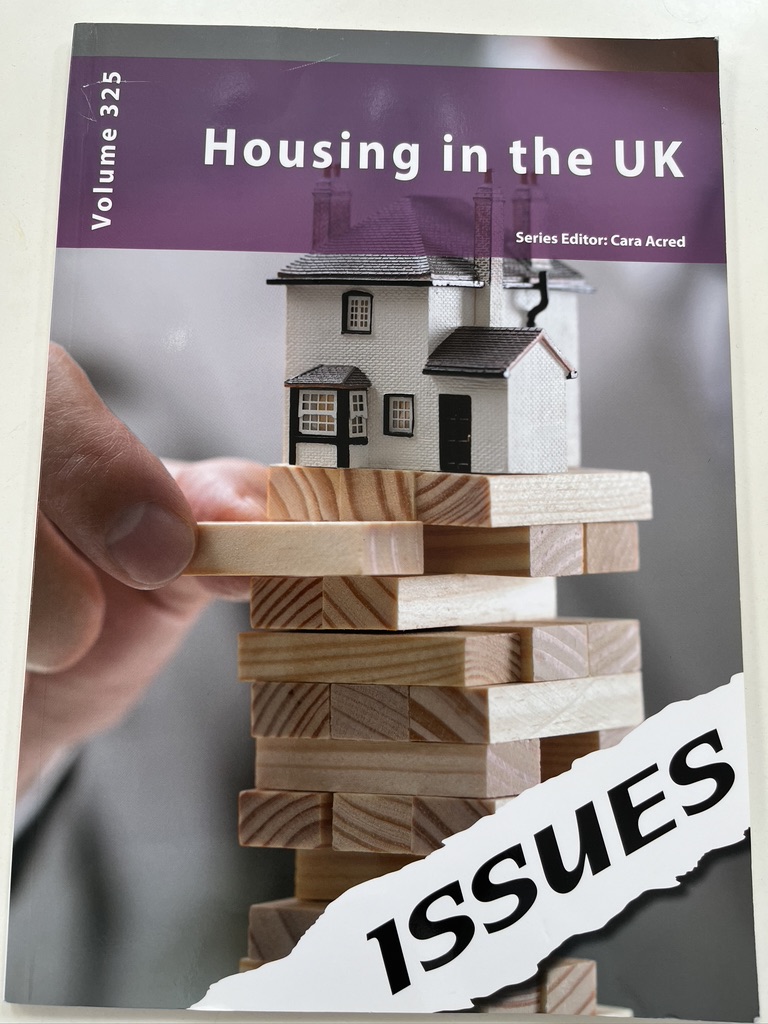

Above – Housing in the UK by IEP, with a list of other titles on the back.
As the series inevitably needs updating due to changes in government policies over time, the latest Housing issue is available here. That doesn’t mean the older issues are of no use – the policy principles and social challenges for many of them remain broadly the same over time. And where they change, the discussion can always centre around what those changes have been since publication, and why those changes were made – and in whose interest.
Generalist or specialist conveners / facilitators?
That depends on the issue and individuals involved. Note that such events are aimed at the general public who won’t have the collective in-depth policy knowledge. Furthermore, there is *always* the risk (especially in somewhere like Cambridge!) of someone in the group having that specialist knowledge and risking monopolising the discussions rather than enabling everyone to participate. How do you create safe spaces where people can ask the basic questions without feeling embarrassed or a sense of shame?
My main reason for picking up on all of this since the city council elections last May was because voters in Queen Edith’s, Cambridge told me that no one had taken them through the local contemporary history around the Greater Cambridge Partnership or on local government reorganisation since the 1960s. So they had no local historical grounding. Furthermore, no one had emphasised the point about the limited powers of local councils vs the power of Parliamentary Sovereignty and the impact of ministerial initiatives and backing from influential secretaries of state. In the case of citizenship studies at school, it only became a thing in the early 2000s because Education Secretary David Blunkett insisted his civil servants made it happen. (The story is in Ben Kisby’s book – essential reading for Labour activists). Similar was true with Michael Heseltine and his reforms in the old Department for Trade and Industry, insisting on his officials providing data and evidence to support their policy recommendations. It changed the way the institution worked. According to his autobiography anyway!
Starting off small and growing outwards?
Much as the sense of urgency of a looming general election wants me to go with a big bang approach, that won’t work. Not with the limited resources vs the effort needed for something like a permanent equivalent of what Florence Ada Keynes and co achieved early-mid 20th Century Cambridge. Furthermore, while there are some topics that affect us all collectively – such as the water crisis, others will not. For example take the IEP’s recent publication on youth violence (Sept 2023). The different demographics and levels of economic affluence and poverty are likely to influence whether a community / neighbourhood sees this as a priority over other issues – such as this 2020 publication on ageing. Which one do you think your local area would prioritise and why?
Hence the limitations of an Adult-School-Union-style top-down syllabus. On the other hand, an evening class series could easily be split into two halves, with the second half on topical issues.
“At what point do you introduce the theory? The laws, rules, and principles that underpin the decision-making processes in UK institutions?”
Whenever your group is ready for it.
In the sessions I have run over the years, I have only brought in the concepts of:
- ministers tabling new legislation in Parliament
- The Budget speech
- What specific laws mean in relation to a topic
…when a particular discussion would otherwise come to a standstill without introducing or re-enforcing those points. One example of me trying to do this was at the Queen Edith’s hustings back in April 2023 here. In that example I tried to explain *why* local residents needed to ask candidates about their party’s national policies on overhauling our governance structures. i.e. local councils do not have the legal powers to do it themselves.
“Do you go for a city-wide model similar to Imagine 2027 from five or so years ago in Cambridge, or do you go for a decentralised, neighbourhood-based model at multiple small venues across and around the city?”
Whichever we go for – if any at all, it will require people and resources. All of that inevitably involves a financial risk. The number of really interesting, positive community ideas that are blocked because of financial issues is soul-destroyingly high. By that I mean the root cause of the barrier is financial. This includes the lack of funding and revenue-raising powers for local councils. For example if councils in/around Cambridge had the power to tax the wealth generated by the sci-tech powerhouses, they could afford to employ the essential community development workers and administrators to do all of the room bookings and community centre maintenance without having to rely on volunteers all of the time.
As a result, the capacity of individual neighbourhoods to run such things varies considerably. A symptom of our unequal city. And (in my opinion!) it will remain that way while we are still stuck with the present government in the present broken system.
Food for thought?
If you are interested in the longer term future of Cambridge, and on what happens at the local democracy meetings where decisions are made, feel free to:
- Follow me on Twitter
- Like my Facebook page
- Consider a small donation to help fund my continued research and reporting on local democracy in and around Cambridge.

 The Cambridge Town Owl