
Did Thatcher’s ideology create an inflexible and rigid system of contractual accountability at the expense of democratic accountability? And thus make it harder for local residents to hold councils to account for local services?
The academic thinking behind all of this stemmed from the ideology of Margaret Thatcher’s Government in the 1980s – as is explained by the Institute for Government below:
“The theory behind outsourcing is that by handing over the delivery of a service to a provider in a competitive market, downward pressure will be put on costs, providers will be encouraged to meet customer needs and allocate resources more efficiently, and innovation will be spurred.11 But evidence shows that in reality the effects of outsourcing differ from service to service.”
Institute for Government – insourcing and outsourcing
So instead of having your local council employing their own staff to collect recycling and waste, they ‘go out to tender’ and invite private companies to compete for contracts to collect the bins for them. You then apply that same principle to other service areas – security guards, reception desks, canteen staff, the lot. Parcelled up and privatised to the lowest bidder. You can imagine what that means for low-paid staff.
There are a host of assumptions that are tied to the principles behind outsourcing. One of them is that there is a genuinely competitive market for the contracts concerned. Furthermore, the public sector organisation letting out the contract has the skilled and competent staff to negotiate the contracts. As time has shown, those assumptions are so strong as to be proven more than questionable in real life. Going back to waste collection, the barriers to entry are massive – not least because you have to have your own depot and refuse collection vehicles. And if you don’t, you have to assume that someone else does and that they are willing to lease them to you. And that assumes there is a competitive market for them because if there isn’t, they can charge much higher rates. And if the contractor goes bankrupt because they cannot fulfil the contract…exactly.
Hotly-contested – the privatisation of public services in the 1980s & 1990s
There were many publications critiquing privatisation in the final decades of the 20th Century. Two of them are illustrated below.

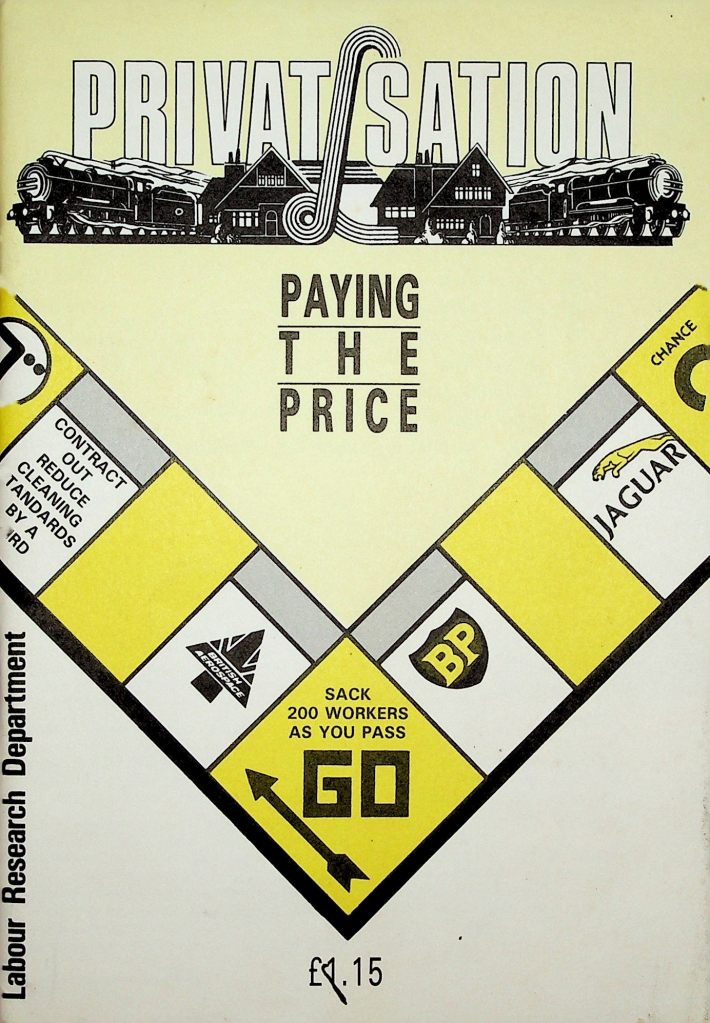
Above-left: Privatisation 1979-1994 – Everyone’s a winner. Above-right: Privatisation – paying the price (1987).
See also Mark Drakeford’s account on privatisation and social policy from the Year 2000 – he later became the First Minister for Wales. Throughout the era, the Labour Research Department published a number of publications covering the policies of the era – a few on privatisation are for sale on ABE here.
The fragmentation of education – MPs voting to give themselves more work
I wrote to councillors asking about citizenship teaching in Cambridgeshire recently. This followed my discovery that only 145 teenagers elected to take the GCSE in Citizenship Studies in 2022. Anecdotal conversations with young volunteers at community events over the summer (for example here) told me that for all of the progress made in the early 2000s, teenagers were not being educated about the essentials of politics, democracy, and public services. i.e. they were suffering the same fate as my generation did in the 1990s where we were taught nothing. Cambridgeshire County Council responded as follows:
“We encourage all secondary schools to offer as wide a breadth as possible of subjects for all pupils. This is however in a context of teacher shortage, financial constraints and an accountability framework which places greater focus on a limited number of subjects. All secondary schools in Cambridgeshire are part of academy trusts, but we will certainly pass on the helpful suggestion you make around sharing specialist teachers across a trust or local area.”
Cambridgeshire County Council, 10 Oct 2023 – letter to A Carpen.
The decision to transfer en masse the responsibilities of secondary schools to private academy trusts – whether charities, religious groups, or profit-making companies, was a party-political decision by Michael Gove when he was Education Secretary. This was provided for and approved by MPs in the Education Act 2011 – you can read the explanatory notes here. There are further explanatory notes on the WikiPage here – including Section 59 on the transfer of land from councils to private academies (note the guidance from 2013 here). Whether you trust the reassurance from the Schools Minister in 2019 here about the safeguarding of public land and the taxpayers’ interests, is your judgement call.
The academies programme ultimately moves the line of democratic accountability away from county councillors to MPs. This is in part due to the creation of the Regional Schools Commissioners. Therefore MPs created more constituency casework for their own offices by voting the measures through rather than maintaining a much stronger level of county council oversight.
The over-centralised system combined with the broken finances of local government mean that there is no method of bringing in county-wide policies that might otherwise have popular and political support. Take the former County Music Adviser Ludovic Stewart’s dream of having county music teachers who specialise in different instruments that covered a number of schools in an area. I was taught by one in the 1980s but by the 1990s the whole system had collapsed in Cambridgeshire due to continued austerity. The additional barriers of the academies structures means that the bureaucratic nightmare created means councils can only make ‘useful suggestions’ to academies to work together rather than making the internal decisions themselves to provide for the specialist teachers to cover a number of schools in a locality that otherwise could not afford to recruit specialist teachers themselves.
“Do you want to be a citizenship teacher in schools?”
Helllllllll-NO!
I’d be useless at it. Also, I’m only trained to teach in the lifelong learning sector – I have no desire (or capacity) to teach children. Not least because they have to sit tests on such things – and I’m against the concept of teaching to the test as a matter of principle. Especially for something so important that they’ll need for the rest of their lives. Rather, I see my role as scrutinising the institutions – which I’m better qualified for, and leaving the teaching of under-18s to the experts.
The other issue – bringing us back to the fragmentation of public services, is that a GCSE in Citizenship Studies *requires* the active co-operation of other public services. This is to give the students a chance to undertake the coursework element of the GCSE. This is easier said than done – as I found out the hard way when trying to make the case for local councils to link up with one of the few government policies of the Coalition that I agreed with – the National Citizen Service (NCS). I wrote this a decade ago. Since then, the NCS local experiences programme has been in-sourced by Cambridgeshire County Council, so if you know anyone in Year 11, do recommend it to them. (See https://wearencs.com/faqs for the other options). And for those aged 16-25 wanting something more intense, see the Prince’s Trust Team here. (I completed this 20 years ago, opting to go on it because I felt I was just a drifting graduate – turns out it was tougher than anything thrown at me in my three years at university!)
Co-ordination of fragmented services remains a big problem
There were a host of things picked up in the Harvard University study of regional inequalities in England which former Education Secretary Ed Balls (Labour) took part in. This was also picked up by Beckie Smith’s summary in Civil Service World here.
“Some interviewees said a level of distrust remains in the civil service, with Greg Clark recalling “general snootiness” towards “people who worked in city halls” in the Department for Education when he was a coalition minister.
“He attributed this to “an institutional memory of skills policy” where “the whole history of local Learning and Skills Councils and the idea of local authorities running further education was not associated with conspicuous success”.
Beckie Smith, Civil Service World, 24 Oct 2023
Having worked in Whitehall for several years, my experience was that this stemmed from a lack of knowledge and working experience in local government by a critical mass of senior civil servants. Successive permanent secretaries and ministers have made noises about trying to get more civil servants to experience ‘delivery roles’ but none has succeeded in creating a system where interchanges between central and local government are routine. If anything, the Civil Service Fast Stream should be merged with – or at least have a common foundation programme with the Local Government Officer Graduate Scheme and the NHS Management Trainee Scheme – one that involves spending early placements in each of the sectors. Because more than a few problems stem from a lack of understanding of how the other partner works – and the pressures they face.
“…when we came in there was a suspicion – certainly from Tony Blair and others – that local government was a bit useless”.
Beckie Smith quoting Dan Cory
After 18 years of austerity, one can hardly blame local government for being in a state. But rather than take on the very difficult and long term challenge of overhauling local government, Tony Blair and Gordon Brown were in a hurry and simply created a host of new agencies with chief executives appointed by ministers, bypassing local government altogether. Inevitably this caused tension and friction all over the place – along with the growth of a significant number of initiatives, funding pots, and performance management measures – targets. It was only late in Tony Blair’s tenure that this was put into reverse by the Strong and Prosperous Communities White Paper of 2006 – one that needed much longer to bed in but was never given the chance when Messrs Osborne and Pickles arrived to zap the entire structure with a swift stroke of a pen. Had Labour overhauled local government and given it far greater independence – including more independence from The Treasury over revenue raising from a wider range of taxes, and had such policies proved successful in regeneration, it might have been harder for the Conservatives to impose austerity in the manner that they did. There’s a lesson for future ministers about structural changes and ensuring they are embedded in to last through governments of alternative political parties.
For those of you who want to have a look at the central-local government relationships and how they apply to Cambridge and Cambridgeshire, feel free to sign up to the Great Cambridge Crash Course session on Sat 11 Nov 2023 from 12:15pm at Rock Road Library. By the end of that session the aims is for participants to have an understanding of how much power and influence councils have compared to central government departments, and who is responsible for which changes.
If you are interested in the longer term future of Cambridge, and on what happens at the local democracy meetings where decisions are made, feel free to:
- Follow me on Twitter
- Like my Facebook page
- Consider a small donation to help fund my continued research and reporting on local democracy in and around Cambridge.

 The Cambridge Town Owl
Antony,
If you are interested in the real effects of outsourcing on public serviceI I can recommend ‘The Whitehall Effect’ by John Seddon. John leads a consultancy that has done a lot of work improving services in local government. It’s based on real world examples and experience. It is shocking. I can probably lend you my copy (if I can find it) so long as I get it back! But it’s available view the web…
LikeLike