And it pre-dated the 2019 General Election according to Dominic Cummings
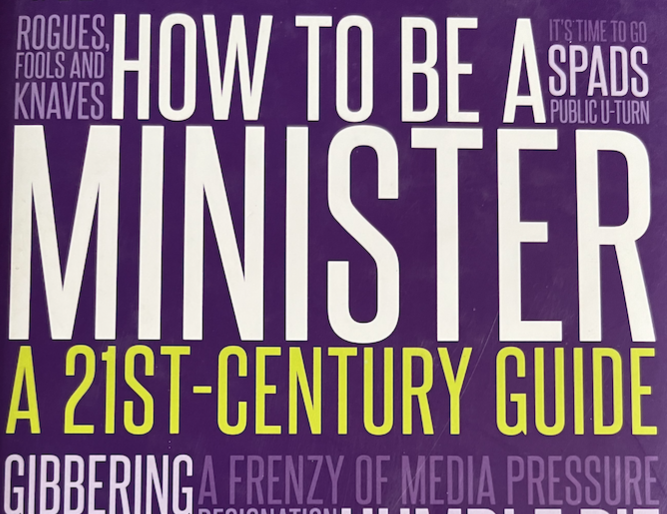
Image: How to be a minister – Hutton & Lewis
Which then makes you wonder who were the individuals and which were the institutions responsible for putting that shower of scoundrels and knaves into government in the first place – and/or rather, what they stood to gain from it.
As I type, the video footage on the YT page for the Inquiry is being edited and re-uploaded. I don’t think they’ll zap out the torrent of abusive language that the inquiry counsel had to repeat for the public record.
Such was the torrent of verbal excrement coming from the various electronic devices of those being cross-examined that it must have been impossible for most other people to function in that toxic environment.
Given my looming event on central government and its impact on Cambridge (Sat 11 November at Rock Road Library from 12:15pm – details here), I may have to draft one or two of my own lines to take – with reference to previous intense rivalries between past senior ministers and their coteries. As constitutional and public policy historian Dr Cath Haddon informed me:
One of the risks of centralisation of power is that it attracts those who desire power for power’s sake. Dr Haddon’s colleague at the Institute for Government, Tim Durrant noted that Boris Johnson’s Government was particularly centralised.

Above – I contrasted this with the Coalition Government which I briefly worked under during the end of my civil service days. Because of the clear written structures and procedures for escalation where ministers disagreed on policy, there was greater decentralisation of decision-making in Whitehall in that era because otherwise every minor argument would have ended up on the desks of Nick Clegg and David Cameron. It also reflects what I recall as the much higher media profile of Cabinet Ministers that had important policy portfolios. IDS, Gove, Lansley, Pickles – they may have been scoundrels ***but at least you had heard of them*** Today? And if you think that reminds you of an old Ben Elton sketch from 1990 on telly, you’d be right – have a watch here – broadcast just before the demise of Thatcher and the rapid rise of John Major, until that year a little known MP for…Huntingdon in Cambridgeshire!
“What will the EU think?”
I put this question to the two of the most knowledgeable EU commentators I could think of – Helene von Bismarck and Jon Worth – the latter who I got to know during my civil service days, and who can now be found on a train somewhere in continental Europe. The reason for asking is because being stuck in Cambridge, I have very little sense of what the outside world thinks not just of a rapidly-growing Cambridge, but also of the UK.
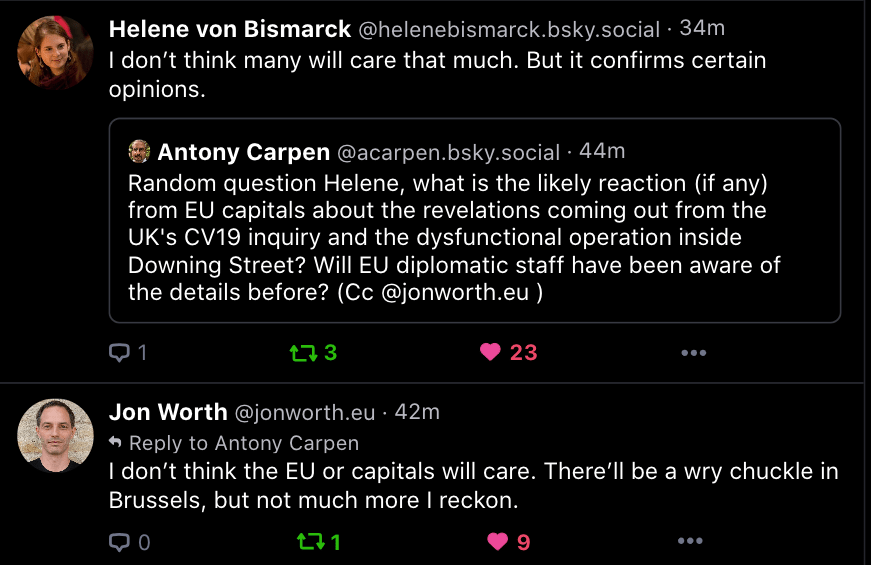
Above – a reflection of the declining influence and importance of the UK despite the rhetoric of pro-leave figures now being exposed for incompetence in high public office?
There was still something strangely surreal about the responses from those being cross-examined. I’m struggling to pinpoint it.
There’s an opportunity for future generations of teachers to turn the transcripts into drama scripts for teenagers as a means of teaching drama, English, history, and politics all at the same time. Whether they choose to bleep out the words or translate them into Shakesperian insult, take your pick. I can imagine both could be fun if properly prepared and with a mature enough class of learners. (Otherwise it’s just effing and blinding for an hour).
Of the four men cross-examined, Boris Johnson’s Principal Private Secretary (Think Sir Bernard in Yes Minister) Martin Reynolds came across as lacking confidence and was far too evasive in his answers – Hugo Keith KC having to pin him down and raise his voice in a way that you normally only expect from a teacher to a stubborn pupil.
Above – note Mr Reynolds (then the Prime Minister’s Principle Private Secretary in early 2020) refraining from responding to Mr Keith KC’s closed questions, providing open responses instead. A clash of styles between the senior civil service vs an expert barrister.
As for Cummings – effectively Boris Johnson’s Chief Policy Adviser, I could go into the abusive language and behaviour that was covered in the exchanges, but the more serious of issues is the impact that his behaviour would have had on those working with him in a scenario few could have imagined in their worst nightmares. Just at a time when you needed the whole team to be working together, we saw the opposite. Here’s what Cummings – effectively Boris Johnson’s right hand man, had to say about the Health Secretary in the middle of a pandemic that had claimed the lives of thousands of people already.
For want of another term, it’s as if Cummings had an empathy bypass – something that came across in the tone as well as the content of his responses. I didn’t get the sense in the apologies he gave, that he acknowledged the negative impact of his behaviour on those around him – something that Andrew O’Connor KC pressed him on.
Above – Mr O’Connor KC presenting evidence that contradicts Cummings’ assertion.
Cummings responded to the evidence about what he’d posted about deputy cabinet secretary Helen MacNamara – think Sir Humphrey’s deputy.
“My language about Helen is obviously appalling and actually I got on with Helen at a personal level. But a thousand times worse than my bad language is the underlying issue at stake.”
Cummings to the CV19 Inquiry, 31 Oct 2023 via Open Democracy
And that for me is the crux: Cummings implies that the issues they were dealing with – incredibly serious as they were, somehow excused his appalling treatment of those he was meant to be working co-operatively with.
As a result, the number of useful insights into the dysfunctional world of Whitehall and Westminster – and how they could be improved, risk being ignored or over-looked precisely because of his inability to work with others to get them implemented. Thus he found himself in a situation where the biggest barrier to the implementation of Dominic Cummings’ proposals for improving Whitehall’s structures, systems, and processes, was…Dominic Cummings. (I’ve said similar about previous senior ministers – where the biggest barrier to a minister achieving their policy objective is the minister themself).
It remains to be seen what the Cabinet Secretary (on medical leave) has to say, along with the disgraced former Prime Minister and the disgraced former Health Secretary.
Will it make a difference to voting patterns at the general election? Here’s Ben Page at Ipsos Mori.
I agree that a large amount is already priced in – and any reminders of all of this will simply confirm what voters were going to do anyway. What might make a big difference in individual constituencies is how individual Conservative candidates handle the fallout from the exchanges – one that opposition parties are more than able to turn into slick publicity materials, and quotations that party activists will inevitably put to candidates with camcorders and smartphones capturing the footage for the rest of the country to see and hear. I hope those chairing the debates and those organising will have someone on hand who knows how to de-escalate tense situations. Because the public quite rightly will be furious about what they now know was going on in the highest of public offices.
And don’t get me started on the broadcast media or print press. How much of this did The Lobby group of journalists with access to Parliament and ‘off the record’ briefings know? Why didn’t they call this out far sooner?
I’ll leave the last word for the bereaved families represented at the hearings:
“After today’s Covid inquiry hearings, Susie Flintham, spokesperson for Covid-19 Bereaved Families for Justice UK said: “The nastiness, arrogance and misogyny at the heart of government during the pandemic is core to the awful decision making that led to thousands of unnecessary deaths and tore families like mine apart. When you see that these figures had such a shocking disregard for each other, you can only imagine the disregard they had for families like mine.””
I normally write about local democracy meetings in and around Cambridge these days But every so often I revert to training as a former civil servant from ages ago, and write pieces on central government:
- Follow me on Twitter
- Like my Facebook page
- Consider a small donation to help fund my continued research and reporting on local democracy in and around Cambridge.

 The Cambridge Town Owl