
I attended the early afternoon sessions of their event in Cambridge and was ‘disappointed but not surprised’ at how over-centralisation continued to prevent counties, towns and cities from improving their public transport networks.
Some of you may recall my earlier blogpost on who does what on regional transport back in September. I stumbled across the EEH’s annual conference in Cambridge and signed up for it, knowing that I wouldn’t be able to cope with a full day. (CFS/ME).
“We are delighted to be here at the opening of this envelope/front door!”
If social media was a thing when I started in the civil service, I’d have posted something like this, because I loved getting out and about in those days, being surrounded by people.
Today? I’m too old to be that enthusiastic about conferences!
So I had to be very selective about the sessions I picked – knowing that there was a community meeting later that evening I felt I needed to be at. The sort that happens on a cold, rainy November that no one wants to go to but that if no one goes, we don’t get nice things.
Hence going for the early afternoon session which covered buses, then going home and crashing out for the next four hours. (It’s how I’ve learnt to manage chronic fatigue).
“Why were Cambridgeshire’s buses the worst in the area of the EEH throughout the 2010s?”
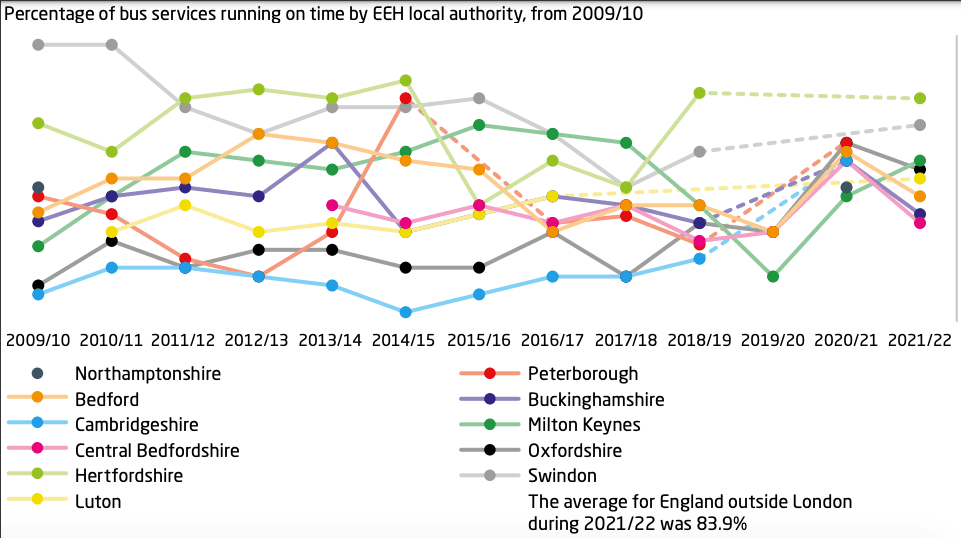
Above – from the EEH Report on buses (2023) p8
Good question. And bus services are still rubbish.
***Top Tory slams Tories of the 1980s over bus privatisation***
Actually, the issue of ideological transport policies was picked up in the EEH’s bus report – one that covered the differing party political policies.
“Both Labour and the Liberal Democrats have called for the ban on setting up municipal bus companies to be lifted.”
Above – from the EEH Report on buses (2023) p15
Why did the Conservatives want local councils to be banned from establishing their own municipal bus companies? Political ideology. As a general political principle, the Conservatives are against the concept local government establishing their own economic functions – municipal trading companies, arguing that it’s more economically efficient for private sector providers to ‘compete’ for the right to provide those services through tendering. For me, that ideological experiment from the 1980s has failed, and the process of bus franchising is too convoluted. I’m in the *No nonsense, re-nationalise the buses #CommissarPuffles style* camp.
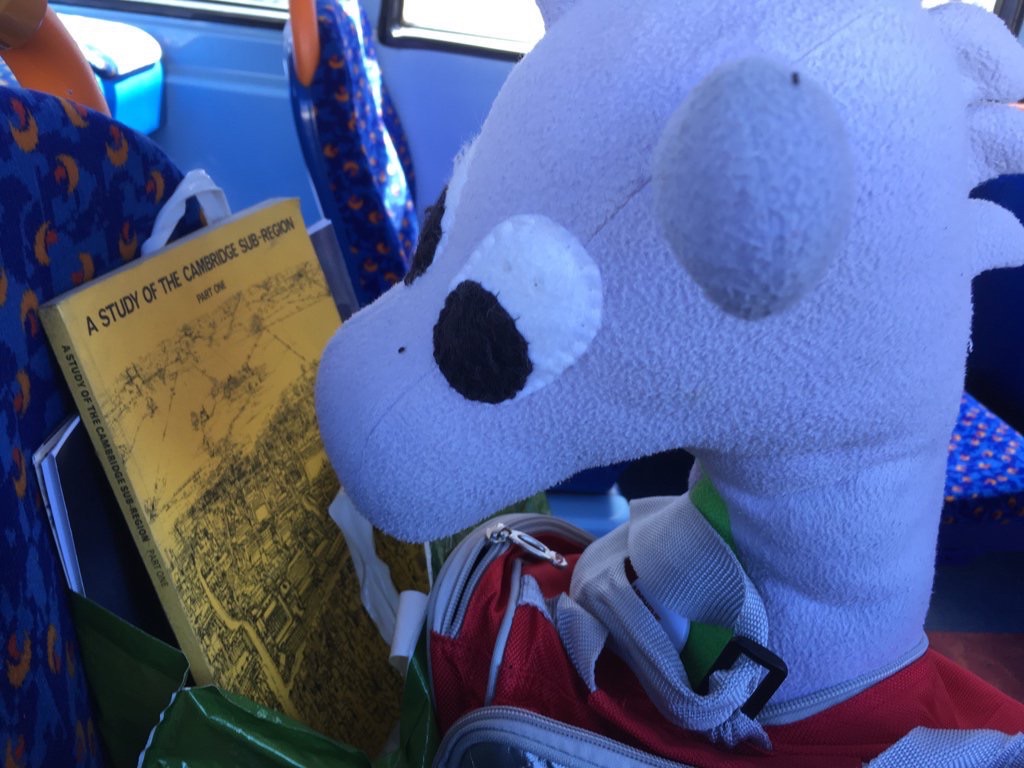
Above – Puffles the dragon fairy on a bus. With the John Parry Lewis report from the 1970s
The breaking down of party political consensus on large public transport infrastructure projects
The afternoon session included a panel session with Marie-Claude Hemming of the Civil Engineering Contractors’ Association. She was one of the few panellists with the freedom to call out the failures of ministers over their changes in transport policies, one that creates policy instability and creates huge additional cost and waste of resources.
Above – there was much in what Ms Hemming told me afterwards that sounded similar to what had been happening with the busway projects with the Greater Cambridge Partnership.
This confirmed in my view that the structures of the GCP were broken by design, and that the GCP was created for party political reasons rather than sound governance and public administration principles. Hence my call for its abolition as part of a wider nationwide overhaul of structures, systems, processes and boundaries similar to the recommendation from the Public Administration & Constitutional Affairs Select Committee from 366 days ago.
#DiversityFail
This was something that Helen MacNamara – the former Deputy Cabinet Secretary raised at the Covid Inquiry. She said that the lack of diversity within Downing Street had a direct impact on the Government’s response to the CV19 pandemic in the early days.
“In other extracts from [Ms MacNamara’s] statement, she expressed concern that the lack of a “female perspective” on the crisis in a number of policy areas.
“This included a “lack of thought” about childcare during school closures, the impact of restrictions on victims of domestic violence, and a lack of guidance for pregnant women.
“She also wrote that a “disproportionate amount of attention” was given to the impact of lockdown on “male pursuits”, citing football, hunting, shooting and fishing.”
BBC News 01 Nov 2023
This also followed the point about none of the employees in Downing Street having grown up in the receipt of free school meals – hence there was no insight into how people on very low incomes might be struggling with the impact of lockdown.
Hence it was hard to get away from the lack of diversity not just in terms of minority ethnic backgrounds, but also – and perhaps more importantly people on low incomes (including White Working Class backgrounds) who are disproportionately more likely to be dependent on public transport.
Above – I don’t think 1980s-style ‘tick-box token representation’ is the answer.
Solutions are more complex and require deeper consideration – ranging from where such events are advertised (noting that this was a free event that anyone could sign up to), to choice of venues, to transport access, to covering the expenses of participants on low incomes, to preparing said participants who might not have been to such events before.
While I have no complaints about the setting (I still want The Guildhall revamped in time for Florence Ada Keynes’ mayoral centenary!), there was another event on later that day which shows what *Wrong!* looks like. In my humble opinion.
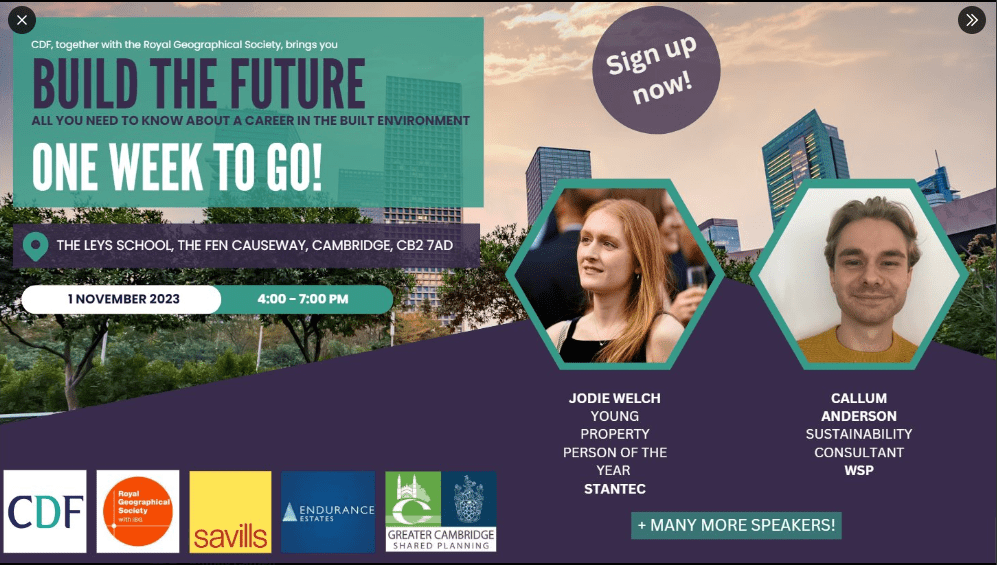
Above. Careers in the built environment. Hosted at one of the most expensive private schools in Cambridge with hardly any direct bus services from across the city.
And if you think I’ve moaned about the CDF before, you’d be right. Click here and scroll down. It’s the same former MP for South Cambridgeshire who got caught up in this Brexit row – all completely above-board in the present system. It’s just that (in my opinion at least) the system stinks.
What would this event have been like if it had been hosted at any of the larger state secondary schools or further education colleges? Who are the young people that need that helping hand in the face of the existing barriers they face? Who are the ones that already have a hand-up? It’s a society-wide issue.
Over-dependence on ministerial initiative
Because all roads lead back to Whitehall – and The Treasury, it was painfully visible to me (in part because I’ve been on the other side looking outwards) how prominent the role of Whitehall was and is. One of the delegates from the Department for Transport was one of my former work colleagues from my early civil service days in Cambridge – she’s moved up in the world since, and is now working in London just like I did.
As you can see from the EEH Report on buses, the document discusses funding issues within the context of the existing system of DfT grants, rather than exploring what a different system of financing (for example alternative local taxation from a wider base and range of taxes that are independent of Whitehall). The former is not devolution and decentralisation if HM Treasury keep a tight grip of the purse strings. And successive ministers have shown no ambition to change that – despite numerous assessments and reports calling for change.
“Will we see much change as a result of the event?”
In the run up to a general election – one that I think will be the most important since 1997, I don’t think any such annual conference can be expected to result in something radical happening. That said, I think it’s good practice for event organisers to challenge participants and delegates to commit to one small one of action or one small behaviour change as a result of attending and taking part. Otherwise all that happens is people end up spending a day in a conference venue for little impact.
I will be hosting an event introducing all things town and transport planning at Rock Road Library, Cambridge on Sat 25 November 2023 from 12:15pm -> Sign up here. It’s aimed at people with little to no knowledge of town and transport planning in the context of Cambridge and Cambridgeshire, and who would like to cover the essentials in a friendly, non-judgemental atmosphere where people get to discuss things with each other and don’t have to sit through ‘death-by-PowerPoint’. (There are a few other introductory events preceding that one – see here for details)
If you are interested in the longer term future of Cambridge, and on what happens at the local democracy meetings where decisions are made, feel free to:
- Follow me on Twitter
- Like my Facebook page
- Consider a small donation to help fund my continued research and reporting on local democracy in and around Cambridge.

 The Cambridge Town Owl