
“If you are curious about organising, and want to get a sense of what a civic alliance does, come along!” they said. So I did. As did many others.
I briefly wrote about the announcement here to help spread the word.
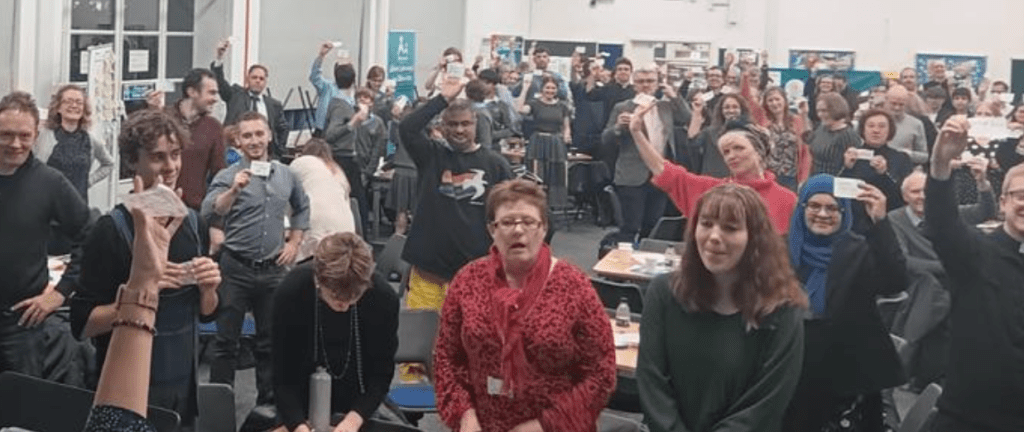
Above – from one of a trio of photos here by the organisers.
The gap behind me is the table that earlier had a group of primary school children seated there, who made a swift exit before the photograph was taken. They were the stars of the show with the presentation of their work under the guidance of headteacher and author Rae Snape – who has succeeded in community organising where Be The Change Cambridge had not.
Above – Be The Change Cambridge from 2014/15 – which Rae Snape was one of the participants.
In hindsight the error I made was focusing too much on individuals and not developing the institutional relationships.
You can find out more about the national organisation at https://www.citizensuk.org/ See also their campaigning publication for the looming general election
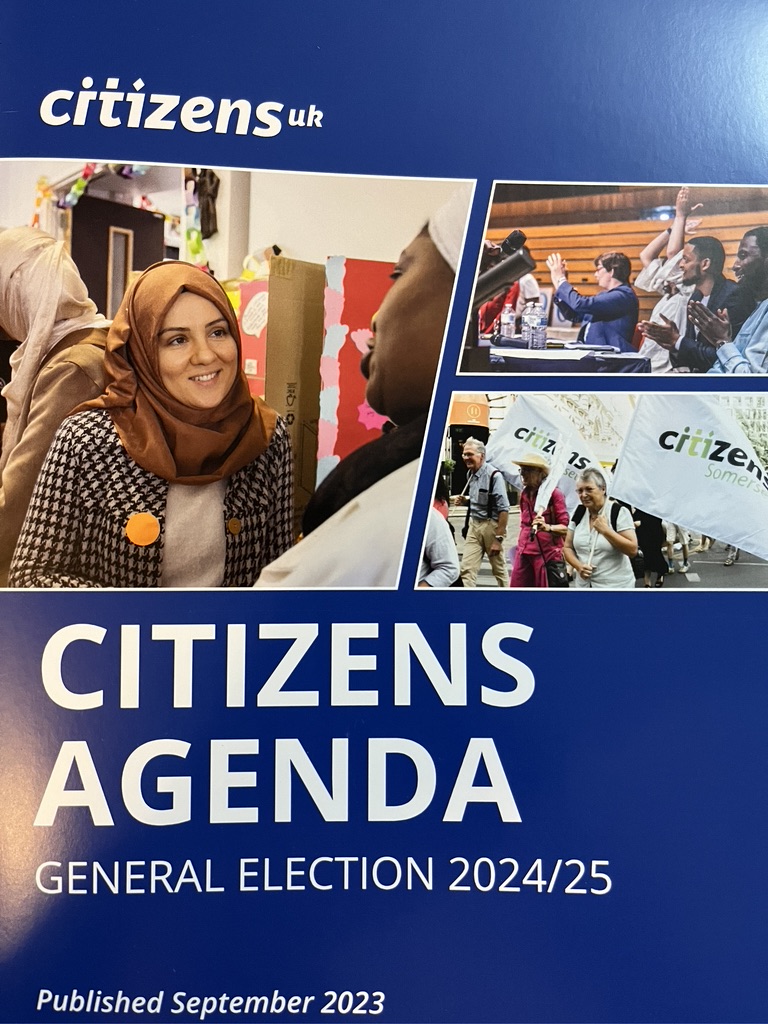
“Citizens UK exists to build the power of people and communities to engage in the democratic process. We are strictly non-partisan. We carry out voter registration and we highlight the needs of our communities to those who seek to govern and ask for commitments to work with us. We also seek to hold those with power to account for the decisions they make that affect our lives.”
Citizens UK Agenda Sept 2023 p5
The Citizens UK Cambridge Chapter focused very much about getting institutions on board. The one gap that will need to be addressed soon is how to involve individuals who are not affiliated to any institution or organisation. There were a handful of us (myself included) who fall into that category – and Cambridge is full of talented freelancers, more than a few of whom will be interested in getting involved.
As often happens with such initiatives, the nucleus reflects the shared experiences or working/social environments of the participants. Hence this evening the core participants all had teaching and education in common. I mentioned earlier how this approach contrasted with the calls for turning Cambridge into ‘Europe’s Silicon Valley’ that I wrote about yesterday. It led to some robust exchanges between the author of the piece and a number of local residents in and around Cambridge.
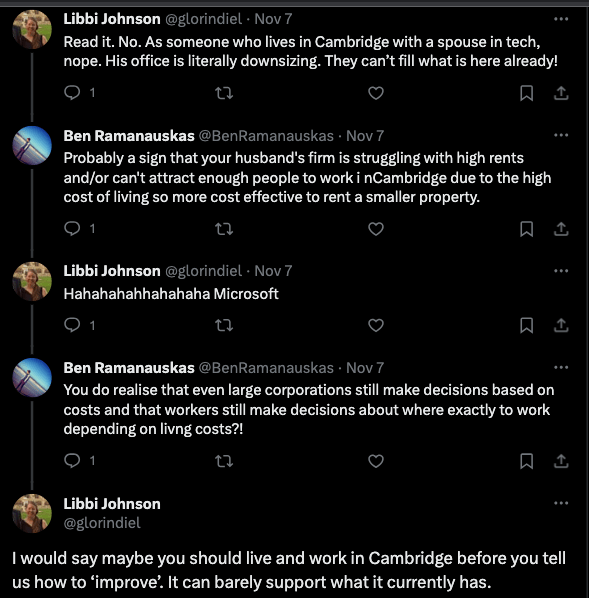
Above – Libbi Johnson to the author Ben Tamanauskas
“Next steps?”
Grow. And create the safe spaces for the people of the city to learn about and discuss issues that affect our shared lives. That was what I took away anyway.
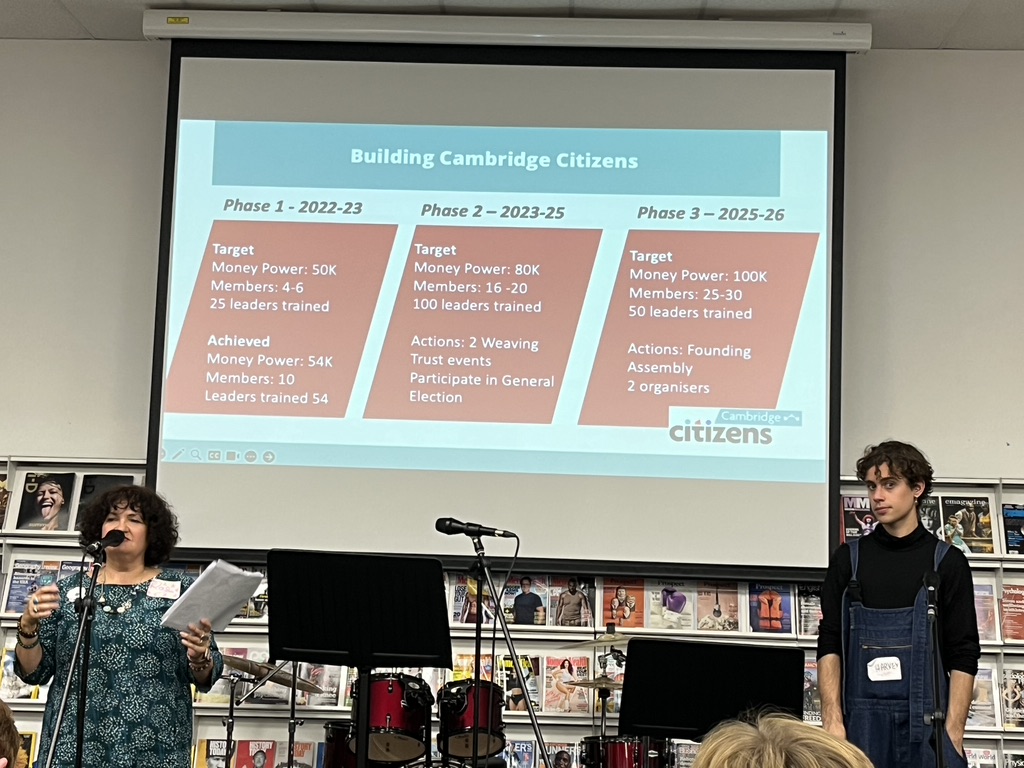
Above – Rae Snape with Harvey Brown of Cambridge University Student Union
As things stand, the Cambridge Chapter of Citizens’ UK (as it is known as) has got:
- £54,000 raised
- 10 institutions committed to supporting the chapter
- 54 people trained up on community organising
Which is impressive.
“What do they mean by ‘participating in the general election’? Are they standing candidates?”
No, they are not standing candidates. That does not mean independent candidates won’t be able to adopt their policies – quite the opposite. Many campaigning organisations will be preparing their own ‘mini-manifestos’ to put to candidates in order to persuade them/their parties to adopt some/all of their policies.
“Why don’t they just join political parties instead?”
Many paid activists in campaigning charities and organisations go onto stand for Parliament in political parties. For example in the Labour Party there’s a well-trodden path of employees of campaigning charities moving into party politics, being adopted as candidates, and getting elected. One advantage of this for political parties is that candidates come in with built-in public policy knowledge in a specialist area – adding to the collective body of knowledge of a parliamentary party. Useful in an education system where teenagers are not educated about politics or policy-making and the workings of Westminster.
Why do you think it is partisan ‘think tanks’ that get far more media time than university-based research institutions? Which ones focus on access to the media and politicians? Which ones are able and willing to fill in that last-minute ‘talking head’ slot to play the controversialist in order to give ‘balance’ even though they know little about the issue? Exactly.
Part of the rebuilding of trust in political institutions and institutions of state involves trying and testing new ideas
In one sense, I’ve been experimenting with this with The Great Cambridge Crash Course. Over the past six weeks, around 40 people have taken part in the introduction events I’ve put on at both Rock Road Library, and at Ross Street Community Centre in Cambridge. The vast majority of participants were not known to me before – so it’s not a case of ‘my mates being nice to me’. Two major take-aways so far include:
- The collective knowledge & awareness of how politics and democracy functions (and malfunctions) in our city (both national and local politics) is much lower than I anticipated;
- The political mandates that long term programmes have from ministers are much shorter than local institutions think they have – and as demonstrated by the congestion charge row and the Greater Cambridge Partnership.
Just because in law and in national public policy a minister or government might have signed something off a decade or so ago does not mean that organisations such as the Greater Cambridge Partnership can carry on as if nothing had changed. That was the big error it made in 2021 – by not accounting for the political earthquake the electorate unleashed. Senior GCP Officers should have offered a change of strategy, and senior councillors should have insisted on one. They did not. The rest is history. Or a contemporary political issue that will come up again at the general election!
We’ve got a local publisher who is already publishing the core textbooks for group discussions

Above – from Independence Educational Publishers in Great Shelford
Thus in the short-medium term there is no need to commission Cambridge/Cambs-specific publications because there is already enough to go on in the existing, extensive back catalogue from IEP. And if anyone needs a guide on how to actually run a discussion group, the guide from K.S. Spreadbury from 1944 is as good as any I’ve seen. Why re-invent the wheel?
The gaps in our education system
The overcrowding at Long Road Sixth Form and Hills Road Sixth Form Colleges is disturbing to see – even more so the dismissive attitudes from ministers in how to resolve the problems caused by their own public policy failures. Both colleges do not have the facilities needed to ensure students have enough study space, social spaces, or even catering facilities. And yet ministers maintain the ban on local government raising revenues from the wealth the city’s economy supposedly generates, while insisting on a broken structure of institutions and governance.
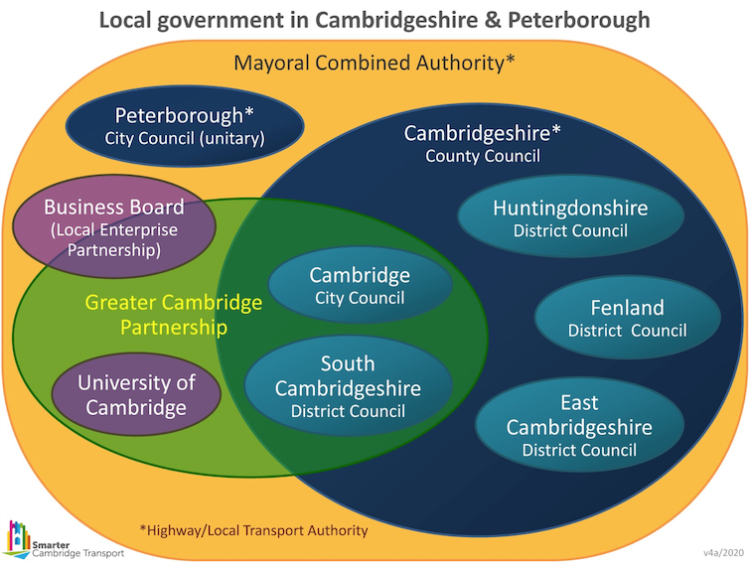
Above – the governance structure signed off by former Chancellor George Osborne when he pressed ahead with the Combined Authority plans for Cambridgeshire and Peterborough.
It’s up to the public to cross-examine party candidates at the general election on what manifesto commitments they have that will enable this structure to be improved/condensed/consolidated. For those of you who cannot wait that long, email your councillors and MPs to see what they have to say –> https://www.writetothem.com/
The Citizenship Studies gap.
For anyone in Citizens UK, I recommend getting hold of an old copy of a GCSE Citizenship students book (see a selection online here) and you’ll get a feel for what it covers, and whether it might be suitable for your schools/colleges/part of the country.
I spotted this display at Long Road’s library – all part of Parliament Week.

I also caught up with one former local councillor now long retired from party politics, and we discussed the low take up of specialist citizenship teachers – reflected in the tiny number of students in Cambridgeshire taking the GCSE in Citizenship Studies despite it being around for over 20 years. They told me that austerity has meant schools and colleges are struggling to recruit specialist teachers in a whole host of subject areas – and that citizenship studies is by no means unique. Cambridgeshire County Council confirmed this when I enquired about encouraging the take up of GCSE Citizenship Studies.
“We encourage all secondary schools to offer as wide a breadth as possible of subjects for all pupils. This is however in a context of teacher shortage, financial constraints and an accountability framework which places greater focus on a limited number of subjects. All secondary schools in Cambridgeshire are part of academy trusts, but we will certainly pass on the helpful suggestion you make around sharing specialist teachers across a trust or local area.”
Cambridgeshire County Council CYP Committee 10 Oct PQ Response to A Carpen
Above – this also reflects how the academies programme has removed the local democratic accountability and local links to local government. Instead, by voting through the proposals, MPs made more work for themselves as the line of accountability goes through ministers and thus via MPs, not their county councillors. Again, this was the product of a previous Secretary of State – in this case Michael Gove and his special adviser a certain Dominic Cummings. Both have moved on, but the structures remain in place. Hence in public policy circles the debate continues on how to hold both former ministers and former senior civil servants accountable for policies and decisions after they have moved on. Recent public inquiries have hinted at some possibilities, but that’s a very expensive method.
Creating the spaces for community discussions
I’ll conclude by returning to the point about community events where people can discuss and learn about specific subjects and issues. While I’ve got my own micro-operation going in South Cambridge, I don’t have the capacity to cover the whole city. Nor should I be the only person doing this. Furthermore, my style of delivery is not suitable for everyone – those that like to sit back and take in a university-style lecture may find my participative style exhausting/annoying. Hence why to cover a city we need to provide a range to reflect people’s needs – both participants and facilitators.
Cambridge being Cambridge inevitably means there will be people who will want to dive deep into specific subjects – far beyond what a non-specialist facilitator might be able to deal with. Therefore part of the solution could also involve tapping into our city’s wealth of academic talent and have guest speakers for where there is demand for those subjects or areas of public policy.
How we put that together?
That’s beyond my pay grade and level of competence!
Anyway, there’s a by-election hustings in Queen Edith’s on 09 November 2023 at St John’s Church Hall on Hills Road opposite Homerton College. I’m running a pop-up booksale from 6.30pm (details here) before the main event starts at 7pm. I’m on filming duties too, so if you can’t make it I’ll try to get the video up online by the weekend.
If you are interested in the longer term future of Cambridge, and on what happens at the local democracy meetings where decisions are made, feel free to:
- Follow me on Twitter
- Like my Facebook page
- Consider a small donation to help fund my continued research and reporting on local democracy in and around Cambridge.
 The Cambridge Town Owl