
It was meant to be the war to end all wars, but it never was. The violence in Central London today reflects the continued public policy failures of generations of ministers to learn the lessons from, and deliver the hopes of a now long-passed generation that lost so much.
With the events unfolding in Central London today, several people picked up on the words of Rev Tim Daplyn
“My United Nations medal is inscribed: “In the service of peace”
Above – the regimental badge looks like it’s from the Light Infantry
Freelance and non-mainstream reporters asked various groups of protesters what they were protesting about
PoliticsJoe created this medley video covering what was happening around the Cenotaph, while on the Palestine peace march, a number of reporters picked up some really disturbing signs and placards. One particular chant that Lewis Goodall reported on remains particularly controversial – one that inevitably puts off some that might otherwise sympathise with the ceasefire demand, from getting involved, as Helen Barnard stated here.
Several clips noted speakers saying it was appropriate to have a protest calling for an armistice on the annual remembrance day that recalls the armistice bringing to an end the biggest and most destructive war that humanity had experienced at that point in history (measured by absolute figures rather than percentages of the population or economies). After all, if you cannot have a peace march on the day when the nation comes to a stop to remember those who lost their lives or loved ones in times of war and violence, when can you have one? Hence the accusations against the Prime Minister and Home Secretary of politicising and inflaming tensions.
Forgetting the hopes and dreams of a lost generation
The British Newspaper Archive is full of digitised local newspapers from the past couple of centuries and has thousands of pages of newspaper reports covering The Armistice and the hopes and dreams of the generation that endured the First World War. On 12 November 1918, the Cambridge Daily News quoted the words of the former Prime Minister who brought the UK into that war in the first place.


Above – Cambridge Daily News 12 Nov 1918 in British Newspaper Archive
“I join with [the Prime Minister – David Lloyd George] with a full heart in his aspirations that not only will this war not be resumed, but that we are now entering on a new chapter of international history in which war will be recognised as an absolute anachronism never to be repeated. (Cheers)”
H.H. Asquith MP (former Liberal Prime Minister) to the House of Commons 11 Nov 1918
One of those ambitions for the post-war future was from women who demanded to be involved in the newly-emerging field of international politics – as the women of Cambridge demonstrated in 1919. Note this was still at a time when the politicians of the day – the Coalition made up of majority Conservatives with a Liberal Prime Minister (Lloyd George) refusing to grant women equal voting rights granted to men in the Representation of the People Act 1918.
As I mentioned in my local history blog, there was an upsurge in interest in learning about civics – politics, democracy, and having an influence in collective/political decisions made about where people lived and the conditions of work and life generally. This was reflected in the number of publications from the time – which although long forgotten, still have lessons that we need to relearn today if we are to avoid making the mistakes all over again. One of them is the book about educating the population in all things citizenship written by Sir Ernest Simon and Eva Hubback in 1935.

Above – Training for Citizenship (digitised for you to read here) by Eva Hubback and Sir Ernest Simon (1935)
“We have endeavoured to show that in order that democracy may work in a modern complex community it must demand from its citizens a fund of self-sacrifice, a passionate love of freedom and truth, a power of clear thinking, and an equipment of knowledge of the modern world.”
Eva Hubback and Sir Ernest Simon (1935) p48
Questions: Are we being provided with the opportunities to gain the power of clear thinking? Are we being provided with the knowledge needed to make sense of the world that we live in, in order to scrutinise those that take major decisions on our behalf?
To which the answer has to be: “No” to both. The challenges they both raise are similar to raised by subsequent generations about whether such political education is really a front for ‘indoctrination’. Furthermore, with modern citizenships studies, post-2010 ministers have allowed the subject to decline somewhat compared to when former Education Secretary David Blunkett steamrollered through the subject onto the National Curriculum just over 20 years ago. A combination of austerity with school budgets plus not making citizenship a core subject doing the damage.
There’s nothing like a crisis to concentrate the mind…
Whether personal, or collective. As I found out the hard way in hospital, you find yourself forced to accept circumstances or compelled to take decisions that you might not have dreamt of in times before. We only have to look at the responses to the banking crisis of the late 2000s or more recently Covid 19 (that still hasn’t gone away) to get a sense of the sorts of decisions ministers are prepared to take if/when their backs are up against the wall.
At the same time, it’s ever so easy to forget some of the thoughts and debates we were having about the sort of ‘post-pandemic society’ we wanted to become from a couple of years ago. Whether the looming general election will revive them remains to be seen. My fear is that the present government will offer nothing but division, while the opposition will be too frightened to commit to anything lest they frighten the voters off with something too radical. Hence why I rate the Discussion Books series from wartime by Nelsons – the latest arrival being Maurice Alderton Pink on Social Reconstruction published in 1943.


Above – Social Reconstruction (digitised here for you to read) published in 1943
Sir Ivor Jennings pulls no punches on political parties either.
Published in 1941, the then Editor of the Local Government Chronicle (and later Vice Chancellor and New Concert Hall Champion of Cambridge) tore into the weaknesses of Parliament as he made the case for the overhaul of that institution.
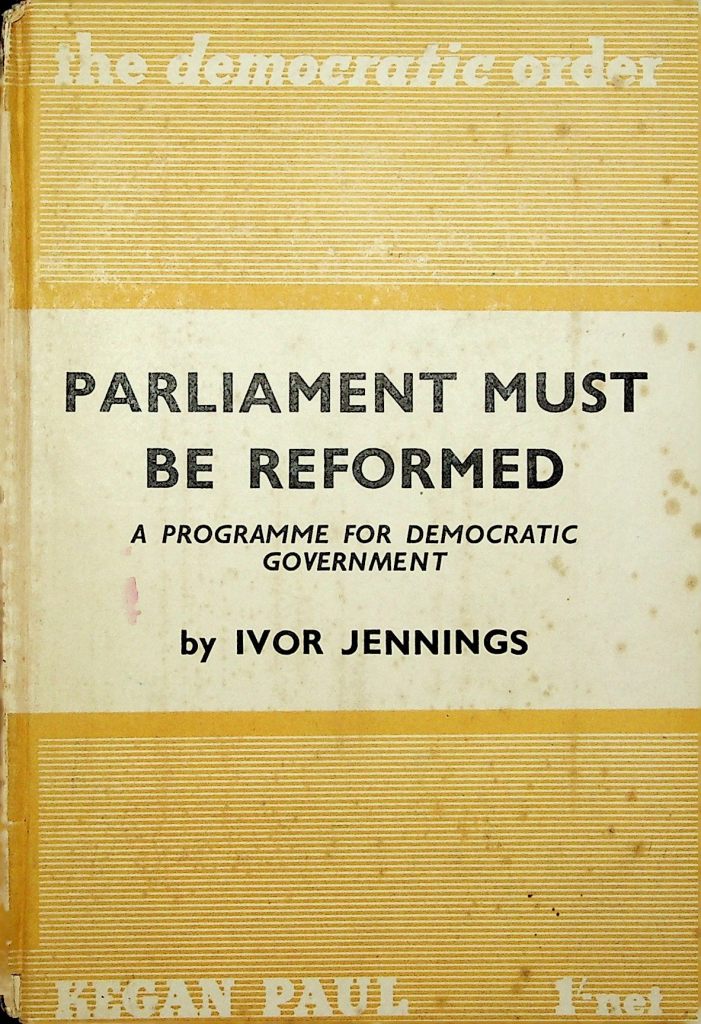

Above – Ivor Jennings vs an antiquated Parliament in 1941
Some of his most damning remarks are saved until the final page of his essay – screengrabbed above where he calls for the overhaul of constituency political parties whereby they become mass local movements so that more people can have a say in who gets selected as candidates, and a greater diversity of more talented people put themselves forward for election.
“So it’s not so much ‘Go and read a history book’ but rather: “Go and read a discussion book published from a previous age”?
Something like that. Given the monopoly powers that bookshop chains and large publishers have – along with the print press and the TV-broadcast media, it’s easy to see how seemingly impossible ideas were seriously considered in times gone by. The useful thing about project such as the British Newspaper Archive and the Internet Archive mean that myths that have grown up in the decades after historical events and catastrophes can be challenged using digitised primary sources from the time.
Hence why I also rate the guide on how to lead a discussion group by K.S. Spreadbury from 1944. Not least because in the run-up to the general election, we will need more people to step forward and host/facilitate such discussions if we are to go further than the passive hustings-only public events that form the vast majority of public events in the run up to general elections in and around Cambridge of late.
As for my own Great Cambridge Crash Course
…the final event which will cover town and transport planning will be on 25 November 2023 at Rock Road Library from 12:15pm.
After which I’ll take stock, have a break, and return with a new schedule for January and February 2024 – assuming the Prime Minister has not called a general election for then! Over 40 people have taken part in the events that I’ve hosted, which given my micro-budget and the fragmentation of social media in recent years is pretty good going for something that most people don’t willingly turn out for unless they are angry about something in politics! Thank you to everyone who has taken part and supported me in testing the water on this. I hope to have some additional topics coming up too.
If you are interested in the longer term future of Cambridge, and on what happens at the local democracy meetings where decisions are made, feel free to:
- Follow me on Twitter
- Like my Facebook page
- Consider a small donation to help fund my continued research and reporting on local democracy in and around Cambridge.
 The Cambridge Town Owl